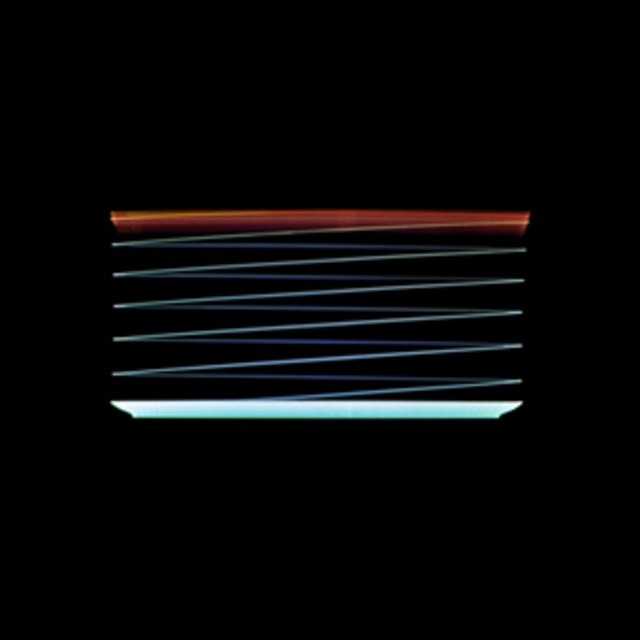
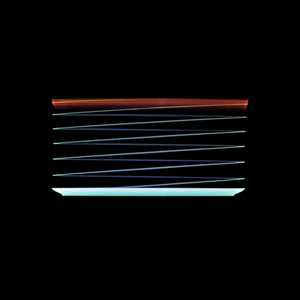
 Stephen Tillmans, from Luminant Point Arrays
Gute Aussichten is the latest installment of a group show that celebrates young German photographers at the Goethe-Institut. You wouldn’t think the mature concepts and execution were student work, but the artists presented are winners of the seventh annual German competition for graduate photography students. As with any group show, themes and technique are varied and sprawling. But from contrast comes interplay, and these works bring diverse visions — abstract, humanistic, mundane — that engage in dialogue not only with each other but with the history of German photography.
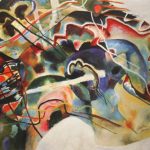
This year’s crop features a photographer whose work has recently picked up a lot of mainstream press. You may not recognize the name Stephan Tillmans (any relation to Wolfgang Tillmans is unclear), but you may have seen his work on Boing Boing or other outlets that blogged his stark photos of tube television sets being turned off. Tillman’s Luminant Point Arrays offer luminous abstracts against a black frame (not unlike the border motif seen in the Kandinsky exhibit across town at the Phillips) that recall Oskar Fischinger‘s abstract animations. Tillman’s work captures a fleeting moment of technological time. The pattern emitted by the tube sets lasts fractions of a second, so the photographer had to make hundreds of exposures in order to get a single image of dying light. These are photographs about photography, speaking across electric generations, the sleek young digital machine pulling the plug on its dying forefathers.
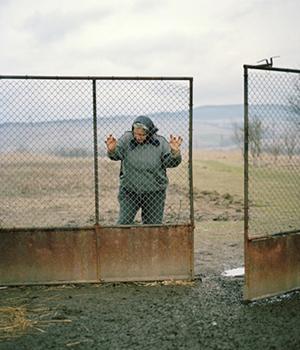 Helena Schätzle, from The time in-between – 2621 km memory
Speaking across generations is a theme in Helena Schätzle‘s series The time in-between – 2621 km memory. By means of intimate portraits and stark landscapes, Schätzle comes to terms with her grandfather’s memories of interment in a Russian prisoner of war camp in 1945. She visited locations along the escape route, more than one of which feature the kinds of structures documented by Bernd and Hilla Becher. But while their Typologies of Industrial Buildings were deadpan, these barren wastelands hold an emotional charge all the more powerful for its restraint.
Rebecca Sampson‘s When emotions fall silent is perhaps the most emotionally raw work here. Her portraits of people with eating disorders were taken around a treatment center where she was once a patient. The set-ups are all chosen by her various subjects, who consume too much or too little, but it’s striking how many of the photos take place around woods or water — and not surprising that several anorexics are to be found in front of the mirror. The subject may contain a hint of sensationalism, but the approach is sensitive and finds a tender beauty in those who may not find it in themselves. The humanism of August Sander’s iconic portraits is nearly a century behind us, but Sampson’s heroic depiction of subjects shunned by society and themselves are worthy successors to the great portraitist.
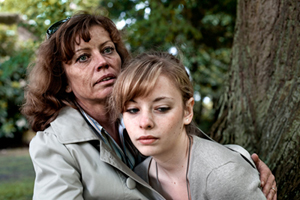 Rebecca Sampson, from When emotions fall silent.
The most playful artist on view may be Samuel Henne. In Something Specific About Everything, Henne makes studio portraits of absurd objects fashioned ala Duchamp’s Readymades. Like many of the artists in Gute Aussichten, he speaks to the past and looks to the future.
Gute Aussichten: New German Photography is on view at the Goethe-Institut through September 2, 2011.