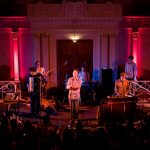
Though the setting was less dramatic than it was at his 2009 appearance at the Sixth & I Synagogue, Beirut’s oft-itinerant Zach Condon made himself at home at the Black Cat on Tuesday night, regaling a capacity crowd with his worldly indie-folk songcraft. Backed by a five-piece band playing an array of instruments including accordion, French horn, tuba, trombone, upright bass and xylophone, Condon embellished his music’s pop core with a broad palette of Eastern European, French and Latin timbres, showcasing the eclectic sound that has earned him a distinct cachet within the contemporary music scene.
Following a charming indie-pop set by Long Island’s Twin Sister (highlighted by the pulsing, lock-groove bass line and disco-hazed vocals of “All Around and Away We Go”), Condon took the stage to an eruption of shrieks and applause from the (mostly female) fans up front, many of whom seemed at least a half-decade younger than their beloved 25-year-old troubadour. Opening with a spirited vocal performance during “The Concubine”, Condon strummed a ukulele during “Elephant Gun” before picking up a flugelhorn to join in on his bandmates’ brassy conflagration.
Along with established crowd-favorites like “Postcards from Italy” and “Scenic World,” Beirut previewed several new songs from his forthcoming LP, The Rip Tide. The swaying “Vagabond” featured a relatively straightforward pop sound dressed up in quasi-exotic costume, a mid-song accordion solo offering a melody Albert Hammond, Jr. or Nick Valensi might play on electric guitar. Later on came “Santa Fe”, an upbeat ode to Condon’s original hometown; meanwhile, his adoptive city of New York was evoked in the gorgeous ballad, “East Harlem”, the band adding gentle horn and keyboard accents to the song’s plaintive vocals.
After “Nantes” provided a loudly-cheered late-set highpoint, Beirut returned for a five-song encore that began a bit languidly with another new track, “Goshem”, before the pace picked up with “My Night With the Prostitute From Marseille”, robust percussion (and handclapping) adding rhythmic heft to the tune’s mellifluous lilt. The waltzy “Carousels” and “Mount Wroclai (Idle Days)” were also rendered with aplomb before the band finished with a stirring rendition of “The Gulag Orkestar”, a musical manifesto of sorts during which the band’s trademark Balkan aesthetics were most fully realized.