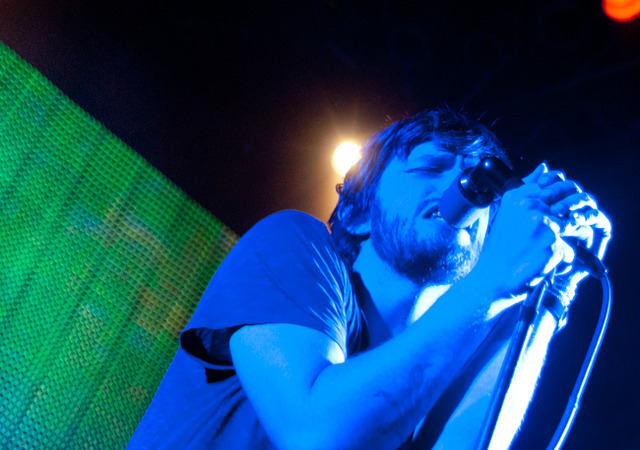
“It’s getting hard to keep pretending I’m worth your time,” goes the chorus of Yeasayer’s “Madder Red,” from 2010’s breakout Odd Blood. So sang Chris Keating Thursday night, soaring through “Madder Red” after opening with “The Children.” When a band gains momentum at the rate Yeasayer has in the last year, it can become difficult for fans to reconcile why a body of music, once mesmerizing, is now diluted by ubiquity. Even in their new incarnation, the Brooklyn-based psych-pop juggernaut from Baltimore showed why they’re still worth fans’ time.
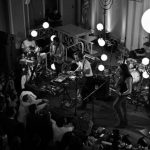
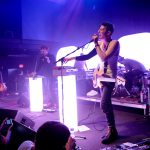
Thursday night’s performance contrasted with their last 9:30 Club performance in April 2010. Instead of the three founding members (Keating, Ira Wolf Tuton and Anand Wilder) on stage, the band showed off their new six-piece form, replete with keyboards and controls spread over elevated platforms and flanked by LED banks and screens. The strobe-effect of the band’s visual accoutrements is nothing new, but this performance’s effects seemed more seizure-inducing than usual. With or without these props, the band would still be at its very heart a show band, with frontmen Keating and Wilder grooving across the stage, Keating taking time to sway with the mic stand and Wilder throwing limbs akimbo as he belts out in his distinctly high voice. Keating mused about the pretense that they don’t work off of a set list, jokingly asking the band, “Should we play a fast one next?” Given the tightness of the set, it’s clear the band is well past that point of rambling spontaneity.
Hits like “O.N.E.” were flanked by new songs like “Henrietta” and “Devil and the Deed”. The band’s been breaking out these darker, bass-and-synth-heavy tunes on this tour, and “Henrietta” sounds like a dreamy Robert Smith production. “O.N.E.” sent the crowd wild as they sang along with the wistful dance anthem: “No you don’t move me anymore and I’m glad that you don’t, ’cause I can’t have you anymore.” Yeasayer still moves their fans, even if the excitement that accompanied their emergence into the mainstream is faded now, a bit burnished. It’s a good look for them.