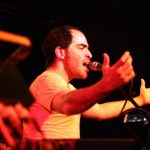
 Tonight’s screening of The Swell Season — a documentary on the band formed by Glen Hansard and Marketa Irglova, the stars of the 2006 indie hit Once — marks the opening of the D.C. area’s most prestigious film festival, and the largest documentary-based film festival in the country. Over the next seven days in the AFI’s three theaters and a screening room in the Discovery Channel headquarters, the Silverdocs film festival will screen over 100 feature and short documentaries, and host conference events and workshops for filmmakers and industry professionals.
The festival will also welcome renowned documentarians D.A. Pennebaker and his filmmaking partner and wife Chris Hegedus for the annual Guggenheim Symposium, honoring his and their body of work, going back to early Pennebaker classics like Jane and http://www.imdb.com/title/tt0061589/, and Pennebaker-Hegedus collaborations like The War Room and Down from the Mountain. Many of these films will screen in a special post-festival retrospective at the AFI, and Pennebaker’s seminal 1968 concert documentary, Monterey Pop, will have a free outdoor screening on Thursday night.
Every day this week, we’ll have a roundup of reviews of films with screenings coming up.

During the 2008 Rock the Bells tour, which showcased the classic hip-hop of the late ’80s and early ’90s, actor-turned-filmmaker Michael Rapaport asked the members of De La Soul whether this tour would be a curtain call for A Tribe Called Quest.
“I hope so,” responded one of the members.
The reason behind this answer was that the members of Tribe — Q-Tip (Kamaal Ibn John Fareed, formerly Jonathan Davis), Phife Dawg (Malik Taylor), DJ/producer Ali Shaheed Muhammad and occasional MC Jobari White — were at each others’ throats. The group had followed a path that is familiar to anyone who has watched more than one episode of Behind the Music: teenage friends start out with noble goals and big dreams; the group “makes it” and puts out its best work; with success comes rifts, and then the band splits up.
This is essentially the story that is told in Beats Rhymes & Life: The Travels of a Tribe Called Quest, Rapaport’s documentary of Tribe’s career. It’s the standard formulaic rock doc, interlacing recent and past live performances with interviews of the band, its contemporaries and those the group influenced. The adherence to formula isn’t a liability, though. The interviews are insightful and reveal the complexities of Tribe’s interpersonal dynamics, which tend to place Q-Tip and Phife at opposite poles, with Jobari and Muhammad in the middle. While Q-Tip was clearly the driving force behind the band’s sound, Phife’s rhymes light the fire under Q-Tip’s layered tracks. Their relationship is the film’s central conflict. Phife gave the quartet its personality, and is in many ways the central character of this film, and his bout with diabetes lies behind the film’s most dramatic moments.
Wisely, Rapaport puts as much focus on the music Tribe created as he does on the band members themselves. After all, classic albums like The Low End Theory and Midnight Marauders have outlived the group in many ways. (Though Tribe still tours occasionally, its last studio album was released in 1998.) The documentary also re-introduces us to the wonderful hip-hop that came out of New York between ’89 and ’93. Those sounds alone are worth the price of admission.
View the trailer.
Premieres tomorrow at 8:45 p.m. in AFI Silver Theater 2.
—

Most of the time, when you hear stories of water contamination, sickness, and a refusal on the part of the polluter to acknowledge, apologize for, or address the issues associated with such contamination, the polluter in question is a corporate entity that plays the role of a movie villain quite well. In Erin Brockovich, the men in the dark, expensive suits from Pacific Gas and Electric were every bit the image we have of negligent corporate polluters. But what happens when the role of the villain is played by someone in the uniform of a United States Marine? And what happens when you yourself once wore that uniform? This betrayal of trust is at the center of Rachel Libert and Tony Hardmon’s documentary about three decades of massive water contamination at Camp Lejeune, North Carolina.
While it is believed that up to a million people were exposed to the Camp Lejeune water contamination, the man central to the story is Master Sergeant Jerry Ensminger, a now-retired career Marine who lost his nine-year-old daughter Janey to leukemia caused by the contamination. Upon learning of the link between the water and the childhood cancer that took his daughter, Ensminger began to dig for answers and reach out to others who had served at Lejeune. He uncovered hundreds of documents which revealed that not only was the water on the base horribly contaminated (one known carcinogen was present at a level 280 times the legal amount), but the Marine Corps was notified by an independent testing firm about the contamination and the fact that it posed a significant public health risk and yet, did nothing.
Through the power of the Internet, Ensminger built a network of thousands of former Marines, their family members, and former civilian workers at the base who had suffered or were suffering from a wide and horrifying range of illnesses — including fatal birth defects and childhood cancers to aggressive cancers in adults — essentially becoming a one-man lobbying firm for the thousands across the country affected by the contamination. Making countless trips to Washington for Congressional hearings and EPA hearings, and trips around the country to meet with affected Marines and their families, Ensminger simply had three demands: he wanted the Marine Corps to notify everyone who had been exposed to the contamination at Camp Lejeune, he wanted studies done on the affected populations and their illnesses, and he wanted healthcare for those who were sick as a result of the contamination.
The most poignant aspect of the film is the sense of shock and betrayal that the affected Marines and their families felt when learning that the branch they faithfully served not only knew about the contamination and did nothing for decades, but, more infuriatingly, behaved recalcitrantly when it was even suggested that they should simply attempt to notify those who were exposed. Essentially, the answer from the Corps on why they weren’t actively seeking to notify the affected population was, “it’s going to be a lot of work.” It was an answer that appeared almost childishly stubborn in the face of the devastating illnesses brought on by the contamination and the tireless and exhaustive work done by Ensminger and others. For the branch of the military whose very motto espouses faithful service, the obstinance of Corps leadership depicted here represents a shocking indifference to the devastation they’ve allowed to occur within their ranks.
View the trailer.
Premieres tomorrow at 4 p.m. in AFI Silver Theater 1, and screens again on Saturday at 4:15 p.m. in AFI Silver Theater 3.
—
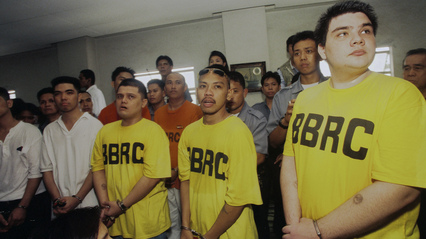
On July 16, 1997, the Chiong sisters were brutally killed on the island of Cebu in the Philippines. Or so the story goes. What really happened to them has never been explained. But somebody had to take the blame, and the background and repercussions of that blame is the subject of Give Up Tomorrow.
Due to a web of family ties and corruption that led to the highest government offices, Francisco “Paco” Larranaga and six other suspects were rounded up, by all accounts without any physical evidence to place any of them at the scene of the crime. In fact, more than forty witnesses can testify that Larranaga was in Manila that day — taking a test, hanging out with friends — more than three hundred miles from where the crime supposedly took place. But despite all evidence to the contrary, a public fueled by a vicious media turned a blind eye.
Give Up Tomorrow raises awareness of a particular injustice, but it also documents the theater of justice and injustice — a sensationalism not too far from the American system. One episode makes you long for the comparatively responsible, sensitive journalism of Geraldo Rivera, as a Filipino television host warns the accused that they had “better watch their asses when they pick up the soap, or else they’ll get another kind of lethal injection.” If you think that’s a circus, just wait till you see the trial. Give up Tomorrow will make you angry, and wonder if such injustice could possibly happen here.
View the trailer.
Premieres tomorrow at 9 p.m. in AFI Silver Theater 3, and screens again on Thursday at 2:45 p.m. in the Discovery HD Theater.
—
 The Ballad of Genesis and Lady Jaye
Anyone who’s heard a note of Throbbing Gristle’s dystopian pre-industrial sound — most notably on 1979’s 20 Jazz Funk Greats — knows the band made its name by defying convention and pushing boundaries. In The Ballad of Genesis and Lady Jaye, director Marie Losier’s fractured portrait of Throbbing Gristle’s singer, Genesis Breyer P-Orridge, we learn that this dedication to non-conformity extends beyond musical taste.
A brief primer: Genesis meets a beautiful young dominatrix and cabaret performer named Lady Jaye and is quickly enchanted. Soon thereafter, Lady Jaye intuits Genesis’ inactive anima and, eventually, the two begin exploring pandrogyny, a process of mutual physical transformation they explored through various artistic outlets until Lady’s untimely death in 2007. The goal of the project was to infuse into a singular persona as an effort to “consume the other, eat them up.”
Compelling stuff, but The Ballad of Genesis and Lady Jaye provides ample provocation with too little context — Lady Jaye is rarely heard — to frame the story as a fanatical love affair. In an effort to emulate its subject’s mercurial nature — or avoid becoming another hagiographic documentary championing an unsung musician — Losier zigzags through the engaging and mundane aspects of Genesis’ existence, unable to distinguish between the two. Candid scenes of domestic bliss and artistic inspiration are hampered by endless shots of Genesis mugging for the camera along with tacked-on detours into the touring habits of his current band, Psychic TV. In addition, Genesis’ boundless dedication to performance — no doubt an asset in his work — makes him a tiresome subject, one that becomes insufferable by the end of the film’s brisk 70 minutes. Without the proper focus, The Ballad of Genesis and Lady Jaye provides a platform for these talented artists to bare all yet reveal nothing.
View the trailer.
Premieres tomorrow at 11:30 a.m. in AFI Silver Theater 2, and screens again on Thursday at 10:15 p.m. in the same theater.