
DCist’s daily roundup of a number of films playing this week at the AFI/Discovery Channel Silverdocs festival. Check out our previous reviews here, here and here.

When you talk about the men who made Molotov cocktails at the 2008 Republican National Convention, there’s a lot of information to consider. There are interviews with the accused, with their families and friends, with the FBI, and security footage of all kinds. So many bits of information are reflected in Better This World that the mind boggles, unable to tell moments of truth from manufactured details. But here is where filmmaker Katie Galloway is most successful.
Thanks to her skillful, patient storytelling, Galloway’s audience can place themselves in 2008, when Bradley Crowder and David McKay found themselves protesting at the RNC and then found themselves in jail. The pair, with a group of friends and activist Brandon Darby, took to the convention hoping to effect change and stop those who were “poisoning” a country they loved.
This first impression of Crowder and McKay suggests that the film ahead will bash violently disillusioned radicals, but Galloway carefully reveals two eloquent young men. Even they don’t seem certain of their path to jail. Her care to play to their personalities and the characters’ emotions while she reviews logistics adds a dimension that often disappears from politically charged documentaries. There’s Crowder’s mother, quietly holding back tears as she realizes her son will be stuck in prison. And there’s McKay, thrilled to be out of jail as he waits for a retrial, but emotionally trapped at the same time, worrying about what’s next and what will happen to Crowder.
Better This World doesn’t push or pull, but in the Silver Theater last night, the film created a disgruntled, fired-up audience that offered question after question for panelists Crowder, Galloway and Michael German, policy counsel for the ACLU. When asked, Crowder said he did not consider himself a political prisoner at any point, that it was “the universal nature of the criminal justice system.” There seemed to be no one in the theater ready to disagree.
View the trailer.
Screens today at 5 p.m. in AFI Silver Theater 1.
—
 Incendiary: The Willingham Case
Not too long ago, I had no real opinion on the death penalty. I understood all the arguments for and against it, but neither had me swayed. And then I read “Trial By Fire“, a New Yorker piece by journalist David Grann whose focus is a Texas murder case in which a man, Cameron Todd Willingham, was accused of killing his three children by committing arson on his own home. The accused, who was no angel during life, was convicted of murder and executed by lethal injection in 2004. The article builds up the prosecution’s case piece-by-piece — making the reader all but certain of Willingham’s guilt — and then tears it apart in the same way. There are people out there who remain convinced of Willingham’s guilt, but the piece affected me in a profound way.
Incendiary: The Willingham Case, a film by Steve Mims and Joe Bailey, Jr., deals with this same controversy, but the filmmakers choose to follow the aftermath of the execution and the political firestorm it created, rather than the alleged murder itself. On one side, there are Texas politicians who want to bury the issue, while anti-death penalty advocates stake their political claims in opposition. In the middle are the scientists, who simply want to improve the practice of fire investigation, and the family members of Willingham and the children who died.
In many ways, the structure of the film mirrors that of a procedural crime drama, but the fact that it is real makes it all the more compelling. One thread at a time, the documentary weaves the fabric together, showing how shortcomings in the system may create a perfect storm leading to a wrongful conviction, even in the absence of any real malice. The film also brings to light how any real discussion on the death penalty is subject to the whims of a political process where no elected official wants to appear “soft on crime.” The film ends on a question as to whether Willingham is truly innocent, leaving it up to the viewer to decide. Regardless of guilt or innocence, the most disturbing thing about this film is its ability to illustrate how the adversarial nature of politics and the courts preclude the objectivity of honest debate, science and intellectual discourse.
View the trailer.
Premieres tomorrow at 1:15 p.m. in the Discovery HD Theater, and screens again on Saturday at 8:30 p.m. in AFI Silver Theater 3.
—

Baseball is mythical. It has its heroes and villains, most of whom have ascended to immortal status. Jackie Robinson. Joe Jackson. Lou Gehrig. Barry Bonds. But baseball’s grand mythology is hardly limited to the men who proudly display stains of grass and the finely ground dirt between the chalk that marks the stage on which they perform.
Take Steve Bartman, for example.
Bartman, the subject of Alex Gibney’s Catching Hell, is arguably the definitive baseball figure for the modern age — a fan forced into a life of anonymity by a frothing public in search of a scapegoat for something they accept pity for and freely admit they never should have been hoping for in the first place. Gibney is uniquely understanding of the Cub malaise as a now-recovered Red Sox fan — which is plenty obvious, considering the director, unable to speak to Bartman directly on camera, heavily frames his tribulation through the mistake which defined Bill Buckner’s career.
Gibney makes the case that Bartman’s role in the Cubs’ devastating Game 6 loss against the Florida Marlins in 2003 was hardly the stuff of ill-intent. Also to blame: the twenty other people that went for the ball (several of whom tell Gibney they were just lucky to avoid touching the ball), the petulant reaction of outfielder Moises Alou, stud pitcher Mark Prior’s suddenly dented confidence, Alex Gonzalez’s shocking come-apart-at-the-seams play at shortstop, the normally-attentive crowd losing track of the game to hurl expletives at the man who tried to grab a foul ball and the overall drunken, loutish behavior of the Wrigley Field faithful, many of which had gone through just the same thing in 1984 and should have known what they were getting into. All were just as important to the choke as Bartman. It’s a commentary on the world we live in today — why blame everyone equally when there’s someone so conveniently placed to take the fall that we can splash on television over and over again?
Bartman — dubbed the “J.D. Salinger of baseball” — wouldn’t speak to Gibney on camera. (Though you’ll get more than your fill of Buckner, as if that was the documentary that Gibney really wanted to make.) And that’s the rub: after all, by keeping himself outside the fray, Bartman is guaranteed a place in the pantheon of recent sporting history, and maintains his image as a figure demanding our sympathy.
View the first few minutes.
Premieres tomorrow at 4:30 p.m. in AFI Silver Theater 1, and screens again on Sunday at 9:15 a.m. in AFI Silver Theater 2.
—
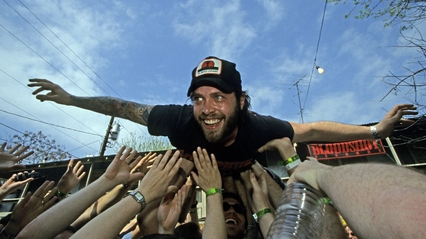
While the name Split Lip Rayfield will not be a familiar one to anyone who grew up ignorant of bluegrass music, the story of the group’s guitarist, Kirk Rundstrom, will strike a familiar note. Much like recently departed local musician Clark Sabine, Rundstrom was an energetic and charismatic singer and guitarist in his thirties whose battle with cancer was ultimately terminal. When doctors told Rundstrom to “get his affairs in order” after aggressive chemotherapy had failed to remove the cancer, he made playing a farewell tour with his long-time bandmates the most pressing item on his bucket list.
Although filmmaker G.J. Echternkamp sets up the film’s premise immediately with a shot of a bed-weary Rundstrom reading a write-up about himself in a local paper, he had actually taken to the road with Split Lip Rayfield prior to Rundstrom’s diagnosis. As such, he has a lot of expository “before” footage and can visually provide the contrast between the wild man with the devil-may-care attitude and boundless energy and the more subdued one who is clearly grinning and bearing it as he delivers interviews in progressively more supine positions.
Echternkamp admits to having signed on to the project initially as a fan, so the film definitely goes for an inspirational tone. It doesn’t always succeed. There’s an occasional overemphasis on probing Rundstrom for his existential realizations. While some of this is par for the course and absolutely appropriate for a piece documenting a life ending too soon, Echternkamp does better when he shows instead of tells. The philosophical conversation with Rundstrom on why he thought he’d contracted the illness will raise some incredulous eyebrows, whereas the shots of the band members’ kids dancing during a sound check will soften the most wizened viewer to the human element.
Rundstrom says in an interview that he hopes this documentary would show him as a dedicated artist, and his music is prominently on display. While the “acoustic scorched earth stamp grass” of Split Lip Rayfield (which includes a one string bass made out of a gas tank) receives the most camera time, Echternkamp also goes on a Rundstrom solo tour where he plays more traditional country fare to bars across the midwest. Echternkamp understands the catalog well enough to highlight performances of Spilt Lip Rayfield’s more lyrically fatalistic tunes — “Never Make It Home” is actually the name of one of their albums — but this doesn’t make the shots of raucous crowds throughout Kansas and the choked gratefulness in Rundstrom’s eyes any less moving.
View the trailer.
Premieres tomorrow at 8:15 p.m. in the Discovery HD Theater, and screens again on Sunday at 2:00 p.m. in AFI SIlver Theater 1.
—

The public schools in Baltimore City are looking for teachers. Not in the area, or even in the country, but rather searching them out far off in the Philippines. There’s a demand for math, science and special education teachers in Charm City, and Filipino teachers are stepping in to meet that demand.
In The Learning, we meet Dorotea, Grace, Angel and Rhea, four Filipino women who are coming to Baltimore to teach and embrace new opportunities, but mainly to make more money to support their families. In the Philippines, these teachers make about 180,000 pesos a year; in the U.S., they make the equivalent of 3 million pesos in the same time. A sum that large can go a long way in the Philippines, and these women send their paychecks back to help their families buy houses, send their children to school, and change the way they live.
The film begins with so much emotional build up — with farewell parties and dreams of what America is like (“a wonderland,” a place where “you live in a mansion”) — that the audience braces themselves for the crash of reality. And while there are difficult challenges — discipline issues in the classroom, homesickness, demanding families back home — these women don’t crash, they excel. They create interactive classrooms, incorporating music, stories and art, and make real connections with their students. While these teachers talk about how much a difference this opportunity — and the money it brings — is making in their lives, it’s clear it’s enriching their students’ lives as well.
Everyone leaves the year of teaching in America changed, and we see this clearly when these teachers return home. The end of the film spends a significant amount of time on their readjustment; there are major consequences from them being away so long and both they and their families have changed. But despite this, all four women chose to return to teach in Baltimore after the summer, joining the 600 other Filipino teachers who currently work there. Filipino teachers now make up 10 percent of the city’s teaching force, and if they’re all as skilled as the women profiled in this film, they’re an invaluable addition.
View the trailer.
Premieres tomorrow at 10:15 a.m. and Sunday at 4:15 p.m. in AFI Silver Theater 2.
—

Filmmaker Leonard Retel Helmrich took 300 hours of footage to create Position Among the Stars, which follows one Indonesian family over 14 months. Over those 300 hours, as he stated in a Q&A after the film’s screening last night, there were moments “when the family did not even realize I was there.” That statement on its own could summarize the film.
The documentary is tender, and without fanfare. The single camera moves quietly, gracefully, through the family’s life, from a tiny village among the rice paddies where grandmother Rumidjah spends some of her time, to the Jakarta slum where the rest of the family lives. There are incredible shots of the night sky in the village, of motorbikes racing through city streets, of family members in their quietest moments as their faces, not their words, reflect their true emotions — as is so often true of people.
The last installment of a trilogy that also includes The Eye of the Day and Shape of the Moon, Position Among the Stars focuses more broadly on globalization — where the previous films worked with the shift from dictatorship to democracy in Indonesia and the strength of Islam, respectively. While these broader issues work their way into daily life, the Shamuddin family, across the world from Silverdocs, simultaneously reflects the basic issues of family — fights with spouses and extended family, the struggle to pay for luxuries or a college education.
But the glory of this film is in its simplicity. It works independently of the other two films in the trilogy, and no family trees need to be drawn at the film’s start for anyone to understand who’s who with the Shamuddin family. Position Among the Stars stands on its emotions and its images, their power traveling from Jakarta to Silver Spring.
View the trailer.
Screens today at 5:15 p.m. in the Discovery HD Theater.