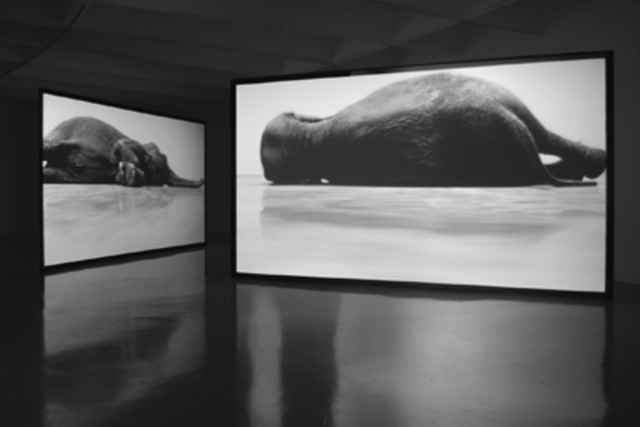
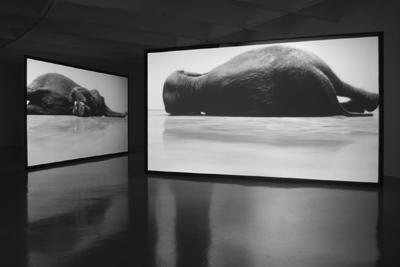
 Douglas Gordon, “Play Dead; Real Time,” 2003. From the collections of the Hirshhorn Museum and Sculpture Garden, Smithsonian Institution, Washington, DC (Joseph H. Hirshhorn Purchase Fund and Museum Purchase, 2005) and the Museum für Moderne Kunst (MMK), Frankfurt am Main.
Long-time visitors to the Hirshhorn will recognize much of the work in the new exhibit Fragments of Time and Space. In this time of economic uncertainty, museums have had to cut costs and repurpose material, and nearly all of the artwork in Fragments comes from the Permanent Collection. But there are small surprises and large returns to be found in this space, if you have the time.
A selection of On Kawara’s date paintings (a.k.a. the Today series) serve as punctuation throughout the second floor galleries, and one of the modest pieces opens the exhibition. These are from a long-running project begun in 1966 in which the artist painted the day’s date in white letters on a small solid-color canvas. Motion studies by Thomas Eakins will be both familiar and unfamiliar to those who visited last year’s magnificent Eadward Muybridge show at the Corcoran. These small works speak volumes, and look forward to the future of photography and cinema — and thus to many of the works in Fragments. And so Eakins gives way to Ed Ruscha’s 1966 book Every Building on the Sunset Strip, in which the artist essentially anticipated Google street view and photographed every building on the north and south sides of the twelve-mile road. These diminutive works from ambitious projects lead to a massive return visitor, Douglas Gordon’s Play Dead; Real Time (2003). This two-panel video projection of Minnie the elephant playing dead in New York’s Gagosian Gallery looks back to the horrific Edison film of Topsy the elephant’s electrocution, but it does makes one look forward to the documentary One Lucky Elephant.
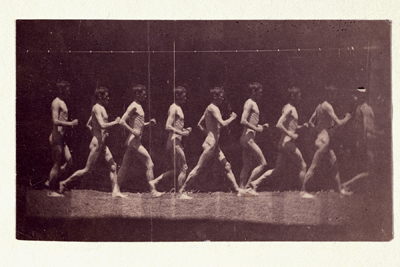 Thomas Eakins, “Marey Wheel Photographs of George Reynolds,” 1884. Hirshhorn Museum and Sculpture Garden, Smithsonian Institution, Washington, DC, Gift of Joseph H. Hirshhorn, 1966.
Other returning works include Hiroshi Sugimoto’s Seascapes, and Tacita Dean’s film Fernseturm, previously installed in a 2001 Directions showcase. One piece never before seen at the Hirshhorn is Takahiko Iimura’s MA: Sapce/Time in the Garden of Ryoan-Ji, a 1989 video that studies space and time in three different tracking shots of a Japanese garden.
The exhibit title comes from an unassuming piece of old media, Mark Tobey’s 1956 abstract gouache Fragments in Time and Space. The modest work seems at a distance to be dissolving, almost in anticipation of Star Trek teleporters, and is not far from the dissolving subjects Kandinsky surveys across town. Light and time are documented in Jan Dibbets’ series The shortest Day of 1970 photographed in My House every 6 minutes from sunrise till sunset. The photographs were made from a fixed spot, framed by the view from Dibbets’ window. His is an exercise in film exposure, as the exposure also remains fixed, and the images become increasingly bright, blowing out mid-day highlights, then dimming again. This series happened to be installed on the longest day of 2011.
The circular form of the Hirshhorn building itself can be seen as a massive time-piece, ticking away the minutes and hours of contemporary art. Fragments promises to recontextualize the permanent collection in a way that suggests new experiences of time and space, but for regular visitors, the familiarity of the pieces may work against this concept. I’ve been visiting the museum for nearly thirty years, and their most memorable exhibits — from Content to Regarding Beauty to Yves Klein — have left me walking out of its revolving doors looking at time and space in a new light. If Fragments seems to be an installation of he Hirshhorn’s Greatest Hits, then it simply proves the enduring power of their mission.
Fragments of Time and Space is on view at the Hirshhorn through August 28, 2011.