DCist’s highly subjective and hardly comprehensive guide to the most interesting movies playing around town in the coming week.
 David Carr
Page One: Inside the New York Times
What it is: Print media’s struggle for relevance in the age of Twitter.
Why you want to see it: If you’re reading this, you may already be part of the problem. From sports scores to weather, from the death of Bin Laden to the new Tom Hanks movie, odds are high you get breaking news online. Advertising revenue has plummeted, print newspapers are folding every day and even the New York Times has resorted to layoffs and a pay wall. Are these, as one media panel put it, the End Times? Andrew Rossi’s provocative documentary Page One may not have the final answer, but it’s a lively read.
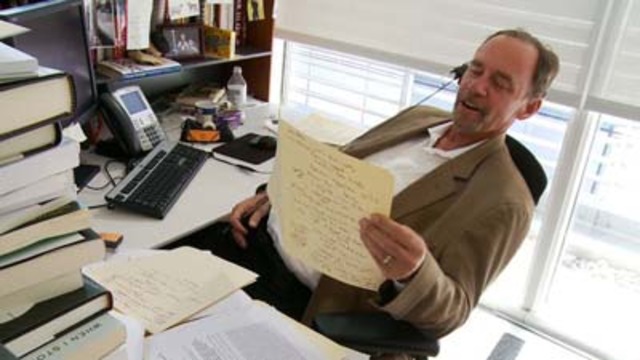
The cast of characters assembled from the Times’ media desk suggest a camaraderie that spans generations, from baby-faced reporter Brian Stetler (b. 1985), whom the Times hired on the basis of his blog TVNewser, to Executive Editor Bill Keller (b. 1949). But the star journalist here is grizzled veteran and former City Paper editor David Carr, who has a voice like a chain-smoking, foul-mouthed Droopy Dog and is even more entertaining than that sounds — the man expresses weary volumes with just the sound of his touch-typing.
In some ways Page One is a companion piece to another recent New York Times doc, Richard Press’ excellent Bill Cunningham New York. While everyone else has gone to digital cameras, the octogenarian street photographer insists on shooting 35mm film, yet his work is still an essential part of the Times’ Style section — he recently had the bright idea to catch people attending the Met’s Alexander McQueen show. Cunningham’s vitality is a testament to the longevity of the artist and the press. But as he and other artists were unceremoniously kicked out of their Carnegie Towers apartments (in favor of a telemarketing office!), so the Times’ eviction from the top of the media landscape seems inevitable.
A few well-publicized journalistic transgressions have blemished the institutional armor. Keller was brought in to “right the ship” after the outright fabrications of Jayson Blair in 2003, and the war-mongering of Judith Miller left an even more bitter taste. Readers on both sides of the aisle have lost faith, no matter how much good reporting still falls under the old masthead. And people just can’t seem to get enough of Gawker. There is still a need and a desire for real news as opposed to Tom Hanks dancing with a Hot Weather Lady on Univision, but Page One makes you wonder not if “the front page” will become an anchronism, but when.
View the trailer.
Opens tomorrow at E Street and Bethesda Row.
—

What it is: The second feature from writer/director/auteur Tom Hanks, whose portrayal of the lowly worker is a stark rejoinder to the oppressive hegemony of the Roumanian New Wave.
Why you want to see it: The titular Crowne (everyman a King, yo) is called to the front office at the big-box store where he works, boasting to his cow-orker that he’s won Employee of the Month designation an Ed Rooney-esque NINE TIMES. But this time Crowne is a different statistic: he’s laid off, allegedly because he lacks a college degree. And thus, multi-millionaire Tom Hanks (who I’m sure is a nice guy) takes an imaginary bullet for The People. Oh the catharsis! Hanks wrote and directed — his first such project since 1996’s That Thing You Do, which painted a picture of stardom in a more innocent time. But is this the right time for innocence? Is Forrest Gump II going to make America sleep better through this economic crisis? No, but Hanks’ studied naivete magically transforms this picture into a live-action Spongebob Squarepants, in which the forbidden sexual tension between Spongebob and Squidward (Julia Roberts) is finally, subversively fulfilled. Co-written by Nia Vardalos of My Big Fat Greek Wedding fame; exercise extreme caution.
View the trailer NINE TIMES.
Opens tomorrow at a pineapple under the sea near you.
—
What it is: The AFI’s Hitchhock retrospective continues with one of his greatest films.
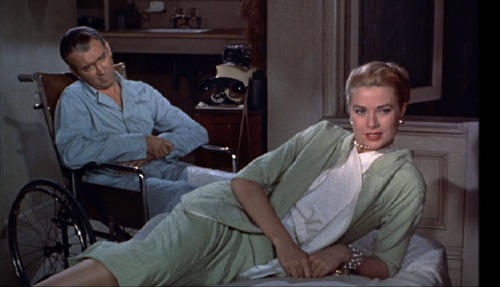
Why you want to see it: Photojournalist L. B. Jeffries (Jimmy Stewart) is holed up in his Greenwich Village loft after breaking his leg shooting an auto race. (Be careful out there, kids!) Bored and restless, he watches the comings and goings of his neighbors across the way. Rear Window is one of the classic thrillers. But it is also a case study in the power of photography, and of seeing. The film’s main action takes place entirely in the space of one character’s apartment, and what he sees from his window: the courtyard, a distant street, fragments of his neighbor’s apartments, framed by their own rear windows. Does this presage the internet? People-watching has long been a favored past-time, and with a lens trained on nearly everybody it’s hard to know where to look. Can what we see hurt us? This masterpiece from fabled voyeur Alfred Hitchcock examines the dangerous nature of photography while celebrating it with finely-crafted suspense and one of the great screen beauties, Grace Kelly. A Bernard Hermann score might have made this a perfect movie, but Franz Waxman’s treacly music serves as a fluffy counterpoint to the brooding danger within. Trivia note: the score is performed on screen by a young Ross Bagdasarian, creator of The Chipmunks.
View the trailer.
Saturday through Tuesday at the AFI Silver.
—
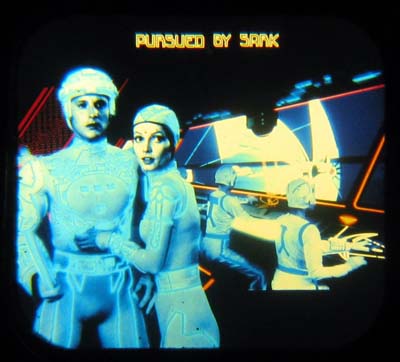 Bruce Boxleitner and Cindy Morgan in Tron. Courtesy of Neatocoolville.
What it is: The original video game movie, the way it was meant to be seen.
Why you want to see it: The latest installment of Totally Awesome, the AFI’s popular annual ’80s series, offers a selection of crowd pleasers and also-rans, and at least a couple of films that will really benefit from the big-screen presentation (assuming they get prints). For sheer visual spectacle, my big screen picks would include Altered States (July 30 and August 4), Blade Runner: The Director’s Cut (July 15-16), Time Bandits (July 29-31) and, this weekend, Tron, which was shot in and will be projected in 70mm, a higher-resolution format than the standard 35mm in which most (but increasingly fewer) theatrical films are shot and projected. Tron Legacy was a watchable if muddled re-boot of a franchise that wasn’t exactly the pinnacle of modern storytelling, but the look of Tron 1.0 look combined then-new computer technology with a visual style that recalls the silent era. Computer-world sequences were filmed in black and white and then selectively colored, giving the bland, deadpan face of Bruce Boxleitner a quality that almost make you think of Buster Keaton. The effects may seem cheesy today — but it’s far more charming and visually elegant than the busy CGI of the reboot.
View the trailer.
Friday through Monday at the AFI Silver.
—
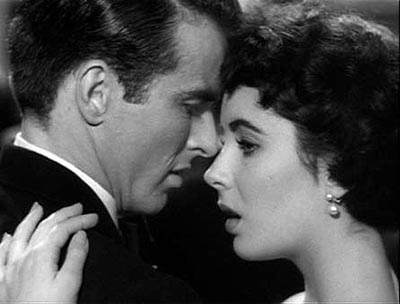 Montgomery Clift and Elizabeth Taylor in A Place in the Sun.
Screen remembrances: Elizabeth Taylor and Dennis Hopper
What it is: A celebration of two Hollywood legends who took wildly different career paths.
Why you want to see it: This weekend, the AFI begins its series dedicated to a pair of movie icons: one the definition of glamor, the other a champion of the independent and rebellious spirit. The Liz tribute kicks off with the family classic Father of The Bride, remade in 1991 with Steve Martin (not in the Taylor role), and A Place in the Sun, a melodrama of love and murder that pits Liz against doomed Hollywood legend Montgomery Clift.
The Hopper tribute begins Saturday with the countercultural watershed Easy Rider, Hopper’s directorial debut, featuring a breakout role for Jack Nicholson. The Taylor series continues throughout the summer with more obscure titles like Joseph Losey’s Boom! One wishes there were room in the schedule for more of Hopper’s lesser-known work: the atmospheric mystery Night Tide (1961); the self-indulgent but fascinating The Last Movie(1971), an infamous flop he directed right after Easy Rider; and the highly unflattering documentary American Dreamer, which documents some of the indulgences, on and off screen, of The Last Movie. These are not easy to find, but my favorite Hopper performance (no it’s not Blue Velvet) is in a film that you can and should add to your queue right away. Hopper stars as Tom Ripley in Wim Wenders’ The American Friend (1977), a fatalistic crime drama co-starring everybody’s favorite Hitler, Bruno Ganz. Hopper’s typically unhinged character is tempered with introspection — one unforgettable scene has Hopper laying on a pool table taking Polaroid photos of himself that he resignedly lets fall over him. (If that sounds familiar, Madonna borrowed the scene for Desperately Seeking Susan.) The name Ripley may ring a bell to fans of crime fiction. The American Friend (view thetrailer) is a loose adaptation of Patricia Highsmith’s Ripley books — Hopper is playing the same character that has been taken on by Alain Delon, Matt Damon and John Malkovich. It’s hard to believe that the man who embodied the evil of Frank Booth is in fact the warmest of the Ripleys; he doesn’t play to the banality of evil that Highsmith depicts so well, but rather finds a gentle soul in madness. Rest in peace.
View the trailer for A Place in the Sun.
View the trailer for Easy Rider.
Starts tomorrow at the AFI Silver.
—
Also opening this week: Nordic monster movie Trollhunter and John Turturro’s homage to the music of Naples, Passione. We’ll have full reviews tomorrow.