 M’Barka Ben Taleb
John Turturro’s acting career spans more than thirty years, from his frequent work with Spike Lee and the Coen Brothers to a recurring role in the Transformer movies. His performances are often restless and fidgety (who else could polish a bowling ball the way he does in The Big Lebowski – which, coincidentally, is playing at the AFI this weekend). Such “thinking outside the box” can be an asset to the creative soul, and so it is with Turturro the director, hewing a vision at once romantic and obsessive. Turturro’s last film as a director, 2005’s Romance and Cigarettes, was a ribald throwback to classic musicals, set in a New York where its perfectly fine to break out into song in the middle of the street. For his latest film — part documentary, part street-opera — Turturro immersed himself in the music of his homeland. The result will have you humming at least a few songs even if you don’t understand them.
Turturro notes that the Neapolitan ballad, which may seem sheer romance to American ears, is often misunderstood. There are levels of irony that are lost as the music travels across the ocean. (For example, that heart-wrenching ballad may be an ode to Vesuvius, the treacherous mountain that promises a stream of demon seed to those in its path.) This story-telling character of much Neapolitan music emerges from the basic human urge of expression — but it also comes from the tax rate. Singers were taxed three percent more than actors, explains Turturro, so by developing a song into a performance, singers could pay the lesser rate.
One musician in Passione explains that a feeling of belonging is elusive to Neapolitans. The area has been invaded by so many different cultures — Arab, Norman, American, French, Spanish — that “growing up here means [being] everybody and nobody at the same time.” (For similar reasons, this goes for Filipinos as well.)
Of course, modern technology has brought even more influences to the area, so hip-hop, electronica and African pop informs the music as well. You can taste many of these diverse flavors in the most unusually passionate version of “Pistol Packin’ Mama” you are likely to hear, with middle eastern influences led by actor/singer Pepe Barra, who takes the themes of sex and violence already in the song and adds his own ideas about race.
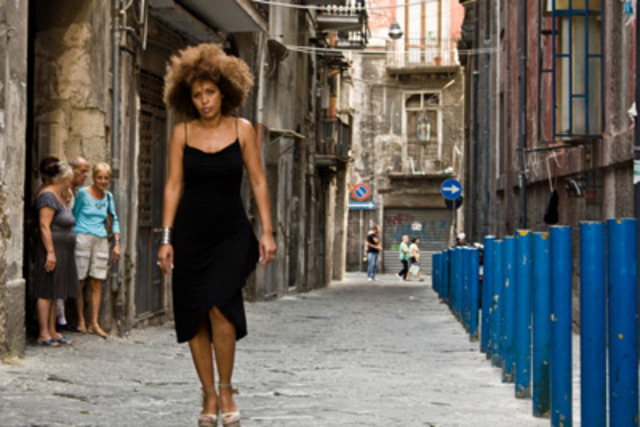
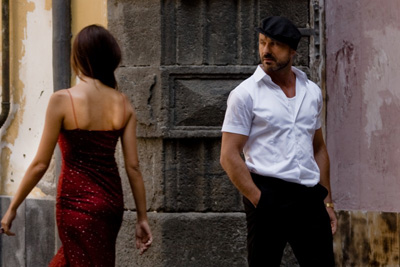 Fluid camerawork captures the sweeping emotion of the music, as does the frequent use of live recording in the streets of Naples. One drawback of the latter is a visible boom mike. It happens too often to be anything but deliberate, particularly in a night sequence where Neapolitan-Tunisian singer M’Barka Ben Taleb purrs a sultry “O sole mio” followed by a very phallic boom. Whether this enhances or diminishes the smouldering music is an exercise best left to the viewer.
Passione‘s most charming interview subjects may the trio of elderly Neapolitans who try to explain the psychology (“The DNA of Naples”) of their countrymen, and argue over the distinctions between local legends Fernando De Lucia, who was an old man by the time the recording era came along to capture his voice, and the better-known Enrico Caruso, whose youthful prowess was well-served by recordings.
Unlike the recent Rejoice and Shout, which surveyed an equally passionate music, Passione does not move chronologically, weaving instead from contemporary singers to classic crooners, and saving turn-of-the-century operatic stars for late in the film. This non-linear approach has the effect of the kind of multi-genre mix tape that comes from an omnivorous musical palette. Yet all of it is Neapolitan, from a region that contains multitudes, and whose voices are raised, if not in unison, in harmony.
—
Passione
Directed by John Turturro
With John Turturro, Lina Sastri, M’Barka Ben Taleb, Peppe Barra, James Senese.
Running time: 90 minutes
Not rated.
Opens today at the West End Cinema.