DCist’s highly subjective and hardly comprehensive guide to the most interesting movies playing around town in the coming week.
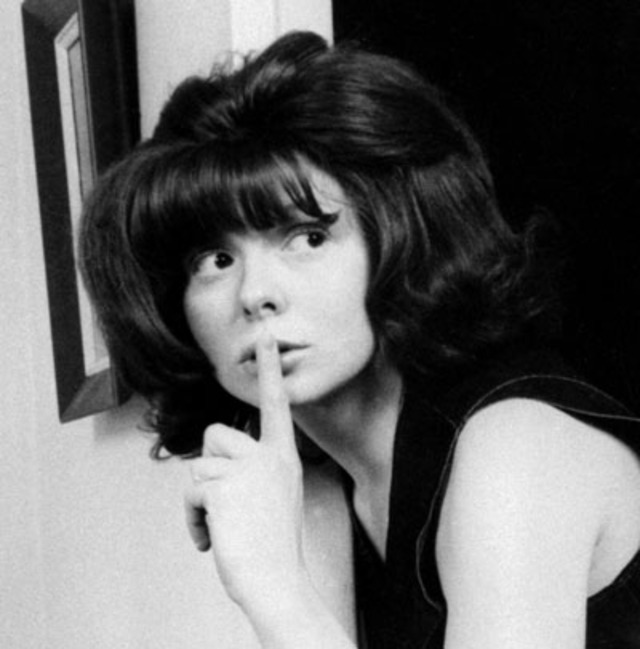
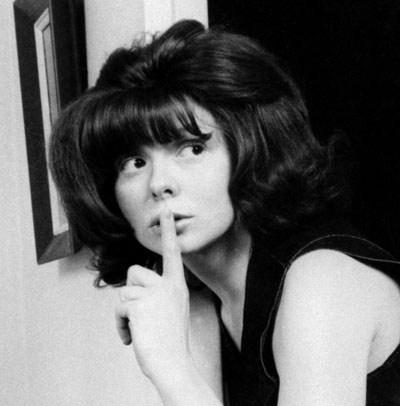 Joyce McKinney
What it is: Erroll Morris’ latest portrait of an obsessive looks at the strange case of Joyce McKinney, beauty queen — and kidnapper?
Why you want to see it: Miss Wyoming 1971, Joyce McKinney could have had her pick of men. What made her not only choose bumbling Mormon missionary Kirk Anderson, but fly across the pond with a hand-picked team of accomplices to abduct him at fake-gunpoint? Morris told the New York Times that McKinney was one of his most fascinating interviewees — “if there was an Academy Award for best performance in a documentary, she’d win.”
But Morris’ new film is more than just a lurid story, although sensationalism is part and parcel of a tale in which a former Miss Wyoming ties a Mormon missionary spread-eagled to a bed and reportedly rapes him over the course of three days of, in McKinney’s words, “fun, food, and sex.” This Rashomon for the supermarket aisle is about how we tell stories — not just the tabloids, but all of us. McKinney tells Morris that her training as an actress came in handy during her 1977 trial, and she performs for the camera today as surely and expertly as she performed for the jury thirty years ago. But we get no less a performance from Daily Express gossip columnist Peter Tory, one of the tabloid journalists who originally covered the story.
In the 1970s, rival British tabloids sold conflicting versions of McKinney as small town sweetheart and S&M call girl — neither of which exactly lines up with her own version of the truth. For that reason, she has waged a campaign against the film. But is there such thing as a reliable narrator? Morris uses the visual language of tabloids in the form of contemporary newspaper clippings and of titles and fonts designed to mimic vintage tabloid graphics. Film footage is framed as if on a television screen against vintage wallpaper out of Diane Arbus. In other words, we all frame the truth through our own particular lens, and we are all performers — even Morris. But some of us tell better stories than others. McKinney turned up in the news again a few years ago, but if you don’t recognize the name, I won’t spoil it for you. It just goes to show you that the best storytellers never stop telling stories. Like Joyce McKinney, and Errol Morris.
View the trailer.
Opens tomorrow at E Street.
—
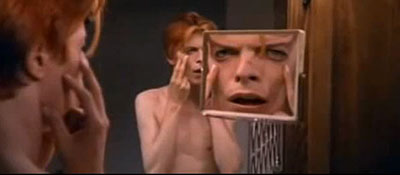
What it is: The 35th anniversary of one of the best-regarded science-fiction films.
Why you want to see it: It’s the role David Bowie was meant to play, and which we all think he lives: Thomas Jerome Newton lands on Earth from another planet, weakened by drought and desperate for water. Along the way, he finds an Earth that makes us too long for another world. Director Nicholas Roeg has set his sights on the terrors of so-called civilization before, and though Bowie is a far cry from the aboriginal figure of Roeg’s masterpiece Walkabout, they find themselves in similar crises: looking for understanding, but feared as a threat. But there’s a fine line between alienation and self-pity. As easy as it is to identify with Newton’s feelings of loss and homesickness, it’s hard to feel sympathy for a poor, misunderstood privileged rock star, then at the top of his form. But 35 years later, Bowie’s declining health and recent low profile makes this more poignant than ever.
View the trailer.
Opens tomorrow at E Street.
—
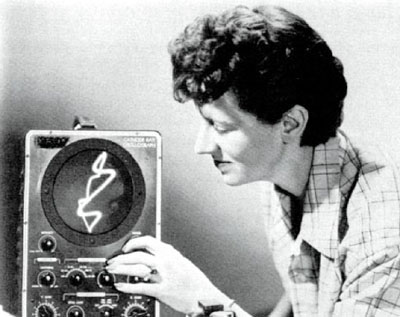 Mary Ellen Bute
Passages from James Joyce’s Finnegan’s Wake
What it is: The rarely seen first film adaptation of Joyce, in a newly restored print.
Why you want to see it: One of the most forbidding classics in literature, James Joyce’s Finnegan’s Wake may seem the most unfilmable of all unfilmable novels. But in 1966, experimental filmmaker Mary Ellen Bute adapted it. Would it surprise you to learn that the result plays like early Monty Python? As Joyce burst the literary envelope with his own strange language, Bute’s visual invention creates a language of her own, forging out of Joyce a cinematic form that subverts Hollywood production values with text, collage and other-worldy graphics. Intimidating though the book may be, the delightful sound of it might convert the open-minded from uncomprehending to spellbound. And lines like, “it is drinking nuncheoun out of something’s brainpan!” makes the Wake — and this fascinating adaptation — funny enough to overcome any trepidation. The same is true of Bute’s rare film. Shown with Bute’s 1958 short film The Boy Who Saw Through, about a Victorian child (played by twelve-year old Christopher Walken) who can look through walls.
This weekend, the gallery is also premiering Sleepless Nights Stories, a new work by the high priest of American avant-garde filmmaking, Jonas Mekas. Watch Mekas follow Yoko Ono, Patti Smith, Marina Abramovic and others through New York after dark.
View a clip from Passages from James Joyce’s “Finnegans Wake”.
Passages screens July 16 at 2 p.m. and July 30 at 12:30 p.m. Sleepless Nights Stories screens July 16 at 4:30 p.m. Free. At the National Gallery of Art.
—
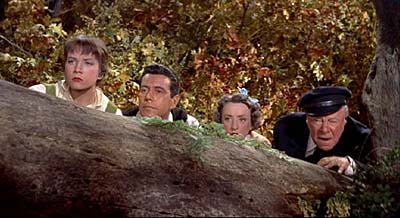
What it is: Alfred Hitchock, comedy director.
Why you want to see it: There’s plenty of dry, morbid humor in the work of Alfred Hitchcock, but The Trouble with Harry is, along with Mr. and Mrs. Smith, one of the rare outright comedies in his filmography. Of course, it’s still Hitchcock — the trouble with Harry is that he’s dead. The rural Vermont setting recalls his small-town thriller Shadow of a Doubt, and painter Sam Marlowe’s (John Forsyth) then racy come-on to Harry’s widow (Shirley Maclaine) puts this squarely in the director’s pantheon of sexual obsession. Harry was also the beginning of a beautiful friendship: it is the first of many Hitchcock films with music by Bernard Hermann. His darkly comic score may be more compelling than the actual film, but Hermann’s music would work in perfect macabre harmony in later Hitchcock classics: the frenzied circular figures of North by Northwest, the Wagnerian romance of Vertigo, the stabby strings of Psycho.
View the trailer.
Saturday July 16 at 3:00 pm, Monday July 18 at 4:45 pm, and Tuesday Jul 19 at 7:00 pm at the AFI Silver.
—
Also opening this week, two more misunderstood teens: indie misfit Terri, and the final installment of the Harry Potter series. We’ll have a full review of the former tomorrow, as we’re sure 90% of you will be heading to see Mr. Potter this weekend no matter what we say.