Anyone who has paid five cents for a plastic bag in the District knows that there’s a constant struggle to take care of our environment in a way that is practical for the public. One of the most recent efforts to protect the ecosystem surrounding our urban landscape is the RiverSmart Homes project, run by the D.C. Department of the Environment. RiverSmart is focused specifically on preventing stormwater run-off:
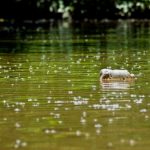
As stormwater moves from our yards to our streams it picks up pollutants such as oil and grease from our roadways and driveways, nutrients from fertilizers on our lawns, and bacteria from pet waste and other animal excrement. Once in the stream, the fast-moving surges of water associated with storms cause erosion and destroys habitat for fish and other wildlife.
RiverSmart offers incentives to homeowners for landscaping projects that help prevent this stormwater runoff, like rain barrel installation, bayscaping, and replacing concrete with pervious pavers. You sign up for one of a handful of environmentally-friendly landscaping projects, wait a few months, and the city will give you a $1,200 grant and assign a landscaper to get it done. And voilà! Government-subsidized flowers, baby, good for you and me and the water all around us. Conceived and tested with a pilot program in 2007 to 2009, it was officially opened to all District homeowners in September 2009, geared towards single-family homes and small apartment buildings built pre-1980s, before stormwater considerations were mandatory in development.
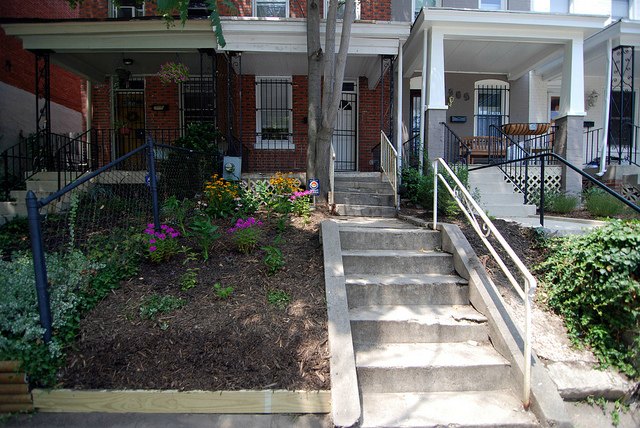
So dear readers, what better way to test out a new program then to do it myself, eh? I’ve been renovating my circa-1909 federal rowhouse in Columbia Heights since I bought it, foreclosed and gutted, in 2007, but still had both the front and backyards to landscape — so this came up at a perfect time when I heard about it from now-Friend of DCist Eric Nuzum. Now that my RiverSmart project is nearly finished — including a front yard full of gorgeous native flowers — I offer my experience for others who would like to participate in the program.
First, this is D.C. government we’re talking about, so no matter how great the result is, don’t expect your landscaping miracles to be timely. Here’s how it went down:
September 29, 2010: Submitted my (blissfully short) application and immediately got an email confirmation.
January 10, 2011: Contacted by RiverSmart to set up home stormwater audit.
January 19: Auditor visits to survey my property, suggest projects that would best fit my needs, and talk to me about my questions and concerns. 45 minutes.
January 25: Received email with the audit details and requesting my final choice of incentive project. (I chose bayscaping and a rain barrel; more on that below.)
March 29: Notified that my projects were targeted for May-June.
May 25: Notified that “due to our funding cycle and administrative delays there will be an additional delay in your [rain barrel] installation, but funding has been allocated and awarded for [the program].” Rain barrel installation now targeted for August.
June 28: Put in touch with my assigned landscaper at Green Gardens.
July 10: Landscaper visits to survey property and let me choose plants.
July 15: Landscaper installs bayscaping. Still crossing fingers that the rain barrel will arrive in August.
Every home has different needs, so the auditor will determine which projects make sense for your property. For a small co-pay, the program provides a grant to cover a large part (typically all) of the project you choose. Rain barrels and shade trees, planted by Casey Trees, are offered for any homeowner that has a place for them. The co-pay for the rain barrel is $30 (for a $300 barrel) and $50 for the shade tree. (You can also buy and install a rain barrel without going through RiverSmart and get a rebate from the city for part of your cost.)
After that, homeowners can receive up to $1,200 for one of three projects: bayscaping, a rain garden, or pervious pavers. Bayscaping is the installation of indigenous plants, often in lieu of grass lawns, that support local wildlife and pollinators and needs little maintenance. A rain garden is good for flat areas where stormwater collects, as the plants will help absorb the excess water. Pervious pavers soak up water and allow it to seep into the ground; they’re typically installed as substitute for concrete or asphalt.
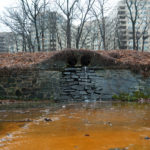
As you can see from the photos above, I had a precarious, erosion-prone front yard that can’t really be used for much. Bayscaping was a perfect choice — the grant easily covered plants for the entire yard, and after the initial weeks while they take root (so they need to be watered every day), they’ll pretty much take care of themselves. Over the next couple of years, they’ll fill out and cover the whole yard with lovely flowers, as well as keep the hill from eroding in every storm.
My landscaper gave me lots of native plant choices (more or less anything that can be found on this list, provided it can also be found at the garden store), but I’m not picky and the variety of plants he suggested for me were perfect. There are larger plants towards the back (black-eyed Susans and a native hydragea), mid-sized plants in the middle (purple cone flowers, cardinal flowers, garden phlox and native petunas), and spreading ground-cover in the front (creeping phlox and butterfly weed). He also planted two inkberry bushes in the strip abutting my neighbor’s yard.
The bayscaping option has the biggest co-pay: $100. But! That’s just $100 — and, okay, ten months — for a whole yard full of beautiful, low-maintenance plants that won’t just help prevent further environmental damage to local rivers and streams — one of the benefits of native plants is that they need little to no pesticides or fertilizers — but will actively contribute to making it better by providing pollen and nectar for local wildlife (I seem them covered in huge bees every day).
The rain garden didn’t make sense for me, but I was also given the option to get pervious pavers to replace a very large concrete driveway in my backyard. However, my auditor advised that while, yes, the pavers were definitely more environmentally-friendly, it’s not the best choice financially. This option is great if you’re looking to pave a small area — a walkway, for example — but they can get quite expensive if you have a large area to cover. RiverSmart only pays $1,200 towards the project, and tearing up a huge area for it would be extremely expensive (not to mention, I’d have to dispose of all the concrete already there).
I appreciated the consultation that provided reasonable advice, encouraging me to make improvements, but taking into consideration my concerns as a homeowner both financially and practically. You’re going to wait as a RiverSmart participant, but there’s really nothing else you need to do except answer a couple of emails and, eventually, write a small check — and there you are, saving the environment. RiverSmart also asks that you make your property available so they can do check-ups to assure you’re properly maintaining the new work. (I got a stern email from my landscaper during the heatwave last week, “There will be hell to pay if I come by and see dead plants.” Sir, yes sir!) In short, as a D.C. resident and taxpayer, this is exactly the kind of program I support — you can sign up here.