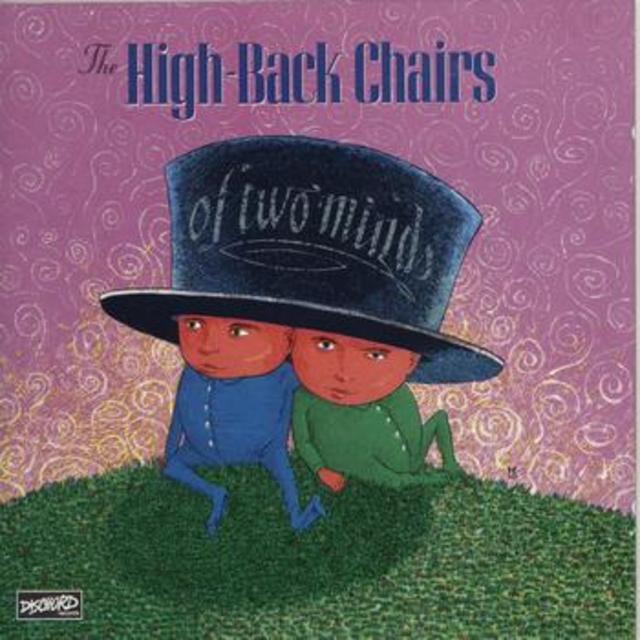
Secret History profiles classic D.C. albums in order to highlight the greatness and diversity of the District’s musical past. This entry focuses on the High-Back Chairs’ power pop triumph, Of Two Minds (Dischord, 1991).
 Before Nirvana initiated a cultural revolution dressed in distortion, depression and cozy outerwear, it looked like power pop had a shot at a major commercial resurgence. In the late ‘80s and early ‘90s, worshipers of the catchy, romantic approach of ‘70s acts like Badfinger, Big Star, Cheap Trick and the Raspberries were cropping up all over the place, and generating significant buzz. Teenage Fanclub, the Posies, Matthew Sweet, the La’s and Material Issue moved pretty serious units peddling addictive melodies about girls and being dumped by girls, adding jangle and snap to make the sadness sound sweet. It seemed like a sure-fire plan, until fall of 1991, when Nevermind radically jarred American pop’s tectonic plates.
One of D.C.’s best-ever power pop acts would wind up on Dischord, a label not particularly known for its sunny disposition. The High-Back Chairs — ex-Wonderama singer/guitarist Peter Hayes, ex-Minor Threat/Egg Hunt/Three drummer Jeff Nelson, Velvet Monkeys/Wonderama veteran Charles Steck on bass and Velocity Girl drummer Jim Spellman on guitar — formed in 1989, broke up in 1993, and were responsible for some of the brightest melodies and hookiest hooks of the period. The group’s 1991 debut Of Two Minds is a too-often-overlooked piece of D.C.’s indie rock mosaic, and an album that helped Dischord broaden its sonic horizons beyond hardcore punk and its immediate offspring.
The members of the High-Back Chairs had a much more pop-centric orientation than many of their fellow D.C. post-punk contemporaries, and especially more so than many of their Dischord label mates. Says Steck, “The Velvet Monkeys were a sort of psychedelic jam band, with strong pop sensibilities — hence the Monkees reference, obviously. The music had trippier and darker aspects to it, too, like the Stooges and that sort of thing. Somebody once referred to the Velvet Monkeys as ‘the American Joy Division’, if Joy Division jammed. So the High-Back Chairs weren’t too far a reach, playing wise.”
“I was into the whole vibe of the Dischord scene and went to all those gigs for years,” says Spellman, “but musically my heart was always with the poppier ‘underground’ stuff of the day like the Replacements and the Smiths. Peter Hayes was on my radar because I had seen Wonderama play once. I think it was with the Vile Cherubs at Georgetown University. They were more along the lines of the stuff I was into: not particularly angry and pretty tuneful, but still ragged enough to be interesting.”
According to Hayes, who was a fan of everything from the Buzzcocks, the Only Ones, and the Birthday Party to Television, Cabaret Voltaire, and the Gun Club, “When the High-Back Chairs started playing out, paths were zig-zagging all over the place. But you have to appreciate the amount of gall it took to stand up and play on stages still charred from Rites of Spring’s self-immolations not too awfully long before.”
The fact that he had been in hardcore pioneers Minor Threat afforded the High-Back Chairs a higher profile than they might have had otherwise, says Nelson, but that higher profile came with a cost. “Promoters would invariably play up the ‘ex-Minor Threat’ angle way too much, and as a result we would get kids coming to our shows expecting a hardcore band. We played a show in Cleveland shortly after an Alternative Press article about us had come out, in which I said that I didn’t care if ‘the Maximum Rock ‘n Roll types’ liked us or not. At that point, I was really sick and tired of every aspect of the ‘scene police,’ whether locally or nationally, with their rigid stance on music and utter dismissal of bands trying new things. We played to a small crowd, and several kids were shouting out the names of Minor Threat songs. The punk rock equivalent of shouting ‘Freebird’”.
 “There would often be a kid up front in a Minor Threat hoodie scowling at us, wanting to hear Jeff play some crazy thrash beats,” concurs Spellman. “I can’t say I blamed them! In practice, I would try to get Jeff to play the beat to the Minor Threat song ‘Betray’.”
The fact that the High-Back Chairs were the odd-men-out on the Dischord roster wasn’t lost on Dischord’s management. “Among the most important things I brought with me to the band was being co-owner of Dischord,” says Nelson. “But we were never a really good fit with the label. No way would [co-owner] Ian [MacKaye] have allowed the High-Back Chairs to be on Dischord if I had not been in the band.”
Furthermore, being a “non-Dischord” band on Dischord may have hindered the High-Back Chairs’ commercial prospects. “We didn’t sound like Fugazi or as heavily post-hardcore punk as most of the other bands,” says Steck. “I think it led to some confusion for potential fans as well as fans of the ‘Dischord sound,’ whatever that may have been perceived to be. I think our sound was compatible with Matthew Sweet or the Lemonheads, but I don’t think we ever really were able to tap into that audience.”
Anyone who wrote off Of Two Minds as “not punk enough” missed out on one of the most enjoyable LPs of the decade. As the chiming major chords of opener “Miles to Inches” kick in and Hayes exhorts the listener to “C’mon, c’mon, c’mon, c’mon, c’mon!,” you know this is going to be a good time. The party continues through the rest of the album’s eight tracks, as Hayes and Spellman trade riffs and bounce off one another in the kinetics of pure pop energy, while Steck and Nelson — channeling the hardcore attack he brought behind the kit in Minor Threat in a more swinging, swaggering direction — keep the songs aloft. Buoyant backing vocals shine light into the cracks and crevices of the watertight tunes, adding breadth and depth to tracks like “Kiss and Tell” and “Afterlife”. By the time the last ringing notes of album highlight “Cannon Fodder” have faded away, there’s only one thing left to do: listen to it again.
To produce the album, the High-Back Chairs tapped Ted Niceley — responsible for Fugazi’s landmark 1990 album Repeater — at Arlington’s Inner Ear Studios. “We wanted someone who wouldn’t bullshit us, and Ted was that guy,” says Hayes. Plus, adds the guitarist, “I was a huge Razz fan,” citing the power pop band Niceley had played in with underground legend Tommy Keene. “I saw them play one summer at a place in Cleveland Park called the Far Inn (now Atomic Billiards). Picture Ted as the guy playing bass in a tiny club, like Joe Frazier with his shorts on fire, wrestling a giraffe in a low-octave hurricane.”
Remembers Spellman, “When I first met Ted he freaked me out. He came to a rehearsal at Peter’s place in Tenleytown on a Sunday morning. He was in the basement wearing shades, smoking and drinking a beer. A real rock-and-roller.” That said, says Spellman, “What I really liked about working with Ted was that he had a real long view. He was there to make a classic record, and he didn’t care about punk rock scene politics or anything else.”
“I think Ted pushed everyone to get it right, and it mostly shows,” says Steck. “I‘ve played in other bands that don’t want to spend the time or are too aware of the money to wait for the right take, but I think Ted was able to find a middle ground where we didn’t play things to death, but we also didn’t settle for less than a really good take. Ted certainly had ideas about how things should sound, but it was always in regards to being true to the songs.”
Despite Niceley’s experience and skills behind the board, there were moments of tension between him and members of the band. “He and I disagreed completely over using a click-track,” points out Nelson. “I had no interest whatsoever in sounding like a robot, and even when I tried I could not play with any feeling or style or enthusiasm when tied to the beat of a machine.”
“We often overlooked Ted’s impressive credentials and constantly second-guessed him,” admits Hayes. “He’d get bugged, but he was pretty tolerant of us. We did overnight sessions at Inner Ear to save money, and I remember the reverse-commute from Virginia back to D.C. at the beginning of rush hour every morning. Ted and I were living in the same group house at the time, so he was my ride. We joked about the need for a morning-drive traffic report specifically for the region’s recording studios, while listening to our mixes on his car stereo. This still sounds like fun to me, and given the opportunity, I’d do it all over again.”
Recording Of Two Minds took more time and money than the band — or their label — had anticipated. “I remember that between Ted’s hourly rate as a producer and our combined perfectionist tendencies, the studio bill added up pretty fast, when combined with the hourly rate from Inner Ear,” says Nelson. “We were the ones who had wanted him, as we figured he could help us create a big, full pop sound, but the total studio bill was certainly well over the very modest studio budget Dischord allowed.”
“I think Ian wanted us to spend less time in the studio, and I admit that I was probably on Ian’s side more often than not,” recalls Spellman. “I would sometimes get frustrated by Peter and Jeff, but it was near impossible to win an argument with them about much of anything. This was the only real source of tension for me in the band. The simplest things always seemed to take forever. I don’t think another band on Dischord, except maybe Fugazi, could have gotten away with spending that much money, and Fugazi were selling a ton of records, something that eluded the High-Back Chairs.”
The album’s artwork likewise ended up being extremely involved and, consequently, time consuming. “The ridiculously complex and jam-packed CD booklet that accompanied Of Two Minds was a perfect example of how perfectionist and overwrought our stuff could get,” says Nelson. “This was all pre-computer, of course, so every page that had full-color graphics required multiple layers of mylar and amberlith, with type and images and windows for images all on separate layers, each painstakingly registered to each other. I think it took me and Peter three weeks straight, working day and night, every day, to complete the artwork for the LP, CD, and cassette.” Adds Hayes, “[When the artwork was finished,] Jeff and I took a picture of us amidst the detritus of our project. It’s a picture of the Dischord porch pretty much covered with art boards. Computer graphics would soon eliminate the need for ‘mechanicals’ such as those.”
“For a while I thought it was maybe a little too polished sounding and could have had rougher edges,” observes Steck, looking back at Of Two Minds today, “but then after not listening to it for a few years I went back to it and I had a new found appreciation for the record. I’ve always liked the songs and I’m glad we didn’t try to conform to some notion of what a D.C. band should sound like. Our live shows were always a bit looser, but I think the record and its approach really presents the songs as little gems. It reminds me of records from when I was a little kid, where each track was like a new discovery, not just a rehashed version of the previous song.”
Says Spellman, “I actually wasn’t really into power pop much during the High-Back Chairs, but I really got into it after the band, and I think this record stands up there with the best of the bunch. I wish that the band had been more popular. It seemed like in Velocity Girl, at that point everything went our way, while it seems like the High-Back Chairs couldn’t get a break. Peter deserves to have more people hear the High-Back Chairs because the records are flat-out great, and Peter Hayes deserves a wider audience.”
“We were interested in crafting and playing intricate — perhaps too intricate — pop songs, and felt that ‘college radio’ would be where we would find our biggest audience,” says Nelson. “This was when the term ‘alternative’ was just coming into use, and before Nirvana’s Nevermind changed the landscape completely. Eventually, I realized it was just too much of an uphill struggle to get anywhere. It proved much harder to get noticed than we had anticipated. While we had felt suffocated by the underground punk scene, it was certainly a very supportive environment for those that still enjoyed working within it. By leaving the safe confines of the punk scene, it felt like we were starting over completely.”
Hayes, who now plays with Cane and the Sticks, describes Of Two Minds as “a commercial record made on an indie label budget, which we exceeded. Dischord was cool about our relative extravagance, even though it ruffled some feathers. We were held accountable and it took a while, but we made good. If we were still together today, we’d still get asked about Jeff’s former band,” continues Hayes. “But I think a more interesting question is to what degree bands like Shudder to Think, Autoclave, Q and Not U, the Make-Up and the High-Back Chairs prevented our excellent label from being pigeonholed as a refuge for sped up, aggro music?”