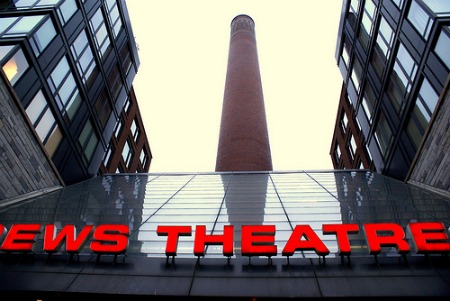
 Photo of the Georgetown AMC Cinema by caroline.angelo.
If you’re like me, you’re tired of just having plain old IMAX in D.C., via the two traditional IMAX screens at the Smithsonian’s Natural History and Air and Space museums. What do we want? The IMAX Experience®, of course, which just sounds sexier, and which you can get at the multiplex instead of having to go to a museum like some tourist. Well, our prayers have been answered, because according to a press release issued by from AMC and IMAX yesterday, starting on September 9 at the AMC Georgetown 14, we can begin experiencing® IMAX here in D.C. instead of just, oh, I don’t know, watching it.
If you’re unfamiliar with the arguments against IMAX-that-isn’t-really-IMAX, you should definitely read Aziz Anzari’s brilliantly offended take-down of the practice, as well as the somewhat less entertaining, but even more informative article at LF Examiner, an industry blog for large format film. The upshot is this: IMAX (the company) redefined what IMAX (the product) meant a couple of years ago in order to expand their market share — so it’s no longer about the massive screen, or even the large film format; it’s mostly about their proprietary projection system and better sound.
There’s no arguing with the sound system; it’s impressive, to be sure. But most of these IMAX-ish screens are actually considerably smaller than the screen at a large old-style cinema like the Uptown, and positively miniscule when compared to a real IMAX screen. And a funny thing about that projection sytem: it uses dual digital projectors with a “2K” resolution designation, which are regarded as much clearer and brighter than the standard 2K projectors used on a lot of standard digital screens. But many theater chains are replacing those 2K digital systems with much sharper 4K projectors, which many claim are clearer than the dual 2K IMAX projectors. Once that transition is complete (at the end of 2012, according to a plan mapped out by AMC in 2009), it may be that all of Georgetown’s non-IMAX screens end up with a better picture than its sort-of-IMAX screen. But hey, at least you’ll have state-of-the-art, high dynamic, low distortion sound.
Of course, you don’t get extras without a price — and IMAX Experience, just like IMAX, comes with a premium charge. But that charge is confoundingly sometimes even more expensive than regular IMAX. For instance, if you want to catch an evening show of the new Harry Potter in 3D IMAX at the Natural History Museum, it’ll cost you $15. Up the road at the Silver Spring Regal Majestic, tickets for the same movie on the much smaller faux-IMAX screen are $18.
So once Georgetown’s IMAX-lite screen opens up on September 9, screening the new Steven Soderbergh-directed, Matt Damon-starring plague thriller Contagion, why would anyone pay more there for an “experience” that’s nowhere near as good as the one just a couple of miles away at the Smithsonian? Not to mention one that may not even be quite as good visually as the one on a less-expensive screen in the same building that has been upgraded to a 4K projector? Well, we’re not really sure. With the first of these screens opening up in D.C. in a few weeks, we just wanted to throw out a caveat emptor that fancy names aren’t always worth the fancy prices, no matter how successful IMAX has been at blurring the line between their original product and its watered-down namesake.