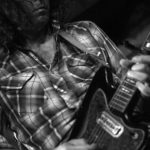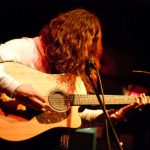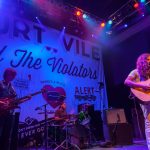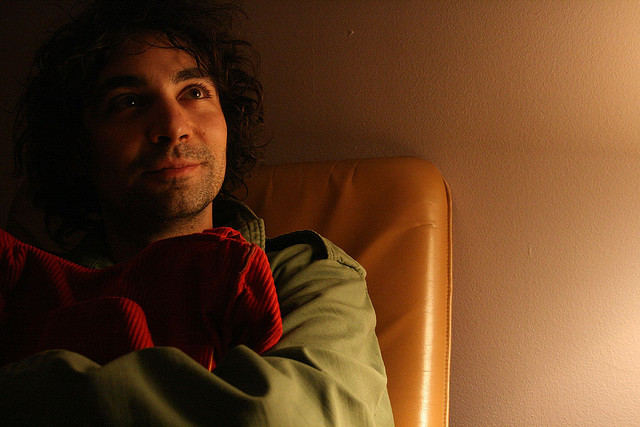
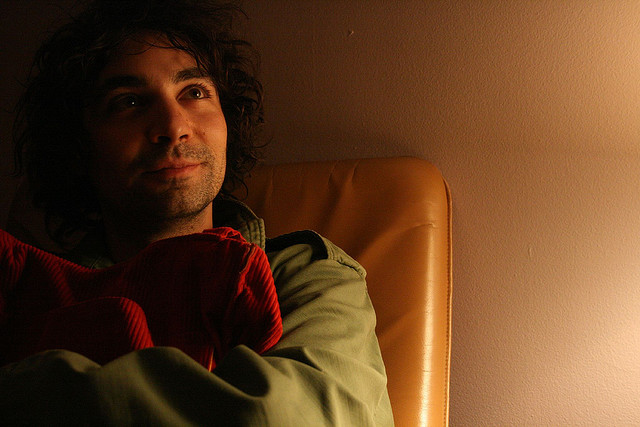
 Photo by Katie L. Thompson.
It’s been fascinating to listen to the evolution of Philly’s rock stalwarts, The War on Drugs. On their debut EP, Barrel of Batteries (which they gave away for free), singer Adam Granduciel emoted like a modern Bruce Springsteen that had inherited Bob Dylan’s vocal cadences as guitarist Kurt Vile sprinkled twinkling guitar around the edges. Vile went on to focus on his solo career and the lineup continued to shift after touring off of 2008’s excellent and seemingly road worn Wagonwheel Blues.
The resulting release is Slave Ambient which eschews some of their earlier lo-fi tendencies, allowing the listener to drift along the keyboard melodies of that mix well with the band’s Americana undertones. In advance of tomorrow night’s show at the Red Palace, we talked to Granduciel about in-studio improvisation, the changes in their recording setup and the advantages to having a fully committed band.
Listening to Slave Ambient, it seemed like it was more of a cohesive album than say, a collection of singles. Is that what you were going for?
Yeah. I definitely think it’s important to — for me — the way I want the albums from the band to be are things of themselves, you know what I mean? Something that’s really cohesive and the songs are all a part of the same little woven family, sewn together in little ways. So, yeah, it’s important to me. That’s kind of what I wanted out of this album. The first record kind of inadvertently ended up that way. The spirit of it and the way it sounded, it ended up being a cohesive album, so I wanted to definitely make sure this one was the same way.
Did you write the songs in chunks and knowing that one was going to follow another?
No, they just kind of ended up. Some of them I just knew, like the three that go into each other: 4, 5 and 6. Once the songs were nearing completion, I found a way to tie them together with the animator. But all the other ones, no. We just kind of recorded and the last eight months when we were finishing everything up, you get an older song and if we were recording new songs, we’d put a similar stamp on an old song. We wouldn’t let any of the songs be done until the very end, so they all kind of tie in with each other. No, they weren’t written with any sequence in mind, but it definitely started to make sense to me at some point.
Going back to that point that you wouldn’t let any song be completely finished until the end, did you improvise the instrumental parts?
Oh yeah. A lot of that stuff is pretty much on the spot. There’s never really anything that’s written with the exception of maybe some keyboard lines, a lot of that stuff is usually in the moment — playing the guitar, jamming on the synth — and then these really nice moments happen. But then sometimes you want to have an actual keyboard part, like on “Call My Name,” that last part. But, to be honest, I put that riff on there before I even had the song figured out. So, in a way I was just kind of jamming on that one chord and then I came up with that ending melody and I never actually redid it. I just kept it. So, in a way, actually, that was improvised and I ended up building the song around this improvised keyboard part.
Slave Ambient sounds like it has a cleaner sound than either Wagonwheel Blues or Barrel of Batteries. Has your recording setup changed?
Definitely. Back then, all that stuff was homemade and on my digital 8-track. But this record was in my home studio, which was a tape machine, a 16-track tape machine with a lot of gear, and then doing a lot of stuff at my friend Jeff’s house who has a good studio. Then we did a really professional studio in Asheville. So, yeah, my personal setup has changed and it’s affected the whole process of how songs start and then transferring stuff and overdubbing and going from studio to studio and trying out different feels and shit and trying different approaches. I definitely don’t obsess over the digital 8-track like I used to. There was definitely a character to a lot of that stuff but it’s nice that my home setup has kind of improved and also that we have the ability to go wherever we want. We can go to a nice studio or be at Jeff’s or whatever. Plus, we spend an insane amount of time on every tone…on every guitar tone. We take a lot of pride in the actual recording process.
One of the songs that really struck me from the new album is “Brothers”. Could you shed some light on what that song is about?
I don’t know what that’s about. That’s one that when we did the version on the Future Weather EP, we did that stripped down version and Dave put the drums on it. Super basic drums and then one night I was just putting those guitar chords on top and I was just singing into a mic and just improvising as I went. About 90 percent of that is completely improvised. Then, I went through and just tweaked a few of the lines. Then, I re-sang it but when we re-recorded it for the record, I didn’t really alter any of the lyrics. But, I didn’t know what it’s really actually about. There are a lot of lines in there that I really like and there’s no way I would have been able to sit down and write those if I had been thinking about it. Yeah, I don’t know what it’s necessarily about, but it’s definitely one of those things that I sing it and I zone out and the band plays it really well and you just kind of let the story blow over you. But there’s definitely some lines on there that I love and I can see why they came out at the time they did.
I had been reading an interview from 2008 when you had a lot of touring mishaps. Has 2011 gone better for you?
Oh yeah, most definitely. For a long time, like when the first album came out, there wasn’t a cohesive live band together. So, if you don’t have that, it’s impossible to grow as a live act, you know what I mean? Especially with the kind of music that we’re playing, it’s impossible to learn how to play these songs…their spirit. Not to recreate the recordings but to recreate the spirit of the recordings when the people onboard aren’t 100 percent committed. So over the years, it was always this thing that was close to being great but we just couldn’t put it up and pop and then back in March when we did a tour with Destroyer, that was kind of the beginning of the new band. Myself, Dave — well, Dave’s been in for a long time, ever since the beginning — but then Robby and Steven just fleshing out the whole sound and everyone just being totally into the music. It felt like a totally different thing now for us.
It’s great because the kind of music is not that difficult. You don’t have to remember a million changes, you don’t have to nail a solo, ya know? It’s just about getting comfortable with the songs and the feel of the songs. It’s figuring out the tones for every song and how to do it and by the middle of a tour, the songs take on a life of their own because they’re not super complicated, so it’s just a matter of how guitar plays off of voice, drumming and bass. It’s not too difficult to keep the shape of the songs or learn the songs we’re playing. Once you get the spirit, the main thing is the spirit of the songs. So yeah, and just back in the day it was just a total fucking nightmare. We weren’t familiar with touring. The bottom of my car fell off. We’d go on tours where we made nothing and got fucked by another band. Definitely now it’s a little more professional and everyone’s super passionate about their instrument.