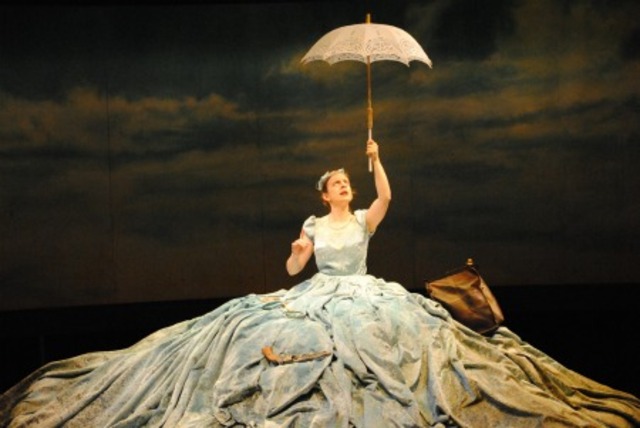
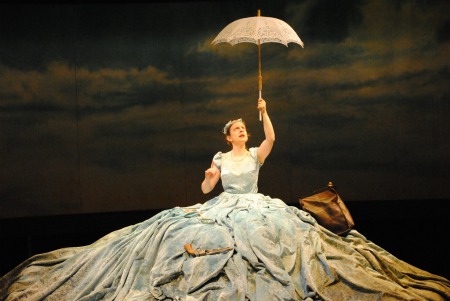
 Delia Taylor as Winnie in WSC Avant Bard’s production of Samuel Beckett’s ‘Happy Days’. Photo by Dru Sefton.
When you’re buried up to your torso in a huge mound of dirt, unable to escape, you don’t have much more than your words. That’s where Winnie wakes up at the start of Samuel Beckett’s classic Happy Days, celebrating its 50th anniversary this year in this production from the former Washington Shakespeare Company, newly remonikered this season as WSC Avant Bard. There is little to the set aside from this giant hill of earth, which appears in Tony Cisek’s design as an extension of a massive dress that Winnie wears, bolts and bolts of fabric spilling down with Winnie fixed on top, as if lodged into the hole at the top of a giant anthill. She has a bag at her side with a few things she needs to get through the days: a toothbrush, hairbrush, mirror, revolver. Just the essentials.
And she has Willie, her barely verbal husband, who lives in a hole further down the hill, and only comes out to read random classified ads to her from the newspaper and masturbate to dirty photographs. As companionship goes, one could ask for a lot more. But Winnie is in no position to ask for much, so she takes what she’s got, particularly since she feels unsure if she’d be able to talk without at least the illusion of someone listening, and if she couldn’t talk, then, well, what would be the point?
How she got there might be anyone’s guess, but guessing would be beside the point. She’s there, she’s dealing with it, and so must the audience. She’s unconcerned with getting out, as it appears she’s been here a long time, with little change in her situation. The blazing sun never seems to go away (at one point it ignites her parasol), and the days are measured by a bell that rings to tell her when it is time to wake and time to sleep. During the waking hours, Winnie talks, ostensibly to Willie, and follows an unending routine. Each day is, as she says, “no better, no worse, no change.”
In her speeches, we find that she holds tightly to whatever shreds of positivity she can find, as doggedly as the ground holds onto her own form, even as she is anxious about things deteriorating. The smallest acknowledgement from Willie can cause her to beam, and declare it a happy day. Words are her greatest comfort, and she has a steady reserve of “wonderful lines,” passages from great literature, that she recites. What seems to worry her most, though, is the thought that there might be a time when words fail, a theme she returns to multiple times.
There is talking, and there is doing, and she’s restricted to only one. As the play progresses, in typical Beckett fashion, things begin to get more and more bleak. Through a clever trick of Cory Ryan Frank’s lighting, the dress/hill looks less like a dress, more earthlike and dirty, in the second act. The sounds of an explosion and misplaced laughter in the distance create an eerie environment. And, as Winnie fears, it seems as if the words seem to begin their failure. The wonderful lines become harder to recite. Willie disappears, and she speculates that it might be her words that cause his existence. She speaks, therefore he is?
Beckett’s work is difficult to parse on a single viewing, but Avant Bard’s spare, yet elegant production, directed by Jose Carrasquillo (who also plays Willie), communicates the confusing absurdity as clearly as one can. “Things have their life,” declares Winnie at one point, giving her few posessions an agency that she lacks. Fifty years into its existence, Happy Days continues to enjoy a rich life of its own, and this production ensures that even if Beckett’s ideas aren’t always easy to grasp, his words never fail to challenge.
Happy Days runs through September 25 at Artisphere. Tickets are available online.