DCist’s highly subjective and hardly comprehensive guide to the most interesting movies playing around town in the coming week.
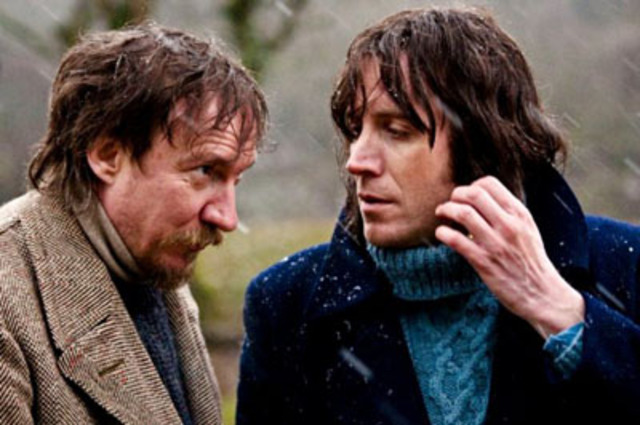
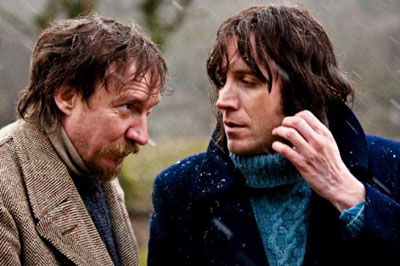 David Thewliss and Rhys Ifans
What it is: The approximately true life of a drug smuggler turned spy.
Why you want to see it: This picaresque biopic wears its agenda on its sleeve: legalize it! Wee foal Howard Marks (Rhys Ifans) seamlessly turns from his first joint to being the brains behind a ginormous international hashish operation, topped by a visit from a friendly MI6 recruiter. Mr. Nice is charming enough, but that charm comes with a side of cloying — the title comes from one of a reported 43 aliases taken by real-life protagonist Howard Marks, and if that’s more cinematic than Mr. Tunnicliffe, it’s a bit self-serving even for a biopic based on a best-selling memoir. Still, the acting, led by Ifans (Notting Hill) and a strong supporting cast that includes Chloe Sevigny, makes it a watchable indulgence. But the real casting coup is David Thewliss, who gave a frightening, incendiary performance in Mike Leigh’s Naked (1993), but has been notoriously underused — wait, there was a Basic Instinct II? — since then. The scowling menace is intact, but Thewliss’s performance as IRA arms smuggler Jim McCann ends up played for laughs as much as intrigue. Which is part of the problem with Mr. Nice. It’s no spoiler to say that Marks pays his dues — his website proudly boasts of spending “seven years in Americas toughest penitentiary.” But the overall arc of the film is that of the triumph and glamour of its star, whose best-selling life of espionage and drug smuggling may be entertaining but pretty much sends the message to kids that Crime does pay — a lot. If you like your odes to criminal hedonism celebratory, then you’ll probably love Mr. Nice. Others may suspect it’s not as nice as it appears to be.
View the nice trailer.
Opens tomorrow at E Street.
—
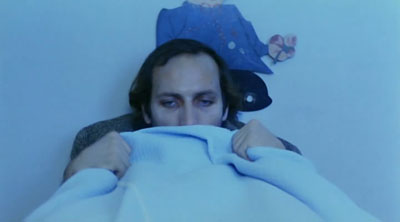 Ivan Zulueta’s Rapture.
Good Morning, Freedom! Spanish Cinema After Franco
What it is: A look at the vital film scene that emerged after 40 years of dictatorship.
Why you want to see it: Generalissimo Francisco Franco came to power in 1936, and his long reign was not kind to the creative class of Spain. Expatriates like Luis Bunuel and Pablo Picasso lobbed critiques from afar, but it wasn’t until after Franco’s death in 1975 that the cloud of repression lifted over Spain’s native cinema, and previously forbidden themes could be freely treated: sex, drugs, dissent. The early work of Pedro Almodovar (guest artistic director of this year’s AFI Fest, coming in November) are the best known films in this series, but that’s just the icing. Other highlights include Cria Cuervos (September 13-15), an early film by Carlos Saura (Blood Wedding), a child’s fantasy that is said to be a precursor to Pan’s Labyrinth; and The South (September 12 and 15), directed by Victor Erice, whose 1973 masterpiece The Spirit of the Beehive criticized the early Franco regime through a veil of childlike wonder, and managed to escape the censors’ wrath in the latter days of the dicatorship.
At the AFI Silver, September 9-22. See the AFI website for a full schedule.
—
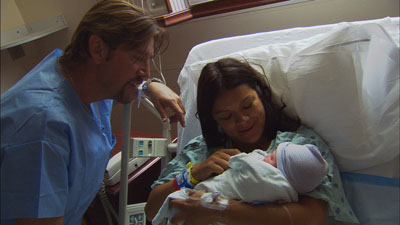 Tanya Villanueva Tepper with husband Ray Tepper and newborn. Courtesy of Oscilloscope Laboratories.
What it is: An intimate look at the lives of five people with a personal stake in this weekend’s somber anniversary.
Why you want to see it: Whether you were in D.C. or New York ten years ago Sunday, or miles away from Ground Zero, this weekend’s commemorations may be rough going. But imagine how hard this time is for the subjects of this documentary: a survivor from an impact floor of the WTC, others who lost a best friend, a mother, a fiance, a brother. For them more than anyone, September 11 will never be just another day. Director Jim Whitaker talked to these survivors over nearly a decade, and also uses time-lapse photography to look at the evolution of the Twin Towers site, from demolition to development.
View the trailer.
Opens tomorrow at the West End Cinema. Director Jim Whitaker will be available for Q & A’s after this weekend’s screenings.
—
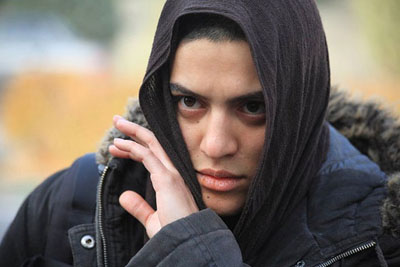 Facing Mirrors
What it is: National Geographic’s program of films made by indigenous artists.
Why you want to see it: All Roads is not your father’s ethnographic film festival. Yes, enduring, endangered traditions are studied in films like Silvestre Pantaleón(Septemebr 16th at 4 p.m.), a look at rope-making in San Agustin Oapan, Mexico, and Grab(September 15th at noon), about a celebration in the Laguna Pueblo Community. But this is also a festival fpr the clash between old and new, met head on in titles like Facing Mirrors(September 16th at 7 p.m.), an Iranian film about a transgendered male, and Kawa(September 16th at 9 p.m.), about coming out of the closet in the Maoiri world. Musical explorers have plenty of options with sounds from the Congo (Benda Bilili, September 14 at 7 p.m.) and South Africa (The Creators, September 15 at 4 p.m.) as well as the Global Groove Dance Party. (September 17 at 9:30 p.m.).
View the festival trailer.
At the National Geographic Society. Check the festival website for a full schedule.
—
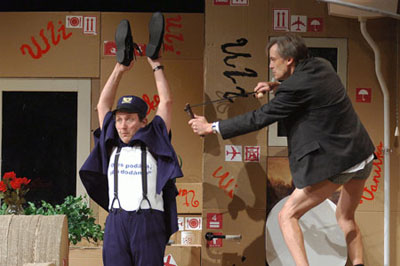
What it is: Director Milos Forman (One Flew Over the Cuckoo’s Nest) trains his camera on his homeland for the first time in four decades with this a comic jazz opera from the ’60s.
Why you want to see it: Milos Forman first adapted this play by Jirí Slitr and Jirí Suchý for Czech television in 1966, when his homeland’s cinematic New Wave was in full bloom. Forman returned to co-direct (with his son Petr) a re-staging of this madcap tale of divorce and inheritance among the upper classes.
View the trailer.
Wednesday, September 14th at 8:00pm at the Avalon.
—
Also opening this week: Steven Soderbergh’s all-star sick bay Contagion, the controversial Iranian film Circumstance, and an indie that’s getting a lot of buzz, Bellflower. We’ll have full reviews tomorrow.