
 Never has a bowl of peanuts been so portentous. Director Steven Soderbergh lets his camera linger over a bowl of airport bar peanuts after a coughing, sniffling Gwyneth Paltrow leaves the frame, and the message is clear: the next person to reach into that bowl is getting more than a snack.
Soderbergh continues the tactic throughout the early portion of his and screenwriter Scott Z. Burns’ dire imagining of just what might happen if a deadly and highly communicable new virus spread into a pandemic. Any surface we put our hands on could be lethal, and the director’s fascination with keeping them in the shot just a little longer gives them the deadly, ominous quality of a knife in a horror film: only this terror seems much more real than a masked killer.
Contagion shares some of its DNA with Soderbergh’s prior global political thriller, Traffic. That was a multi-threaded globally-set story adapted from a longer British miniseries into a dense masterpiece that never sacrificed entertainment even as it engaged in serious analysis of international drug policy. Contagion is an original work, but feels like it might have been a television series as well. The film hints at rich narratives driving all of its storylines, even if we only get bits and pieces. Once again Soderbergh, ever the entertainer, couches the policy parts of the film — a believable simulation of how government and society might react to a rapidly spreading virus — within a tense, edge-of-your-seat thriller.
Paltrow’s Beth Emhoff is the first identified victim of the disease in the U.S., having just returned from a trip to Hong Kong to her husband Mitch (Matt Damon). It’s not spoiler to say that Beth isn’t long for this world, and given that she was traveling, it’s easy to imagine how quickly things begin to spread. In a matter of days, the virus has claimed hundreds of lives and is spreading exponentially.
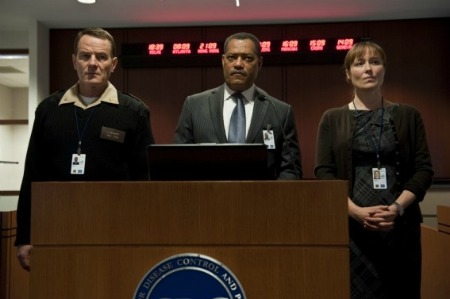 CDC scientists, led by Ellis Cheever (Laurence Fishburne) try to figure out how serious things are, and then attempt in vain to control the spread. Meanwhile, a World Health Organization official (Marion Cotillard) runs an investigation in Hong Kong trying to identify where Beth might have picked it up, and thereby identify the source of the virus, which they’ve genetically identified as a hybrid of pig and bat viruses. Meanwhile, a muckraking blogger (Jude Law) is spreading rumors that may or may not be true about what officials know — and if there’s one thing that spreads faster than the virus in Contagion, it’s rumors.
There are a lot of balls to keep in the air, and Soderbergh manages it, in part, by keeping a clinical distance from his characters. There’s a cold calculation in his direction, a desire to create greater potential for fear by making things seem as realistic as possible. Not documentary reality; Soderbergh is too much of a stylist for that. But by keeping these characters at arm’s length, on the other side of the glass with the viewer looking in, Soderbergh invites us to come closer than we might otherwise dare. Before we know it, we realize we can place ourselves in this world, and that sinking sensation in our guts is the fear and anxiety of the characters. It’s a neat trick, making us feel an emotional connection specifically by keeping an emotional distance directorially.
At a remarkably pithy 106 minutes, the film at times almost feels too rushed. A couple of the storylines suffer slightly for the inability to delve just a little deeper. Cotillard’s story in particular has a gaping hole in the latter portion of the film, and Law’s journalist is little more than a caricature for much of the film, spouting some fairly clichéd dialogue about the failings of print journalism and the future being in social media. Traffic took nearly two and a half hours to tell its stories, and feels more complete than Contagion without ever lacking forward momentum. I’d be curious to see what Soderbergh might have done with even just an extra 20-30 minutes here.
Ultimately, the film is scariest not because it makes us frightened of getting sick, or because it shows us how unprepared we might be. The terrifying thing here is the suggestion that it may be impossible to be prepared for disasters once they grow to certain sizes. Much of the suffering in a catastrophe like Hurricane Katrina may have been the result of mismanagement of resources, but even after you’ve identified and addressed those failings, what happens when the problem is orders of magnitude larger? When there are simply no facilities to treat the number of people getting sick, no infrastructure to even handle the bodies of the dead, and no clear path to developing a cure? A widespread societal breakdown in that scenario may simply be unavoidable.
Horror films are cathartic, because they stimulate our fears and then let us walk outside into a world where monsters don’t exist. Contagion is something else entirely, because the fears it plants in our brains aren’t the kind that can be chased away by the light of day.
—
Contagion
Directed by Steven Soderbergh
Written by Scott Z. Burns
Starring Matt Damon, Laurence Fishburne, Jennifer Ehle, Jude Law, Kate Winslet
Running time: 105 minutes
Rated PG-13 for disturbing content and some language.
Opens today at theaters across the area.