Martin Austermuhle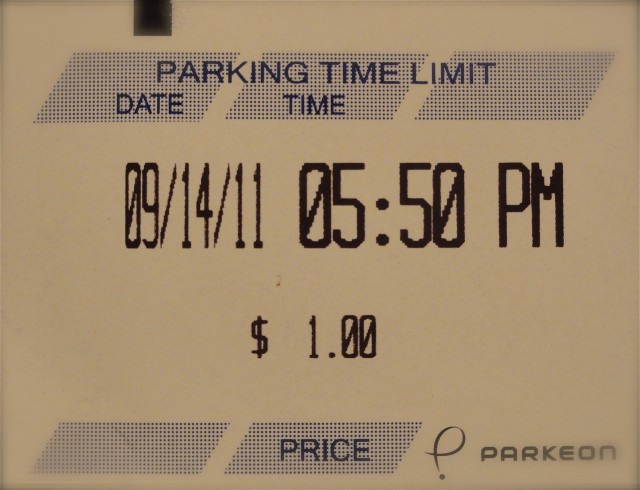
Am I allowed to hand those parking meter receipts to someone else if there’s still time left on it?
While looking for on-street parking, you’re often lucky to find a spot in a busy part of town. But it’s always something of a blessing to find a meter that still has time left on it. Not only have you found a spot, but someone else is paying for it.
At least that’s how it used to be.
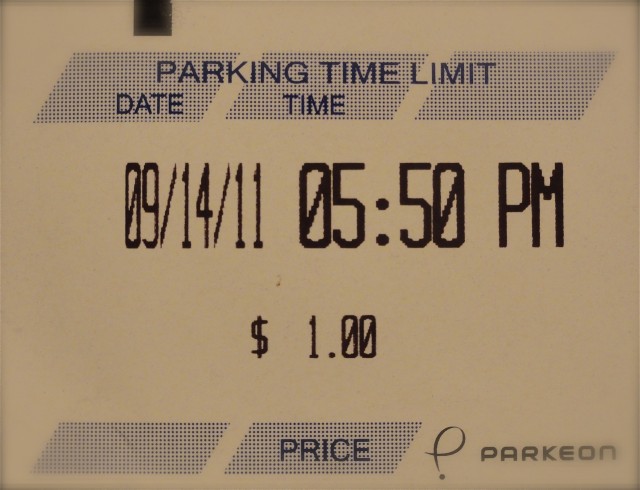
With the District turning to multi-space electronic meters that print out receipts that you then place in your windshield, these random acts of chance have started to go by the wayside. Once someone moves their car, they often take the receipt — and whatever time may have been left on it — with them.
But for every absent-minded driver there’s a kind-hearted philanthropist that believes in a certain social contract through which parking receipts are handed off to a waiting motorist, if for no better reason then to put the money spent — and the time it bought — to full use.
It happened to me just last Thursday on Capitol Hill. I was parked in a spot and standing by my car, and a nearby driver offered me what was left on her parking receipt. There was no real reason she had to do so; she had paid for her time, after all. But in a random act of vehicular kindness, she figured that the minutes she had paid for but not parked for could well be used by someone else — me.
The offer reminded me of how bus-goers used to do the same with Metro’s paper transfers, which were discontinued in 2009. One commuter would get on a bus, pay their fare and travel to their destination. Once they got off, they could easily hand their transfer to someone else — giving them two hours of free riding. The act, which the City Paper memorably called a “great fraud,” was one of the reasons that Metro did away with paper transfers altogether. Beyond the fact that plenty of people were riding for free, there was a healthy market in counterfeiting the things.
So how is handing off a parking receipt any different? Well, it’s really not. Someone paid for a temporary service — on-street parking — and is denying the city additional revenue by subsidizing their successor’s stay. But that’s how it has always been, though now it’s gotten a little more difficult. While you used to be able to rely on mere chance, you now have to hope for a willing donor. For every one driver that’s handing over those last 15 minutes worth of parking, there’s likely many others that drive away with them.
Also, it all somewhat breaks even. Cities love the multi-space meters because like their name implies, a single machine covers an entire side of a block. The District has 550 of the meters covering 4,200 parking spaces. The meters take credit cards and break less easily — and when they do break, they report the problem directly to DDOT. And because the meters don’t allow drivers to get lucky with remaining time, they take in more money. John Lisle, DDOT’s spokesman, estimated that multi-space meters see revenue increases of 25 to 40 percent relative to their old-school predecessors. Someone not only designed a machine that’s easier to use and maintain, but more likely to capture more money from drivers looking for scarce parking spots.
It’s not DDOT that enforces parking rules, though — that’s left to the D.C. Department of Public Works. According to spokeswoman Linda Grant, there’s no need to be worried. “DPW views the transfer of a parking meter receipt the same as a vehicle parking in a space where there’s still time on the meter,” she told DCist.
So, go ahead — pay that parking forward.
Got a burning question about D.C. that you want answered? Email us and we’ll do our best to dig through musty archives, make a load of phone calls and corner reluctant spokespeople. This isn’t Ann Landers or Dan Savage, though — we can’t help with your relationship or fetish.