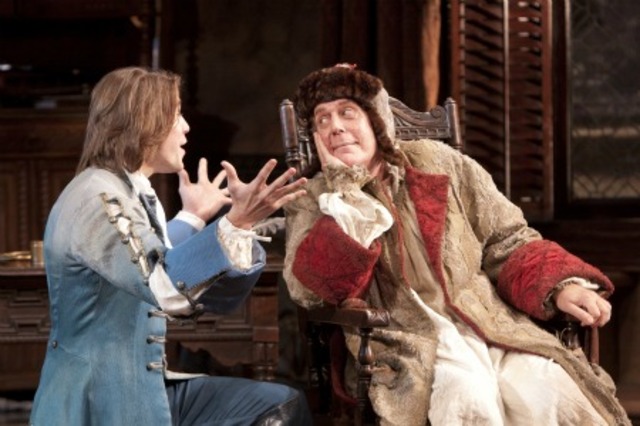
 Andrew Veenstra as Eraste and Floyd King as Geronte in the Shakespeare Theatre Company’s production of The Heir Apparent, directed by Michael Kahn. Photo by Scott Suchman.
How can you make a 300-year-old French farce that loses something in translation accessible to a modern English-speaking audience? For the Shakespeare Theatre, the solution is to simply re-write it with that audience in mind, and it works out quite nicely.
Le Légataire universelle (“The Sole Heir”) is one French playwright Jean-François Regnard’s best loved works, and here Broadway playwright David Ives updates the language while leaving things set in early 18th-century France. Eraste (Andrew Veenstra) is a young man looking to marry his love Isabelle (Meg Chambers Steedle). Eraste’s got plenty of earnest feelings, but not much cash. That’s where his ailing uncle Geronte (Floyd King) comes in. The old man is a respository for sickness, limping, coughing, and spitting his way across the stage when not evacuating the stage in as much of a rush as he can manage in order to evacuate his bowels. He’s also notoriously stingy, based on the run-down grandeur of the drawing room in which the play takes place, Alexander Dodge’s set suggesting once-great opulence overtaken by cheap neglect and hoarding.
All that penny pinching has left Geronte with quite a lot of pennies, and Eraste, with the help of the help — Geronte’s valet Crispin and long-suffering servant Lisette (Carson Elrod and Kelly Hutchinson) — he aims to be named Geronte’s sole heir. Once his inheritance is in writing, Isabelle’s fussy dowager of a mother, Madame Argante (Nancy Robinette) will agree to the marriage, and everyone can live happily ever after. The only problem: not only is Geronte not much inclined to leave his cash to his nephew, the moment he lays eyes on Isabelle, he decides he wants to marry her himself.
What follows is as wacky, insubstantial, and bodily-function-obsessed as any Adam Sandler vehicle. But it’s also clever and utterly enjoyable. Ives’ version is, as was Regnard’s, written in verse, an endless procession of rhyming couplets. Despite the period setting, the writer includse plenty of modern terminology, with references to plastic surgery, tweens, and the Lone Ranger. The pure, mad goofball tone of the whole thing makes it work — The Heir Apparent never pretends to take itself seriously.
Local theater luminaries King and Robinette are predictably excellent, but the show is really stolen by Elrod as the valet Crispin. He’s the idea man in all the scheming that’s going on, and the role requires broad physical comedy and changes of character as he adopts various disguises and personas (including, at one point, impersonating Geronte himself) in pursuit of the share of the riches Eraste has promised if he and Lisette can help him pull this off.
Amid the avalanche of wordplay, puns, and more nudges and winks than a Monty Python skit, nearly everyone here seems in competition to steal whatever scene they’re playing out. The actors are having such obvious fun with the material and with one another, it’s difficult not to get caught up. Sure, it’s nothing but a bit of good-natured silliness, but the only standard it needs to live up to is whether it provides consistent laughs from start to finish. By that measure, it succeeds admirably.
The Heir Apparent runs until October 23 at the Shakespeare Theatre‘s Lansburgh Theatre. Tickets may be purchased online.