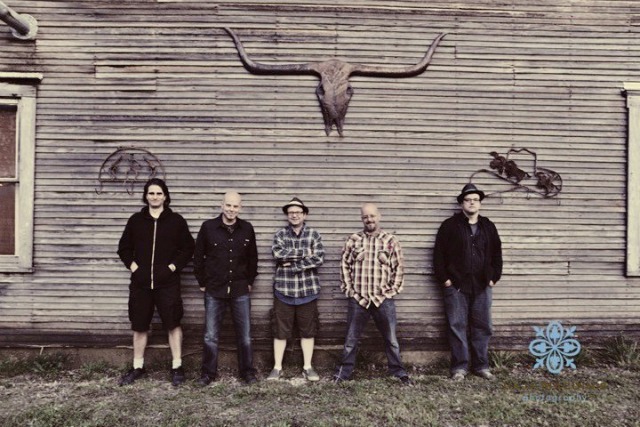
It may seem to anyone in their mid- to late-twenties that post-rock instrumental bands have always been a niche somewhere, creating walls of sound and toying with explosive dynamics. Tone will tell you that this is not the case. When Norm Veenstra and Greg Hudson started the band 20 years ago, they were very few bands without vocalists, which is how Tone ended up opening for many of the big names (Mono, Explosions in the Sky, Mogwai) of the expansive, cinematic sub-genre.
They’ve also been around long enough to see the landscape of D.C. music change, but they’ve also seen lots of familiar faces remain. With two decades under their belt and a new album on the horizon, the band, currently a five-piece, has invited some alumni members to play with them at the Black Cat tonight. We sat down with Veenstra, Hudson, bassist Shaun Wright, and guitarist Jackson MacInnis to talk about collaborating with a dance company, staying relevant as an older band and keeping their cliche buzzers functional.
Find them Online: On myspace and Facebook.
See Them Next: Tonight at the Black Cat with Caspian and Savage Republic. 9:00 p.m.
How did this run of Caspian/Tone/Savage Republic shows come together?
Norm: What started all this was sort of two things. Savage Republic got offered a New York show and originally we thought we were going to do the New York show with them as well. We’d fly out, do the New York show and then they said, “Can we get some other dates?” So we put some work into getting some other dates. Then their New York show fell on a Thursday which completely cogwashed it for us because Shaun, our bass player, is a professor at JMU now. So, he’s going to do these shows and he’s going to do our CD release party at the end of October and after that, he’s going to step out of the band for awhile because he can’t do it anymore because of the drive. So, New York falling on a Thursday killed it for us, but Vicky at the Black Cat was super amazingly cool and got this on a Friday because it fit with her schedule and Scott Verrastro who used to book shows at Velvet years ago who books some shows up in Philly was the one who put together the show on Saturday. It’s at a place called the M Room. We don’t know a lot about that room, but our friends, Caspian, have played that room before and said that despite being small, it’s a really nice place. It sounds like, based on the conversation I had with Caspian months ago, that it’s like what Red & Black used to be. Tiny, but it works.
Have you been to the revamped site?
Norm: I like Red Palace a great deal. I’m really impressed with it. The sound’s really good. The line of sight is really good. It’s a nice room. We’re pretty lucky in this town, actually, at this point. I’ve lived here twenty-one years. Greg and I are both ex-9:30 Club and so is Jack, from way back, so we’ve seen venues come and go. The fact that there are the potpourri of venues at this point in this town — a lot of people don’t realize how good they have it, because it didn’t used to be this way. I think the only thing we’re missing now is one or two more the size that Black Cat used to be/the size that the Hotel is, somewhere else, in a different neighborhood, so that it would be a catalyst for that neighborhood. I hope that it would be up here somewhere, like, upper Columbia Heights.
Or by Comet Ping Pong?
Norm: Yeah, we’ve played at Comet Ping Pong and we loved it. Sasha’s great. She’s a pro.
Greg: It’s great to get done with sound check and then have some of their pizza.
Shaun, what do you teach at JMU?
Shaun: I teach at the school of media arts and design. So, I teach production classes. Hopefully, soon, documentary filmmaking.
Who’s space is this right here?
Norm: This is the Tone rehearsal space. We found this — it must be close to ten years ago, now. It’s at least eight. We found it as a space for rent up here, convinced the property managing people that we were responsible, that we had a history of being in another space, so we could show that. And at the time, we were friends with a band that was a serious band in D.C., Phaser, that doesn’t exist anymore. So, it worked really well with two bands. They built a control room so they could record here. That’s what that used to be before we did everything on a computer. So, the two bands shared it for awhile and now we have five bands that share it, total. Everyone gets a different night.
Greg: There’s also a downstairs area with a bathroom. It’s not soundproof. So, there’s more bands downstairs, so we can keep this place going.
Norm: It’s a bunch of people that have been around long enough that know how hard it is to get practice space in this town.
I’m shocked that this exists where this exists.
Greg: Well, we got some resistance when we first moved in from the neighborhood council who had a different vision for the place. For the block as a whole. But, we got a certificate of occupancy. We did everything by the books and so far the neighbors on either side have been pretty cool. Mostly we do it at night.
Norm: Yeah, most of the businesses are daytime businesses with the exception of a couple restaurants. We don’t mess with daytime during the week that much.
Greg: Keep the landlord paid. Keep the utilities paid. So far, it’s been that easy.
Norm: We get water downstairs when it’s raining this much, but the bands downstairs built a platform to accomodate for that. It’s a tough town for rehearsal space.
And Tone has been a band for well before you found this space.
Norm: This is our 20th anniversary. When Greg and I were working at 9:30, we started this band in 1991 and went off and on at it for a number of years.
Jack: It’s never been off completely, though.
Greg: There were some gaps in there, but not tremendous.
Norm: We used to rehearse at a space that’s been torn down, since, Brookland Music Studios. It was over near where the dance place is and they’re building a new artist complex. We had a space there for years. It was tiny but it was great. It was by a railroad track, a dance studio and a car repair shop so there were never any neighbor issues although there were a couple of times where people were teaching classes in the front studio, so there were a couple times that we had minor issues, but I eventually sublet that to Guy and John Davis and Chris Richards back in Q and not U days when Guy was trying to get some music going, post-Fugazi stuff. Then, they tore the building down. So, now no one’s there.
You said that you’ve got an album release in a month. How long has it been since the last album?
Norm: Quite awhile. And a lot of factors played into that, unfortunately, but that’s the way things go in a band of older adults. Our new record’s coming out courtesy of the very fine The Kora Records. Douglas Smith and Mike Fink put out Meredith Bragg’s stuff. So, it’s going to come out sometime in October. At the show this coming week, we’re going to offer a deal where people can buy limited silkscreened posters or they can buy the poster and a certificate which will basically be a presale of the album. So, you’ll get the album mailed to you and you’ll get the download codes so that you’ll get the album sooner and you won’t have to wait until the end of October. The record’s called Priorities. We recorded it quite awhile ago. We recorded it, literally, Inauguration Weekend in January of ’09 in Baltimore in the fine Magpie Cage, the J. Robbins studio. We’ve done several of our records with J. He’s a long-time friend and someone we very much trust with understanding what it is we’re trying to do when we record. Our last album was on Neurot which is the in-house label for Neurosis from San Francisco.
Greg: And the recording actually features the larger ensemble, some of whom are coming back to do the 20th anniversary show with us. So, the album is a seven-piece.
Norm: We’ve been a five-piece since Jack joined in ’08. So, it took us awhile to figure out whether we were going to put the album out with Neurot. It ended up not working out, so, we pursued some other labels. Out of that pursuit, which took time, we went to SXSW, we put ourselves out there and ended up sticking with the people we knew already, which was Douglas. So, we’re really excited about it. We’re doing this 20th anniversary show on Friday and we’ve got the record coming out in October. We’re doing a show at Iota for that.
We’ve been doing this a long time and when we first started, there weren’t a ton of instrumental bands. Don Caballero and years later, Dirty Three and a couple of others. Then, at the tail end of the ‘90s, Mogwai showed up on the scene. Then, a little bit after that, Godspeed. We opeend for Godspeed. All the bands you’ve heard of now, we opened for. We opened for Godspeed at the 9:30 to 150 people. We’ve played with Explosions three or four times on the first two tours. We played with Mono a bunch. We played with Maserati a bunch. We were the D.C. instrumental band that’s been around for a long time so, when these people go out on their first tours, they’re like, well, we’ve got to find someone to play with us locally. Some of thes bands found us. Maserati sought us out. Mono — a friend of mine tipped me to Mono so I got in touch with their U.S. manager and made it clear that if they need help with D.C. that they please keep us in mind. So, I stuck my nose into it with them and got some nice shows with them. But then, no one ever calls us back.
Greg: Well, they spend their lives touring. We go back to work on Monday.
Norm: All of these guys have kids.
Greg: We’re trying to strike the balance of still being able to do this and be relevant while having careers.
How is that working for you right now?
Greg: Fantastic until he moved to Harrisonburg.
Shaun: Career wise it was great. Band-wise, it wasn’t.
Norm: Our new record is called Priorities and there’s a slight component of the title that plays into the theory that it’s never a perfect balance, but you keep doing the best you can with all of it. And I don’t mean just playing in a band. I mean the whole picture. How you keep going in your life with things happening. We’ve all had some tough stuff.
Greg: I totally regret seeing, when I worked at the 9:30 Club, people who totally impressed me playing and then stopped. They stopped because they moved out to the ‘burbs and tried to make rent and ultimately put their instruments down and that depressed me. We don’t want to do that so we keep playing. We can. When my daughter looks at a photo album she’s not going to go, “That was you? You played drums?” No. My daughter comes and watches us play. She came to Europe when we went to Europe and played shows. She’s been all over to see us.
How old is your daughter?
Greg: She’s five. So, she’ll be raised with this. My wife’s a dancer. Dad still plays in bands. So, this won’t be a foreign thing to her. And same with these guys.
Shaun: Probably the most nervous I think I’ve ever been was when both of my kids came. They’re six and four. When we played Harrisonburg. And they were right up front. I actually thought if we gave them earplugs that they’d only listen to a couple of songs but they just stayed.
Jack: They were mesmerized.
Shaun: My wife always laughs and says, “I’d never seen you smile so much when you play.” I guess I usually have this look like I’m exorcising demons or something.
Greg: What’s great was that behind your kids were these guys headbanging.
Shaun: It was great though and I know it will stay with them. It’s great to be at a certain point in life and be able to play music that’s relevant and not be in like, a cover band.
Has that ever been a concern of yours? Staying relevant?
Greg: Individually we all had to hit the point and then work through it where you ask yourself, “Okay, I’m X age and there are so many new bands with younger kids doing what we do, very similar to how we do it. So what does that mean?” Then you get to the point where you’re like, “Oh…nothing” and we just keep doing what we wanted to do. We don’t have to think about it too hard at all as far as the music we’re playing. That’s easy and that’s natural and we keep playing. We’ve never had to sit around as a band and wonder, “Okay, are we doing the right thing?”
Jack: I agree completely. I think we have a low threshold for cliches. I think that’s a goal that art should have in general that you should have a cliche buzzer that says, “Holy crap! Run from that cliche!” I think in the music I write and that I’ve always played and listening to Tone over the years, I think they have a way of sidestepping real generic things and creating new stuff. I think when you’re younger it’s easier to not even see those cliches. When you’re a really young guy starting out, you just play whatever you can play. But as you get older, you have a bigger palatte to choose from, so you have to be careful that you’re tuned into that cliche buzzer.
Greg: And being born when we were born we got to grow up with some ‘80s punk and other music that at the time, no one was going to get older. And now, the people that we grew up with are either more or less still doing it or they’re reforming. Whether it’s Marginal Man or whether it’s J.’s project. Any of that stuff. It’s like, “Whoa, okay. Do we have to stop? No.”
Norm: J’s never stopped playing and his own standards have been fantastic and meticulous and consistent and it shows in every project he’s been a part of. He’s never been a part of something that wasn’t completely quality in what it was trying to be. All these bands are good bands.
I want to address the question in a slightly different way. What’s neat for us is that because there are so many instrumental bands now vs. ten, fifteen years ago when it was more rare is that we freed ourselves up a long time ago as far as not really giving a shit about who we played with, in terms of, oh, they’re too new. There’s no high school elitism about any of that. If they’re an instrumental band or something vaguely in that rock kind of scenario where we think it fits, we’re pretty psyched to play with somebody. So, we end up being the old guys who roll in and bands are like, “What’s this going to be?” and look at us funny, initially. Then, we do what we do and it all goes away. I don’t know what to call that phenomenon, but it’s a neat thing when it happens.
Jack: I remember Leslie West came in the studio one time and he shared a stage with Hendrix. And he’s about 80 and he played with more distortion than I’ve ever played with. They started this stuff a long time ago, so, I know we think we’re old, but, relative to when this stuff really started, in the ‘60s. I mean, Jimi Hendrix was modding these amps to make them explode with distortion. We’re so tame, and, I hate to say “less creative than Hendrix,” but, yes. People like that really broke the door down a long time ago.
Norm: Your point speaks to the sonic aspect of it. Then, a lot later on where those of us in our age bracket, we’re all basically in our 40s, we lived through punk, post-punk, industrial when it was really industrial music. So, we saw a reinvention of what was possible. Anything could be an instrument. Anything could be music. Anybody of any skill level could play. That kind of thing. There’s a little bit less of this now, but there was music in the ‘80s that was dangerous. There were things where you didn’t go see it because you were grooving, and there’s nothing wrong with going to see bands that groove. Greg and I are big techno-heads.
Jack: I did not know that.
Norm: But there’s an era there where music was dangerous and confrontational. I’m not saying all music should be that way but, on the relevance tip, I think bands deny someting that they shouldn’t deny. I don’t deny it. When you’re in an active band, you pay attention to what’s out there. Somewhere in there, you’re a music fan. If you’re a band just to listen to your own music — I have nothing against you if that’s the case — but I just don’t believe it. I just don’t think it’s all that likely. It was an interesting experience for me to learn as somebody who worked in the music business first and then played where you have your palatte of things that you like and you learn how to play and you pay attention to what’s happening contemporaneously at the same time. That had an effect on us where we had certain things that we wanted to sound like or emulate but then things happened while we were playing and that continues to happen to us where if you keep up with new music, there’s no way it doesn’t permeate through how you play or how you approach things. I don’t mean in a plagiarism sense but more in a cultural filtration kind of way.
Greg: I don’t have an issue with the current music scene. I love a lot of what’s out there. There’s a lot of people bemoaning it. There’s great stuff out there and I’m totally influenced by it.
How many people will be playing onstage with you for the 20th anniversary show since you do have some people coming back?
Greg: It’s a total of nine, right? If you count all of the guests, it’s five plus four.
How many will be onstage at any given time?
Greg: Five to nine.
Jack: It might be nine before the end of the show.
Norm: Let’s do it this way. Tone is a five-piece band, currently. We’ve invited back several key members for certain songs. So, it’s eight unless Doug comes up and does Moonpony at the end. Which we’ve talked about but didn’t practice. So, there’s a chance that it’ll be nine by the end.
Jack: Unless Caspian gets onstage.
Norm: We had talked about doing a song with Caspian. We’re friends with those guys. But there’s just not enough time. Solidarity, the Neurot album that came out in ’05 or ’06 — there’s eight people on that record. And the Dischord album that we put out before that, that’s seven. And Structure has a bunch of guests on it. We called that the expanded ensemble. We had the multi-guitar thing and for awhile we had two drummers. But, this show will start out as the five-piece that we’ve been for a couple of years now and will be after this show. It’ll be just the five-piece going to Philly. But, by the end of the show, it looks like it’s going to be eight or nine. It’s just the people that have been in it for awhile. The seven and eight piece lineup was for a long time. The two drummer thing was between 2000 and 2009. Steve was in the band for eleven years. Jordy was in the band for more than that, probably. I’m not quitting ‘til he [Greg] quits.
You two started the band?
Norm: Yeah.
Greg: And we’re getting a good enough cardiovascular workout from this stuff.
Norm: It’s cheaper than a trainer.
And you met working at the 9:30 Club.
Greg: Yeah. He hired me for a job where I was supposed to be 21. This is when I realized that one of the most thorough and detail-oriented men in the world missed that. So, I’m just doing my job, saying, “Hey, you can’t be drinking, get out of here.” And they’re like, “Wait a second, you can’t be telling them that they can’t be drinking!” So, they fired me and then they brought me back to do a different job after a couple of months. They’re like, “Okay, you can do THIS.”
Norm: Making pizzas.
Greg: We were just sitting around, shooting the shit, talking about the bands we like and next thing we know, we’re in the basement of a group house in Silver Spring.
Norm: We rehearsed there for awhile.
Greg: Trading records. Trading influences. Savage Republic was one of them. Sonic Youth.
Norm: Helmet
Greg: Jesus Lizard was around, then.
Norm: We got to open for them once.
Greg: Twice! Twice!
Norm: We’ve opened for a fair number of people. We can’t complain.
Greg: The thing about Tone with its rotating roster of people is that everybody who was in Tone had other musical projects as well. Tone has just been the constant for so many of us for all these years, which is why we figured that this is worth celebrating.
So, will you be culling your Black Cat set from several different albums?
Greg: It’s more looking forward than it is a retrospective because that’s the movement that we’re feeling right now. So, there’ll be some older stuff, but a lot of it is new material and stuff that’s from the last two records.
Norm: There’s a nice amount from the forthcoming record and we’ve been very fortunate that we happen to have been discovered by an international dance company that happens to be based here in Arlington called Bowen Collie Dance. We did performances with them in 2004, 2006 and just this past March that we performed at the Kennedy Center for a piece that they choreographed around some of our work.
Greg: Which was cool because we were like the orchestra in the pit.
Norm: There’s some excellent YouTube footage! That’s youtube.com/tonetheband. This past calendar year was their fifteenth anniversary so they pulled in some of their big hits and our piece was one of the ones that they were very excited about doing. So, we got to do it again. So, there’s a component of the songs that make up that work that’s in here because we got to do it again recently. It’s fresh for us again.
Greg: And Jack didn’t get to join us the first time around and he totally stepped up.
Jack: I’m the freshest, newest perspective. I remember seeing them start at the old club.
Norm: We opened for Wire and that was ’08. And that was Andy and Steve’s final show. Jack saw that show. The three of us had known each other for a long time because Jack had worked at the old club, too, years ago. Jack’s a senior engineer at XM, currently. So, I followed up with Jack after that show and said, “Hey, we’ve just had a big shift in personnel.” So, he started playing with us in ’08 and his first show was April ’09.
Jack: They lose three people and I come in and I’m supposed to fill all that space. It’s been hard. It’s hard to play parts that have already been pre-determined many years ago and then actually try to smoosh them together as one part without another drummer. We had to write a bunch of new stuff in the new five-piece.
Norm: Going to a five-piece wasn’t the plan. It was something that happened and Jack’s quality, what he brought to the table, was part of what made it happen. Playing with Andy, having a second drummer wasn’t “Oh, we want a second drummer!” He was a really good friend of ours who was open to the idea of trying it and then it gelled and worked really well for a long time, for nearly a decade. Once, that stopped happening we had a couple other drummers that we knew as friends that we wanted to talk to and it wasn’t the right time for them, so we forged on. Greg’s a fantastic drummer. Unfortunately, because we’ve been this instrumental band at a time when that was sort of strange and because at one point we had a lot of guitar players, we get sort of pegged by that. The reality is that this is a band where the instrumentation has changed a lot over time. It’s never been exactly the same thing. Yes, it’s always been instrumental. It’s always been rock based. We don’t write like a rock band. We don’t think so, at least.
How would you say you write?
Norm: I think it’s a little closer to a chamber group where there’s no solo, there’s no interest in solo, there’s no attempt at a solo. With chamber work, and I’m not enough of a musicologist, but first violin isn’t one instrument, it’s a group of instruments and second violin and so forth. And they’ll write parts that blend and compare and contrast and so forth. I think our writing is the same way where the only thing that ever comes close to being a solo is the dynamics. Dynamics are incredibly important to us.
Greg: You see that on movie scoring. That’s incredibly important to us, too. We’ll write on themes and end up building it and repeating it and then seeing where it goes. So, it’s arranged less like a rock song and more like a classical composition.
Jack: I’ve played in a lot of situations with people where you have open-ended areas of music that almost every band plays something different every night a little bit. But this group is composed. You’ll hear this wall of noise for awhile but then you’ll hear this stop break in it and you realize, “Oh. Holy crap. They’ve been counting.” There’s a lot of thought behind the wall of noise. It’s not just noise for noise’s sake. It’s very thought out beforehand.
Greg: We’re about as far from the jam band side of things as possible.
Sean: There were moments in things that have space, but it’s still pretty structured.
Greg: Wine and beer at the rehearsals, not pot and acid.
You said you went down to SXSW this past year. Was that your first time?
Greg: It’s the only time we’ve ever been.
Norm: We went to SXSW 2010.
Greg: It was the only time we’d ever applied and it was a blast.
Norm: That fact that we were a five-piece, it was a little bit more viable on the logistics level. And being the five people that we were, we were able to negotiate professsionally and domestically to make it work. So, we applied and they took us which we’re all still kind of shocked by because, yeah, we’ve been around and we have records out but we’re not The National or something like that who tours all the time. So, we were accepted and one of our main reasons for going was that we were still very much in the finding a label hunt and we knew we’d get to play in front of some people from Mylene Sheath, Caspian’s label, and a few other people we wanted to play for as well and it was a fantastic experience. It’s expensive. It’s a ton of work. But go at it with two things: one — your own gig is a priority and any other gig you get to see is just gravy, is just bonus. And also, you can’t go at it at the pace that many people who are there as patrons go. You have to downshift it. At least I have to.
Greg: There’s the official SXSW gigs and then there’s the unofficial gigs.
Sean: One of the things that was pretty cool was that a writer from the Rolling Stone magazine was at the show. Because they were doing 100 things you must see over SXSW and we were on that list. We were on the main Rolling Stone web page. We were like 90th?
Norm: 91.
Jack: It was in order, right?
Greg: It was in the order he saw them. And we were on the last night. We were the first band he saw on the last night.
Norm: “D.C. guitar army makes an outdoor show sound like an indoor show.”
Greg: And it was one of those weird Austin days where it was like, 50 degrees.
Jack: The wind was crazy. We were buying hats in stores right before the show.
Greg: I gave Jim my sweatshirt so he wouldn’t die.
Norm: It was cold, it was hard but it brought out really good adrenaline for us. We played fantastically well and it was really cool with our music. Our music has, we hope, this really epic, grand quality to it in places and it was really neat to see Mother Nature finally catching up! We were playing and there was wind blowing and trees moving and it was seven o’clock so it wasn’t dark yet. So, I’m like, I’m cold, but this is worth it.