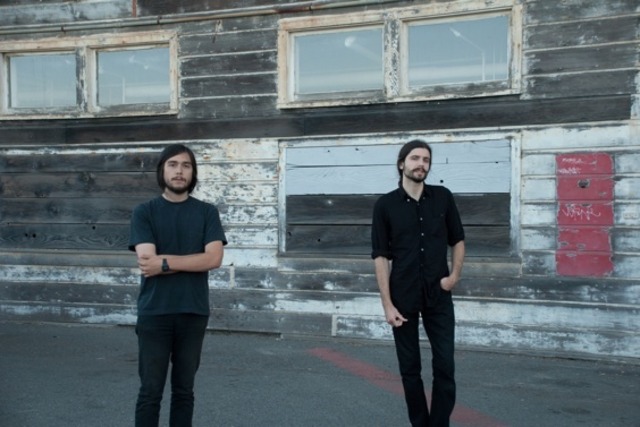

San Francisco’s Barn Owl, the project of Evan Caminiti and Jon Porras, demonstrates the extent to which two guitars can envelop a room. Although the duo had some help from friends on percussion and bass clarinet for their latest LP, Lost in the Glare, the album’s sound centers around building upon a consistent slow drone. Theirs is the sort of music that conjures up dark, sinister landscapes. Don’t close your eyes during their set at Pyramid Atlantic this Sunday night if you don’t want to be transported from the safe confines of Silver Spring, Maryland.
Caminiti and Porras took a few minutes out of their touring schedule to talk to DCist about the differences between American and European audiences and why there can be more than one Barn Owl.
You guys will be on the final date of another festival when you come through D.C. Had you heard of Sonic Circuits previously?
Evan: No. We were not aware of it before the show.
Jon: It was something our booking agents set up for us.
What other sorts of bands have you gotten to play with on your recent tours?
Jon: In Montreal we played with The Necks who were great. In Vermont we played with Toby Aronson who runs a tape label called New New Age Tapes. Then, at the Hopscotch Festival there were all kinds of bands playing. On our stage in particular, we played with David Daniel who’s also released a few records on Thrill Jockey with solo guitar stuff and also really great. So, those were some highlights.
Evan: For me, it was really awesome playing with The Necks because they’re from Australia and it’s rare to be able to see them. They’re sort of a minimal jazz trio in a way. It’s just piano, bass and drums. They do really sort of interesting textural work that you never really hear anybody else with that same configuration of instruments create.
You guys have toured Europe off this album, right?
Jon: In April and May. We’re going back in October and we did this Polish Festival in August.
How are European audiences different than the American audiences that you’ve seen?
Evan: It’s kind of interesting because in Europe, the age demographic is much wider. I feel like we’ll see some older folks at Europe at the shows that maybe we wouldn’t see in the States. In the States, it’s a little more of a younger crowd. That’s something interesting we noticed.
Do you also play with different styles of bands in Europe?
Evan: It’s usually pretty similar. People try to find the commonalities between the projects. It’s cool in the essence that you get to tour with people who don’t tour themselves, so, you’d never really get to see them unless you went to Europe. They’re definitely two wholly different experiences. I don’t know if there’s a greater appreciation for experimental music, but we tend to have bigger turnouts in Europe. That could also be because we’re from the States. We’re exotic. We’re from far away. I’m not sure if it’s that or if there’s a wider appreciation for our kind of weirder music.
Jon: I think there’s a greater appreciation, or people just have kind of an open mind who like weirder types of music. Whereas, anywhere you go in the States, you have a small diehard following, but it’s not necessarily wide reaching.
You have a third member playing drums on your album. Is Jacob able to tour with you?
Evan: No. Unfortunately, no, Jacob isn’t touring with us. He’s more of a collaborator. Also, we had our friend Michael Elrod play tambora and another friend of ours played bass clarinet. So, for the record we invited a few friends to play along with us. If we could, we would bring them all along, but unfortunately we’re not quite there, yet.
Do you ever try to recreate any of the sounds they added to the record in a live setting?
Evan: We have effects pedals and we try to make the range of our guitars a little bit wider using them. But even with effects pedals it’s difficult to recreate the sound of a tambora or drums or a clarinet, but we do our best to bring together a rich live set. As much as we can do with two guitars, we try to stretch out the sound of a guitar as far as possible, so we can do things like play some lower register type stuff. We’ve got a fuzz pedal which can make it sound like a bass clarinet in a way, but we don’t necessarily aim to mimic those instruments exactly.
Have you ever had people collaborate with you when you’re on the road?
Evan: Not really.
Jon: Not really, although I guess we did collaborate with Stephen O’Malley in Paris back in April. But we usually will collaborate with folks at home, friends from the Bay Area.
Is there a good experimental music scene in the Bay Area?
Evan: Yeah. It’s small. It’s a bit isolated. But there’s stuff happening there. It’s not like there are shows every week but there are always bands touring through San Francisco so that gives us experimental bands opportunities to open for them or play with them. But, there is a scene there, yeah.
When I google “Barn Owl band” I found a very different group of people.
Jon: Is this the twenty person banjo ensemble?
Yes! Has that ever caused confusion for people?
Jon: Yeah, I’ll have family members say, “Yeah, I looked up your band. I had no idea you played banjo.” I think we’ve emailed in the past and we’re cool with each other, so, it’s friendly. There can be more than one Barn Owl, I guess.