Martin Austermuhle
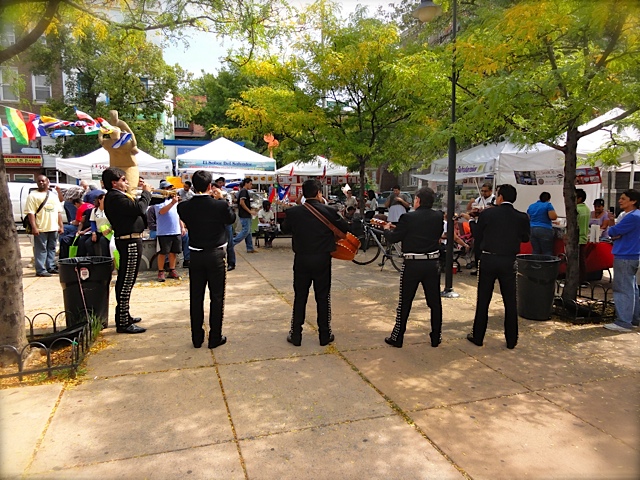 A mariachi band plays at the final day of Unity Market in Adams Morgan, where 17 vendors sold Latin American food since 2008.
The mariachi band matched the somber mood today at Unity Market in Adams Morgan, playing songs of love and loss as customers lined up to eat their favorite Latin American specialties for the last time.
After today, the market, which has been there since 2008, will be no longer. A legal agreement that allowed the 17 vendors to stay and sell expires tomorrow, leaving cooks to fret over the future and customers to complain of yet another good idea derailed by city bureaucracy.
Unity Market was born of necessity. Many of the vendors had long sold their wares in front of the Sacred Heart Church at the intersection of 16th Street and Park Road NW, but periodic police fines led the D.C. Office of Latino Affairs in 2008 to relocate vendors to Unity Park, an otherwise uninspired triangular plot of land bounded by Columbia Road, Champlain Street and Euclid Street. Under a memorandum of understanding signed by the Department of Parks and Recreation, which has control over the park, vendors were allowed to sell traditional foods otherwise not widely available in Adams Morgan on weekends, provided they acquired all necessary licenses, paid taxes to the city and attend financial literacy classes.
It wasn’t long before some local restaurants started complaining that the vendors enjoyed a competitive advantage that ate into the bottom lines of brick-and-mortar mainstays — the vendors paid no rent, skipped out on taxes and weren’t consistently inspected. (A similar fight is heating up over food trucks.) The market remained, though, buoyed by support of residents and a local Advisory Neighborhood Commission, which in September 2010 approved a resolution siding with the vendors. (The same ANC had supported the establishment of the market in 2008.)
Like much in the District, though, things got murky from that point on, notably as a transition began between Mayor Adrian Fenty and Mayor Vince Gray. George Escobar, who served as the Office on Latino Affairs’ deputy director under Fenty, placed the blame squarely on Roxana Olivas, who became Gray’s choice to lead the office. He said that Olivas replaced the market’s manager with an ally, ended Saturday sales (the most profitable day for vendors) and otherwise opted not to continue the market — a choice that was “hers and hers alone.”
Olivas, though, argues that the law is simple — it’s illegal to sell in a public park, and at no point during the program’s first two years did city officials or members of the D.C. Council work to change that. Additionally, the market was supposed to be a two-year pilot program, during which OLA spent over $150,000 on vendors to help them become entrepreneurs and move into traditional restaurants.
“I wish [Fenty officials] would have pursued the right licenses the first year. I wish they would have gotten an executive order; let’s get emergency legislation to get these vendors a license or let’s get legislation to permit commercial selling on a park. I wish that would have occurred, but that never happened,” Olivas told us. She added that she was working to move the vendors to a private parking lot along 14th Street NW, but that some had opted out any negotiations altogether. (The Examiner’s Jonetta Rose Barras said in a recent piece that Escobar had been working to organize vendors against Olivas; he rejects the charges.)
Regardless of who’s to blame, many of the vendors at the final market day were saddened by the impending closure. Elizer Segui, a 22-year resident who sold Puerto Rican specialties at the market for the last 15 months, called the market’s shutdown a “devastating blow” and said he didn’t know what was next.
For Pablo Lazaro, who has run Viva Mexico: Cocina Mexicana for the last three years, the loss isn’t just on vendors, but for the community too. “It’s a shame, because it’s the only Latino market that exists in Washington that Hispanics really come to and find foods from their countries,” he said. Though he admitted that restaurants had complained and put pressure on vendors to leave, Lazaro argued that they catered to a different consumer — local workers that couldn’t afford restaurants. “I’m going happy, and I’m going sad,” he said.
Maria Isabel Guevara, who started selling mangoes in front of Sacred Heart before being moved to Unity Park where she began cooking Salvadoran dishes, said that she’d likely end up in front of the church again.
“We have to survive,” she said.
Update, 6 p.m.: According to the Greater Washington Hispanic Chamber of Commerce, which helped manage the market, seven vendors have agreed to move to a privately owned location at 3505 14th Street, NW staring in mid-October. Four vendors remain undecided.