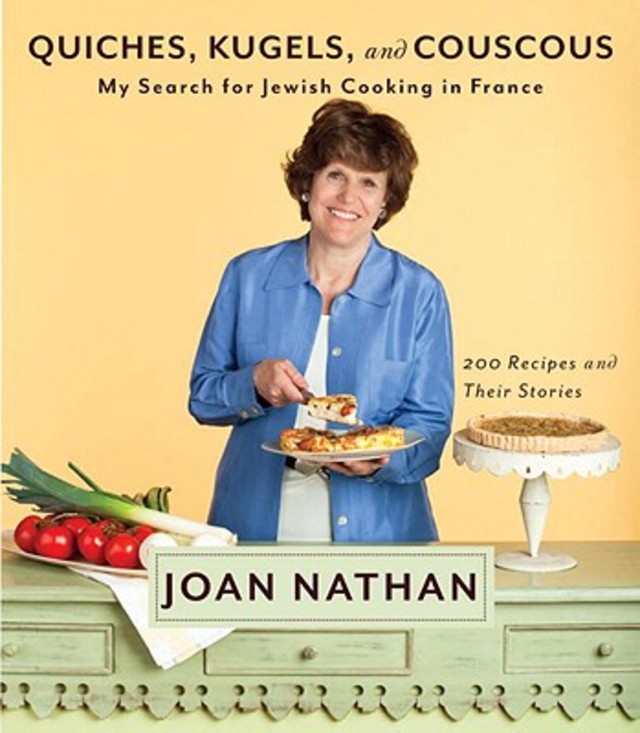
 “You really think so?”
Joan Nathan asks this earnestly when I use the words ‘food world luminary’ to describe her.
When you think of the stories behind Jewish foods and culinary traditions, you think of her, I explain. She’s the preeminent authority on the delicious subject. So, yes. Past cookbooks of hers such as Jewish Cooking in America, The Foods of Israel Today, several holiday books, and the subsequent television and radio programs she’s done and regular articles she writes chronicle recipes contributed from Jewish peoples across the globe and the rich stories behind them.
Nathan, who lives in Washington, sat down with me for an interview before the start of Rosh Hashana. After offering some slices of challah bread as a snack (along with being a cookbook author, she’s ever the Jewish mother), I relish the delays, stops and starts of our chat as a glimpse into the life of the writer-cook-book promoter. Her assistant has set the table for a small dinner she is hosting that evening for another food journalist and is boiling down apple cider for the main dish of ancho-cider glazed hens. With her assistant and an intern, it’s the home kitchen in which she tests all the recipes that go into her book. She compiles an guest list for an event in Paris around her book. Will the Rothschilds come if she invites them? Can the furniture delivery men place a new couch one more inch to the left? Does she have time to run a few extra errands before dinner that evening and leaving for Martha’s Vineyard for the Jewish New Year the next day?
As with other cookbooks of hers, an expansive introduction serves as a historical primer,
getting into the arrivals of different populations of Jews in the country, the foods and traditions they brought with them, and how France influenced these traditional dishes as people have assimilated. Recipes are peppered with anecdotes, both from the author and her subjects, and asides that draw you into the people and families who have passed them down and now passed them on through the cookbook.
She also suggests a smattering of sample menus for shabbats, holidays and other occasions borrowing from Alastian, North African, French and Pan-French traditions that are the heart of her search for Jewish cooking in France. A favorite of hers that would work great at your Yom Kippur breakfast is Tarte aux Quetshes, an Italian Plum Tart from the Alsace-Lorraine region:
Crust
1 cup all-purpose flour
1 tablespoon sugar
1/8 teaspoon salt
1 stick unsalted butter or margarine, cut into 8 pieces
1 egg yolk
Filling
3 tablespoons plum or other fruit jam
1 tablespoon brandy
1 1/2 pounds Italian blue plums
1/2 teaspoon ground cinnamon
1 teaspoon grated lemon zest
1/4 cup sugar
1) To make the crust, pulse the flour, sugar, salt and butter or margarine together in the bowl of a food processor fitter with a steel blade until crumbled. Then add the egg yolk, and pulse until the dough comes together.
2) Put the dough in the center of an ungreased 9-inch tart pan with a removable bottom. Dust your fingers with flour, and gently press out the dough to cover the bottom and sides of the pan. Refrigerate for at least 30 minutes.
3) Preheat the oven to 450 degrees, and bake the crust for 10 minutes. Reduce the oven to 375 degrees, and bake for another 5 minutes. Remove the crust from the oven, and let cool slightly. Reduce the oven temperature to 350 degrees.
4) Mix the jam with the brandy in a small bowl, and spread over the bottom of the crust. Pit the plums and cut them into four pieces each. Starting at the outside, arrange the plums in a circle so that all the pieces overlapp, creating concentric circles that wind into the center of the pan. Sprinkle with the cinnamon and lemon zest.
5) Return the tart to the oven, and bake for about 30 minutes, or until the crust is golden brown and the plums are juicy. Remove the tart from the oven, sprinkle on the sugar, and serve warm or at room temperature.
Joan Nathan will be at the National Geographic Society tomorrow evening (Tuesday, October 4) at 7 p.m. to talk about her latest book Quiches, Kugels, and Couscous: My Search for Jewish Cooking in France with a reception and tasting of some of the recipes to follow. Tickets are $48 and can be purchased in advance or at the door.