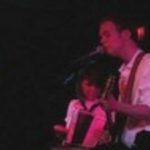
Only two songs had passed in Jens Lekman‘s stripped down set before he realized that something was amiss. Lekman proceeded to explain in his charming deadpan that as honored as felt to be playing the historic Sixth & I Synagogue, the room was filled with echoes and he and drummer Addison Rogers could barely hear what they were doing.
“If all of you could just make a human pyramid to absorb the sound,” he quipped. “Or sing along to this next song,” which was “A Sweet Summer’s Night On Hammer Hill.” The crowd obliged with some “bum ba bum ba bums,” but seated austere venues are not conducive to uproarious singing and dancing.
That said, this wasn’t going to be 2007’s celebratory night anyway. Lekman had no cute backing band with matching white embroidered blouses, and at least half of his monotone banter between songs dealt with a painful breakup after a two-year relationship. Therefore, the song turned into something of a tell-all, a comprehensive “Behind the Music” of all the new songs he had written.
That’s not to say that the stories were universally sad. For every song about wanting a new pair of cowboy boots (for walking away from his former love), there was a song like his ode to Kirsten Dunst. Apparently, upon figuring out that Dunst visiting his hometown of Gothenberg, Sweden, Lekman went to a club where she was rumored to make an appearance — only she did not get in because, as he sang in the chorus, “there are no VIP lines in Gothenberg.” Yet, regardless of whether the topic at hand was a breakup or a famous actress, the songs were delivered with the warm love-worn treatment for which Lekman has become renowned.
Yet, after a night of alternately humorous and heartbreaking love songs (his performance of “Black Cab” was goosebump-inducing) he finished his set with a return to blissful cuteness, letting his sampler play the melody of “Opposite of Hallelujah” as he pranced around the stage with a tambourine and pantomiming the final xylophone notes of the song. Lekman ended up doing two encores, and during his final number, he conducted the audience to provide the percussion and backup vocals to “Pocketful of Money”.
As music reviewers start hitting their late twenties and early thirties, they often secretly hope that “our last song” really means “our last song.” Buts Lekman could have performed a third or fourth encore and thrilled any cynical patron in the sold out venue.