DCist’s highly subjective and hardly comprehensive guide to the most interesting movies playing around town in the coming week.
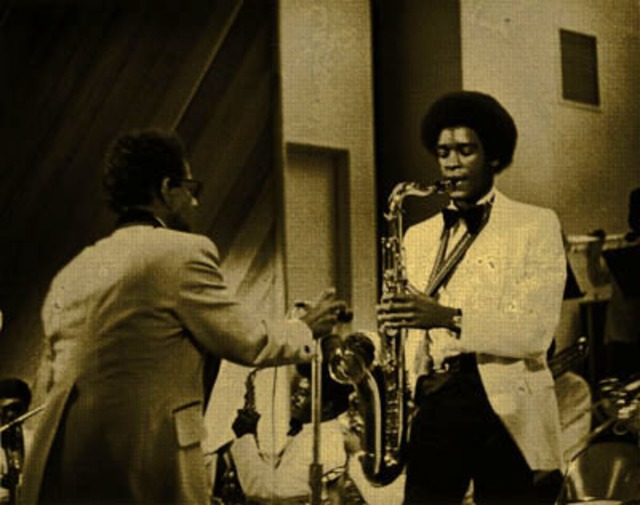
 Conrad O. Johnson conducting the Kashmere Stage Band
What it is: The inspiring story of an unlikely funk success.
Why you want to see it: Director Mark Landsman hits one out of the park with his feature-length documentary debut. Thunder Soul documents the history and reunion of a legendary 1970s funk band that happened to be made of high school students. At the end of the 1960s, band director Conrad O. Johnson took charge of the music department of Kashmere High, an all-black school in Houston, Texas. He instilled his students with a sense of dignity, discipline and showmanship, and with his own stirring original compositions and arrangements he turned the Kashmere Stage Band into an international success. The stage band scene grew out of the big bands but with a pop bent — think early Chicago or “Spinning Wheel” played in velvet suits. The bands were typically very square and very white, but Johnson proved that expert musicianship, both professional and soulful, could be achieved by inner-city kids — and that they could blow away the competition. The film is told in vintage footage and photographs of the band along with contemporary interviews, as well as a look at the rehearsal process of the band’s reunion for their 92-year-old prof.
You may have never heard of the Kashmere Stage Band, but the film opens with a sound clip that may sound familiar. It’s DJ Shadow, working with Handsome Boy Modeling School. Josh Davis (a.k.a. DJ Shadow) appears late in the film to explain that when he found that drum break (from the funky theme song Johnson wrote for Kashmere High) he had no idea he was listening to a student band. A hipper director might have taken the DJ Shadow angle and framed the entire story around it, but thank your documentary stars that Landsman focuses on Kashmere itself and treats the rediscovery of the music as a sidebar. It is an important sidebar, as the music reached an audience far beyond the Houston community that spawned it. Interviews with record label owner/”funk musicologist” Eothan Alapatt tell the story of rediscovery, as he tracks down the albums in thrift shops and is eventually introduced to Conrad O. Johnson and his treasure trove of master tapes. A CD compilation of the Kashmere Stage Band’s music band was, as Alapatt put it, popular with “middle-aged white people.” It climbed as high as number 3 on the Amazon charts, and if Thunder Soul has the legs it deserves, their numbers will be going up again. The reunited band is available for gigs, although many of the reuniting band members had not picked up their instruments in more than thirty years. You hear those missing years in the early rehearsals. But then the voices come together again in unity and all is fight and funky with the world. (Note: I could insert an Amazon link to the CD, but ask your local independent record store — if Melody Records doesn’t have it in stock, I bet they can get it).
View the trailer.
Opens tomorrow at E Street and the AFI Silver.
—
 Saigon Electric
Asian-Pacific American Festival
What it is: A staple of the D.C. festival circuit since 2000.
Why you want to see it: The D.C. APA Festival opens tonight with the U.S./Vietnamese production Saigon Electric, a dance-heavy film that sounds like it’s in the tradition of the Step Up series, but is probably a lot fresher. Other highlights include the shorts program Dance, Love, and Donkey Kong (Saturday, October 8 at the Goethe-Institut); a documentary about Chinese American actress Anna May Wong (Saturday, October 8 at the Freer, followed by the documentary Big in Bollywood); the neo-noir Girl from the Naked Eye (Saturday, October 8 at the Goethe-Institut); and Cape No. 7 (Thursday, October 13 at E Street), about ups and downs in the world of Taiwanese pop.
View the trailer for Saigon Electric.
October 6-15 at venues around town. Check the festival site for details.
—
 Edie Sedgwick in Lupe.
What it is: One of the last films Edie Sedgwick made with Andy Warhol.
Why you want to see it: In conjunction with the exhibit Warhol Headlines, the National Gallery of Art is programming a series of the wigged one’s 16mm films through the fall. Saturday’s feature is the Lupe (1965), starring the ill-fated Edie Sedgwick as the equally ill-fated Lupe Vélez, a starlet known as the Mexican Spitfire who killed herself (but perhaps not in the gruesome manner of legend) in Beverly Hills in 1944. Velez was 36. Sedgwick didn’t make it that long; she was 28 when she died in 1971. Warhol’s film is a sordid recreation of Velez’s final descent, and a harbinger of Sedgwick’s coming fall. The National Gallery will be showing the single-screen 73 minute version of the film.
October 8 at 12:30 p.m. at the National Gallery. Free.
—
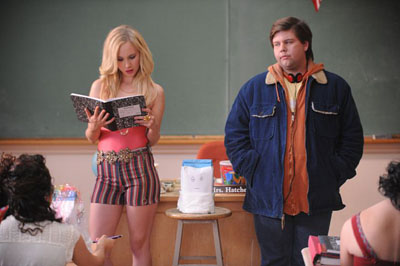 Dirty Girl
What it is: The 20th anniversary of Washington’s International LGBT film festival.
Why you want to see it: Next Thursday’s opening night gala features Dirty Girl, about a free spirited teenager (Juno Temple) who strikes up an unlikely friendship with an outcast (Jeremy Dozier) coming to terms with his homosexuality. It’s getting a commercial release, but check the festival listings for titles that may not come to Washington screens again, like Hollywood to Dollywood (October 15), about twin brothers who have a script that Dolly Parton just has to see; Soeur Sourire, a biopic from Belgium about the real story behind the Singing Nun (October 21); The Pulpit (October 21), from the Phillippines, set in the world of Manila’s gay prostitutes; the self-explanatory documentary short subject, T’aint Nobody’s Bizness: Queer Blues Divas of the 1920s (October 15); and the Twilight counter-programming Vamp Night (October 20).
October 13-22 at venues around town. See the festival website for a full schedule.
—
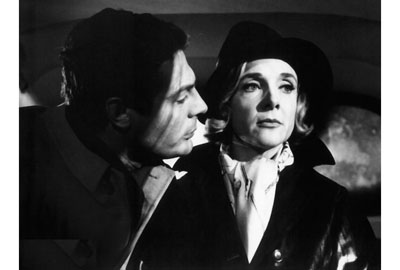
What it is: A newly restored classic of art and politics in 1960s Italy.
Why you want to see it: Marcello Mastroianni stars as a shady antiques dealer who is finally arrested — but not for what he thinks. The National Gallery calls this “a pointed critique of politics and police power,” a description that could apply to any number of Petri’s films, like Investigation of a Citizen Above Suspicion (1970). The AFI programmed an Elio Petri series in 2004, but his stylish, highly political films have been hard to come by since, so this is a rare treat for Washington moviegoers.
October 9 at 4 at the National Gallery. Free.
—
Also opening tomorrow: the documentary The Autobiography of Nicolae Ceausescu, and George Clooney directs and stars in Ides of March. We’ll have full reviews tomorrow.