 I’m generally a proponent of the notion that if there is information essential to the understanding of your movie that isn’t contained in your movie, then there’s a good chance you’ve failed to do your job as a filmmaker. Andrei Ujică’s The Autobiography of Nicolae Ceauşescu would be one of the exceptions to that rule.
Ostensibly a documentary, the film is actually hermetically sealed away from reality, even though every piece of film or video that appears onscreen during its three-hour running time is a true event that really happened. Sure, the camera doesn’t lie. That’s what editors are for.
The key to understanding what Ujică has done here lies with the word “Autobiography” in the title. To comprehend why a movie about Nicolae Ceauşescu is not to be believed, when it’s told the way he would want it to be told, requires the viewer to come in knowing the basics of Ceauşescu’s history. A familiarity with his reputation during the two decades that he led Romania, and the increasingly repressive, violent and image-conscious regime that developed during that time, is as important a lens to view this through as is knowing who Hitler was before watching Leni Riefenstahl’s Triumph of the Will.
The film opens with the hasty, informal trial of Ceauşescu and his wife, Elena, that occurred after the swift 1989 revolution that removed him from power. An off-camera interrogator asks if they’ve heard the charges against them, and tries to get them to admit to authorizing the genocide that helped spark the revolution. Nicolae and Elena — a romantic pair remarkably well-suited in their shared capability for cruel delusion — refuse to answer, and sit in silent, proud judgement of their own judges. The skewed history that follows can then be read as Ceauşescu’s own defense.
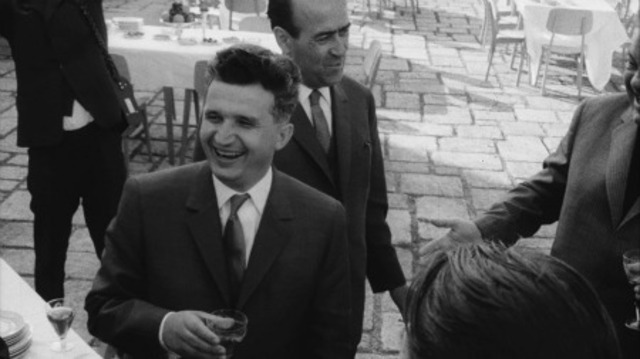
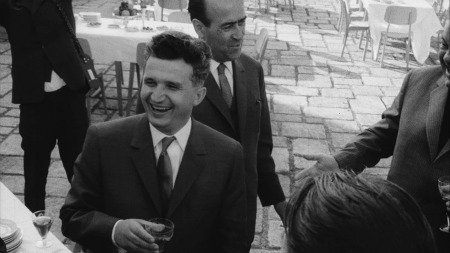
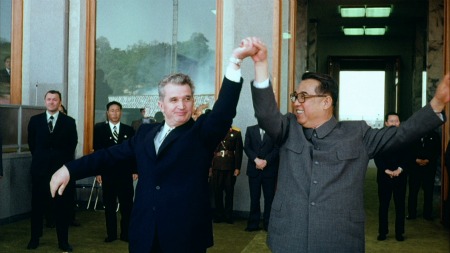 Ujică’s approach is reminiscent of another of this year’s best documentaries, Senna, in that it is constructed entirely out of archival footage, without any narration or external attempts to give it context. It’s the embodiment of storytelling based on showing instead of telling, and even knowing how much has been left out — given the conceit that this is Ceauşescu’s version of events — it’s still remarkable how complete and cohesive a story it tells.
That story begins with Ceauşescu’s ascension to Secretary General of the ruling Romanian Communist Party. (Actually, it the “Workers’ Party” when he took it over, but changing the name of the party and the nation were among his first official acts.) All of this is shown so that Ceauşescu is immediately displayed in the most positive light; from the his silent respect at the somber funeral of his predecessor, to his quick and decisive installation as the new Secretary — which, in reality, was not so decisive, and the result of great party rancor and eventual compromise.
Ironically, through much of the first half of the film, Ceauşescu’s self-aggrandizement isn’t necessarily that far off from reality. Scenes of him being enthusiastically embraced by western leaders — including Nixon, Carter, and Queen Elizabeth — reflected a perception in the west that his willingness to stand up to Soviet hegemony might be the first signs of cracks in the Eastern Bloc. But just as important as those visits is a trip to China where Ceauşescu meets Chairman Mao. The lessons learned about building a cult of personality from the Chinese leader quickly begin showing through in the way Ceauşescu conducts himself, and even a film told from his perspective can’t hide the fact that he worked very hard to maintain an image and retain power through that created perception.
The Autobiography of Nicolae Ceauşescu is all about created perception, and Ujică brilliantly manages to craft a film that is not just about a real character, but a formal reflection of its subject. Everything that made the Romanian President the personality that he was is embedded in the very method used to assemble the film. In presenting him this way, Ujică creates a feel for the man that goes far deeper than any straightforward history ever could.
Don’t let yourself be scared off by the lengthy running time: even that is part of Ujică’s statement, because if Ceauşescu were to tell his own story, it’s clear he’d never be able to shut up about himself. If it was just a gimmick, that would be a long way to go for a dig, but every moment here is engrossing: from the magnetism of his speeches, to his nakedly opportunistic photo ops with both workers and foreign dignitaries, to the adulation that most of those in power seemed to hold for him.
We return, in the end, to that impromptu courtroom, as the incredulous Ceauşescu accuses his accusers of “lies, mystifications and provocations.” Which is not just a classic case of the pot calling the kettle black, but also a statement of purpose for the straight-faced propaganda satire Ujică has so brilliantly constructed.
—
The Autobiography of Nicolae Ceauşescu
Written and Directed by Andrei Ujică
Running time: 180 minutes
Not Rated
Opens today at West End Cinema.