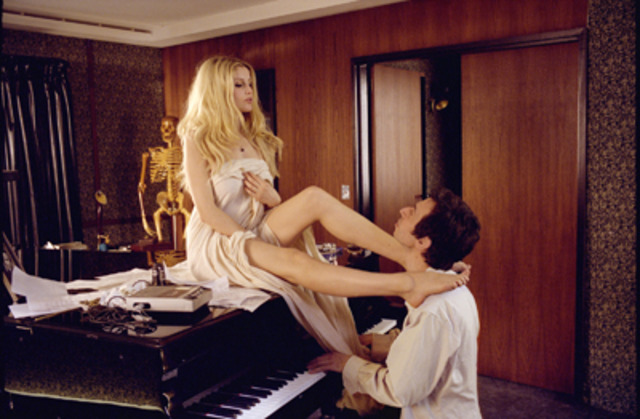
 Brigitte Bardot (Laetitia Casta) and Serge Gainsbourg (Eric Elmosnino). Courtesy Music Box Films.
Can a graphic novel successfully make the transition to a live action feature film? The attempts have varied wildly from sources both independent (Terry Zwigoff’s spot-on adpatation of Dan Clowes’ Ghost World) to blockbuster (Zach Snyder’s muddled vision of Alan Moore’s Watchmen). Comic artist Joann Sfar bypassed the usual artistic differences by adapting his own graphic novel based on the life of an iconic and controversial French singer. The resulting film, Gainsbourg: A Heroic Life, straddles the fence between graphic novel invention and cinematic convention. Its cinematic successes and graphic novel excesses make me wish it had taken the real life plunge and left the comic art world alone.
If any French singer was suited to the graphic novel treatment it would be Serge (born Lucien) Gainsbourg, with his famously grotesque schnozz and hit song “Comic strip.” That schnozz is given star treatment, for reasons that may mean more to the filmaker than to the singer. Sfar notes on his blog that when he Googles his name the first hit is inevitably “Joann Sfar, Jew.” This raises questions of identity for the author, and Judaism prominently figures into Sfar’s telling of the Gainsbourg story. Throughout his life, our hero is shadowed by a puppet/familiar that the young Lucien first encounters in a piece of anti-Semitic propaganda. It was indeed a part of his identity, and Gainsbourg was one of the composers celebrated in John Zorn’s Great Jewish Music series (source of my second favorite Gainsbourg cover, Cibo Matto’s almost innocent-sounding “Je t’aime, moi non plus”). The self-consciousness of identity, in the form of that puppet, inevitably gets in the way of the storytelling.
“Why is my body changing?” seems to be the cry of the young Gainsbourg, and his anti-Semitic vision of himself, part Humpty Dumpty, part albino cockroach, matures into a lanky Svengali figure. If the acting in Gainsbourg left something to be desired, then the puppet’s regular appearance might have conveyed what the live performers could not. But this is far from the case: Eric Elmosnino, who endured five hours of makeup to approximate the famous nose, is a thoroughly convincing Gainsbourg. The actor has so much presence that even when that puppet trails his every move, you can’t stop looking at the star human. If I were Elmosnino, I would have given the director a piece of my prosthetic: “Get that fahkeeng puppeet out of my fess and let me ACT!” Elmosnino manages to make a sympathetic character out of Gainsbourg, whose arrogance and boorishness grows more evident as his career progresses, though some of the most outragoeus behavior is not reenacted here (such as his vivid encounter with Whitney Houston).
 Courtesy Music Box Films.
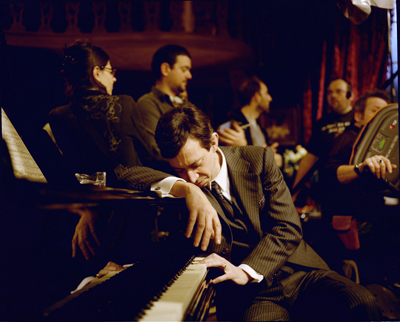
Gainsbourg: A Heroic Life follows its hero from his birth to Russian Jewish parents, to a childhood in Nazi-occupied France, to his years as a struggling painter. He cut his musical teeth playing piano for drunk bar patrons, and it was only after frustration with his artistic direction as a painter that he devoted himself to music – and a frequent redefinition of that music, from cabaret to mod to a reggae parody of “La Marseillaise” and even to rap.
Thanks in part to Gainsbourg’s shifting musical identity, A Heroic Life is never boring. But despite attempts to push the biopic envelope, it is perhaps better as a conventional movie, stumbling most when that puppet rears its ugly head. The trouble is that much of the meaning the puppet seems to convey is painfully obvious, mirroring the actor at various of life’s milestones: childhood traumas, sex, crises of artistic identity. To take one of the most unnecessary instances, in a moment of mourning, that damn puppet just gets in the way of Elmosnino’s considerable acting chops, making what should have been a moving scene a muddled distraction.
Of course, with a musical biopic, the treatment of the music is a major concern, and here the film acquits itself admirably. Some of Gainsbourg’s music has dated. Despite Jane Birkin’s orgasmic coos, the signature duet “Je T’aime” sounds more silly than scandalous today. But others in the varied oeuvre still sound striking: “69 annee erotique,” which go figure, is from the same session, sounds very much of its time but oozes style that is still thrilling in 2011. The performers in A Heroic Life treat the music with varying levels of reverence, from parody (which I’m pretty sure is what Sara Forestier, recently seen in The Names of Love, is up to with her incompetent schoolgirl rehearsal of “Baby pop”) to convincing spins on the originals. A version of “Bonnie and Clyde” (favorite Gainsbourg cover: Luna’s smouldering version with Laetitia Sadier) is performed in rehearsal at ballad tempo, as Elmosnino works it out with his Bardot (coincidentally named Laetitia Casta).
With any biopic, one wonders how fans will react as opposed to novices. It helps to know Gainsbourg’s work: Bardot is not introduced by name but by instrumental strains of “Initiales B.B.”; Jane Birkin (Lucy Gordon, who committed suicide before the film was released) is never named at all. But the script is relatively light on the exposition that often weighs down biopic dialogue.
An animated fantasia by Sfar opens the film, and the beauty of its artistic vision is undeniable. But does this have to do more with Sfar than Gainsbourg? If you like a biographer to insert their own story and concerns into their tale, then you may be intrigued by Sfar’s graphic novel, although it is not yet available in an English edition. If you want to learn about Gainsbourg himself, you may find Sfar’s film worth watching, despite its excesses.
Read Ian Buckwalter’s NPR review of Gainsbourg: A Heroic Life here.
—
Gainsbourg: A Heroic Life
Directed by Joann Sfar
Starring Eric Elmosnino, Lucy Gordon, Laetitia Casta, Doug Jones, Sara Forestier.
Running Time: 130 minutes.
Unrated: contains male and female nudity, violence, and profanity.
Opens today at the West End Cinema.