
Photo courtesy Discovery.
Most people are probably very familiar with Dogfish Head Brewery founder and president Sam Calagione’s philosophy and his “unconventional” beers. (For those unfamiliar with Calagione, his best known beers are probably the 60-Minute, 90-Minute and 120-Minutes IPAs, which were among the first beers to be “continuously hopped” for the indicated time periods. This practice leads to intensely flavored beers.) But the zone where Calagione derives his notoriety is his quest to recreate what most people would not consider to be beer.
Most people’s concept of beer lines up closely with the definition set forth by the Bavarian purity law known as Reinheitsgebot. It dictated that beer could only be made from water, barley, and hops. But Calagione decided to subvert that definition with his Ancient Ales series, digging through history and going around the world to revive old brews. Many of these old brews used indigenous ingredients, such as purple corn, quinoa, and rice rather than the “traditional” barley or hops.
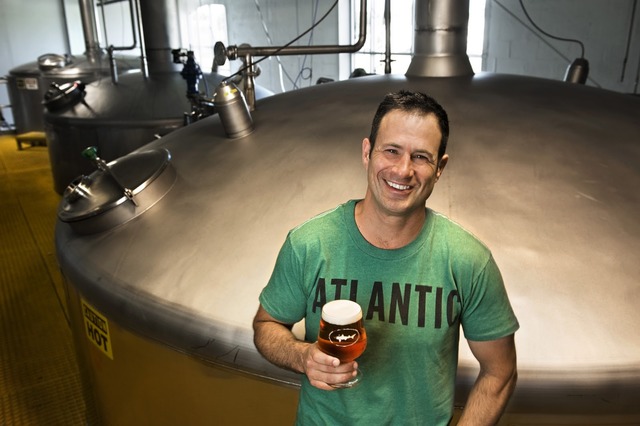
Whether or not you agree with his practices or enjoy the output, there’s no doubt that Calagione is pushing the envelope and redefining beer — as he noted during last week’s TEDx Penn Quarter event, where he discussed how he was reinventing beer with his slogan of “off-centered ales for off-centered people.” I was fortunate to have the opportunity to speak with Calagione, and ask him about the American beer industry. (And if you’re anything like my fan boy brother-in-law, yes, he is as cool as you think he is.)
So one of the things that blows my mind is that you met our beer writer, John Fleury, once, and you remembered his name after that. You meet so many people, how do you do it?
I don’t know why that is, but I think it just came from 17 years being on the road doing events, and beer people are cool people in general. We say our industry is 99 percent asshole free. So I probably do forget one of every hundred names of the person who was underwhelming. But everyone’s so nice in this industry so I look forward to seeing them a second time.
How would you define craft beer? Is it about how many gallons are produced or something else?
We’ve never really gotten hung up on styles or what’s hot and coming next. Our whole mission of off-centered ales is basically thumbing our nose at things we’re supposed to do and that doesn’t mean that we’re anti-light lager, the generic light lager that most of the world drinks. It also means if someone’s doing something really interesting in a great category, we’re psyched for them as craft brewers. But we’re not really interested in following what other brewers do. And we’ve been doing wood ales since Immort Ale in ’96, so we’re in a big believer in that world but not at the expense of thinking it’s gonna take away from really great IPAs or fruit beers or anything else. It’s such a wide open spectrum of opportunities.
So you’re interested in not doing what other brewers are doing. Do you feel any pressure to follow the trends, such as sour ales?
The trends are out there. We’ve been working with that. We did a beer called Festina Lente in ’02. It might have been the first bottled American lambic. And we do our Festina Peche every summer, which is a tart sour Berliner weisse style. So we love playing in that area. We do get a little anxious about bringing bugs in to our big production brewery. So when we do experiment, we mostly do that at the pub. But we’ll probably do another version of the Festina Lente at our pub next year or the year after just cause we miss drinking it.
What was the impetus for the Google collaboration?
To be clear, it was not an official collaboration between two companies. I went and gave a talk there, and there’s a bunch of beer lovers/homebrewers that work at Google. So it’s really just Dogfish and a bunch of people who work at Google getting together, doing this beer, using a bunch of Google’s tools so that we could learn how to use them better, and documenting it on film, so that a bunch of other entrepreneurs could learn about using those tools. And the impetus was all of us being beer lovers, and Dogfish using Google all the time when we’re coming up with something new or I’m trying to source a new exotic ingredient. I’d say Google is the site I’m on the most because that’s how we learn stuff. We’ve don’t have consultants and focus groups.
An interesting thing that I noticed is that a company recently decided to release a beer specifically targeting women, called Chick Beer. What are you thoughts about that?
I think it’s a little unfortunate, frankly. Because it’s half the people out there, and they’re saying we’re only going after half the people out there. I believe it’s started by a woman, and that’s nice. But the women I know don’t want to be separated from the beer loving populace, in general. They want to be part of it. And I believe it’s catering to a non-bitter flavor profile. I know tons of women who are way huge hop heads, and love dark, roasty beers. So I worry it perpetuates a stereotype that women’s palates are less attuned to the more aggressive flavors in beer. And if anything at Dogfish, we have a really robust sensory program. And most of the women we work with are the best palates, the best tasters in our company.
A lot of craft beer labels are really interesting, and Dogfish has some really interesting ones. Who designs them?
It used to be poverty was the source of invention. So when we couldn’t afford advertising, marketing or packaging, I used to do all that myself. I designed our logo, and doggy font and our original labels like our 90 Minute and Raison d’Etre. But once we got our feet underneath us, that was less necessary. I still love to create labels, and I recently painted the Namaste label and the one for our upcoming beer Noble Rot. But now we have some financial strength, and since I’m a big music geek like I’m a beer geek, I love reaching out to rock n’ roll artists to invite them to put their spin on what we’re doing. That’s my way of giving a high five to the music community.
Obviously, a lot of the talk is how D.C. has increasingly become a strong beer city. What city do you think is the most exciting in craft beer?
I think Wilmington, Delaware is up and coming. It’s a city which certainly has had an identity crisis, but is really becoming a good scene for restaurateurs, who as they’re opening are really paying attention to their beer selection. So that’s really encouraging. It’s weird in this area, because Philly took off first, and Baltimore was pretty good. D.C. was a wine town when we started 15-16 years ago, but the trajectory D.C. is on is an even bigger trajectory albeit smaller beer base than Baltimore and Philly. So it’s really exciting to see D.C. going off.
What’s your go-to non-Dogfish session beer?
That one’s pretty easy. I always have Saison Dupont in my house. I turned on my friends, who are not necessarily beer friends, who live in Lewes, the town I live in, to be excited when we pop a few corks of Saison Dupont. So that’s definitely a favorite of mine.
Do you still drink cheap beer?
I do. I play on an adult hockey league team. And every week it’s one of my teammate’s job to bring a 30 pack of cheap, cold cans of lager. And whatever one it is, whatever brand it is I look forward to having it. There’s nothing like that light lager for refreshing after a hockey game. There’s really not any other occasions in my week where I’m craving that kind of beer. But I’m a beer geek, not a beer snob. And all beer is good. And there’s a time and place for any kind of beer.