In 1803, a prominent Washington businessman, Colonel John Tayloe, bought a couple hundred acres of land north of Rock Creek Church Road. Tayloe, considered the third wealthiest man in America, named his estate “Petworth.”
Tayloe’s inspiration was a town in England, meaning our Northwest Washington neighborhood has a counterpart in the Chichester District of West Sussex. Washington’s Petworth has tidy rowhouses. England’s Petworth has the grandiose Petworth House, a 17th-century mansion that holds a notable art collection of pictures, ancient and Neoclassical sculpture, fine furniture and carvings.
More than 80 years after Tayloe purchased Petworth for a place to raise his thoroughbred racehorses, a syndicate represented by B.H. Warner and Myron M. Parker bought the property from two Tayloe heirs.
Mentions of Petworth up until 1887 referenced Tayloe’s farm. After the purchase, the name belonged to the seed of a new Washington neighborhood.
The Tayloe estate and the Marshall Brown estate were combined to create a 387 acre subdivision. On January 17, 1889, the Washington Post wrote that the tract was, “the largest ever put on record in this District, being about one-fifteenth the size of the entire Old City of Washington”
In 1927, The Post describes how the groundwork was laid:
On May 18, 1889, Mr. Parker made a contract with Andrew Gleason for grading and opening streets in the new subdivision, at a cost of $40,000, and this was the beginning of Petworth, now one of the most populour residential sections of the city. Congress at the preceding session had chartered a new street railroad to serve that region, and its success was thus assured from the start.
Some may have heard Tayloe’s name mentioned in the same breath as the historic Octagon House, which he also owned, on New York Avenue and Eighteenth Street (When the British set fire to the White House in 1814, President Madison and his wife Dolly sought refuge there).
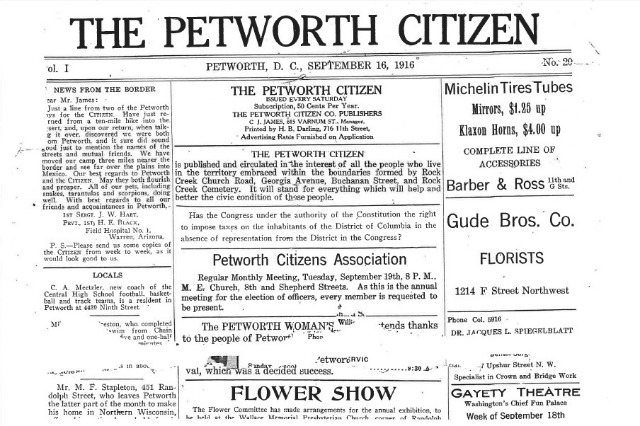
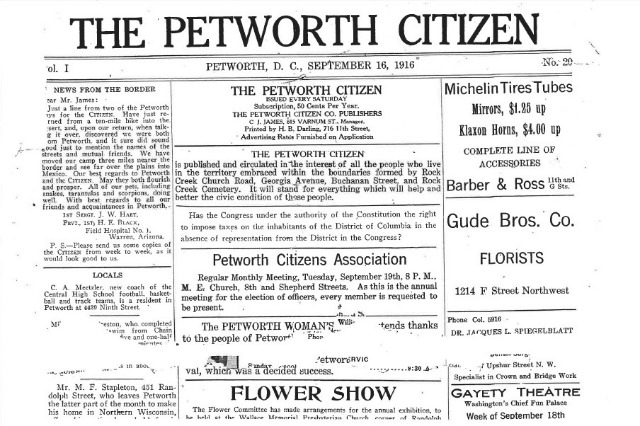
The Petworth neighborhood’s identity was well-defined by the early part of the 20th century. It boasted The Petworth Citizen, which was issued every Saturday, and chronicled neighborhood happenings, including notices for the “Pansies of Petworth” (girl scouts) and the Petworth Union Market. A subscription was 50 cents a year.
From the front page:
The Petworth Citizen is published and circulated in the interest of all the people who live in the territory embraced within the boundaries formed by Rock Creek Church Road, Georgia Avenue, Buchanan Street, and Rock Creek Cemetery. It will stand for everything which will help and better the civic condition of these people.
After the neighborhood burgeoned for several decades, The Post noted in 1939 that Petworth had finally reached “middle age.”
In a city that seems determined to spread itself all over Virginia and Maryland, the neighborhood trying to hold its own has a tough tussle. Like the mule on the treadmill, it has to “run hard just to stand still.” Petworth, which is centered by Grant Circle and has within its boundaries the biggest group of public educational buildings in the District, has been a long time a-growing. And now it is demanding a peaceful middle age in which to enjoy its development.
Since then, the neighborhood has experienced profound demographic shifts. In the 1950s, Petworth was mostly white. In the 1980s, it was mostly black. In the 1990s, more and more Latino homeowners began moving in. Today, the neighborhood is becoming increasingly diverse.
While the community has undergone quite a few transformations, as long as it’s been a neighborhood, it’s always been “Petworth.” Even if not everyone knows why.
In 1895, an amateur writer did a short piece on the neighborhood for The Post:
I do not know why it is called Petworth. Perhaps by the Dutchman’s reason, who, when asked why he called his son Jacob, replied: “Because dat’s his name.” We cannot afford to ignore names. They have been running on for a good many years…