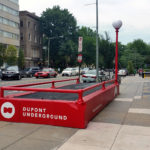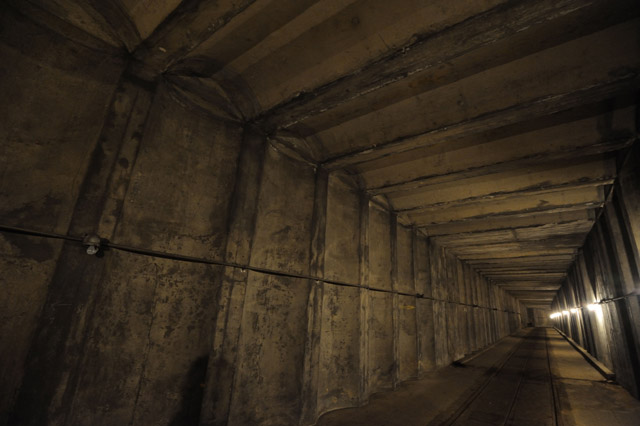
Aside from a misguided food court concept that came and went in 1995, there’s a cavernous space beneath prime Dupont real estate that has sat unused for decades. But in the last few years, there has been a renewed interest in making something out of the former trolley station known as The Dupont Underground. What was it, and what will it be? Chairman of the Arts Coalition for the Dupont Underground’s Board of Directors and producing Director of the Warehouse Theater Paul Ruppert invited me to take photographs of the site and answered some questions about the project.
The last streetcar ran in D.C. in 1962, but the Dupont station looks as if it were built not long before that. When was the station constructed, and how did the streetcar fall out of favor so quickly?
Streetcars have a long history in the nation’s capital. The first one was launched in 1862, when a horse-drawn car traveled between Georgetown and the Navy Yard. The Dupont Circle station was constructed around 1947, in conjunction with the automobile underpass — and both projects were built to ease the notoriously congested traffic around the circle. For a number of reasons, automobiles and buses became the transportation mode of choice after World War II, and streetcars could not compete. For a time, in the late 1960s and early 1970s, the space was used as a fallout shelter.
New York’s High Line has been mentioned as a model for the kind of transformation considered for the Dupont Underground. Can you tell me a little bit about your vision for this space?
Our goal is to create a world-class center for art, design, creativity and innovative entrepreneurship that will be a focal point for the city. Dupont Underground will be a highly versatile, ever-changing space where the public can experience and interact with today’s most influential ideas and debates through the lens of contemporary art and design. And just as the High Line has fostered an amazing growth in business and real estate development, in creativity and inspiration, we expect that Dupont Underground will prove to be a similar catalyst for the Dupont Circle neighborhood and, more important, the District of Columbia.
Can you give me an example of the kinds of events that you see happening in the Dupont Underground space?
Cultural programming will fall into three main areas: One, events, performances and exhibits organized by an in-house team of curators; two, programming organized by local partnering institutions — think The Phillips Collection, Fringe Festival, Civilian Art Projects, et ceteral; and three, traveling exhibits of national and international scope.
The food court incarnation of the Underground in the ’90s was an infamous bust. Has the failure of that previous attempt to revitalize the underground made it harder to get support for this venture?
The failure of the food court has actually made this project stronger as we’ve had to respond to the very real challenges of developing a successful project in a difficult environment. With 75,000 square feet of space available for programming and businesses, we believe that a thoughtful design and mix of uses can make this a success. We are taking our time to ensure that our solutions will lead to long-term viability.
Are there any political hurdles to making this project happen?
At this stage, we haven’t faced any hurdles that have been too difficult to address. We continue to work with the city and the neighborhood in a deliberate way to move the project forward. We have spent thousands of hours working on the Dupont Underground over the past couple of years, and we are at the point where we are ready to engage the community for more input and feedback.
I realize this is a city of highly flexible timelines, but if funding and permits go as planned, do you have a projected/ideal opening date?
We hope to enter into a lease in a year’s time, once we have successfully completed the milestones that are part of our Exclusive Rights Agreement with the city. Development of the space would be in phases, allowing us to do some programming relatively soon after entering into a lease and eventually moving through a multi-million dollar fundraising effort to help bring the vision to completion over a period of several years.