
 Addictions are time-consuming disorders. There’s the time spent finding the object(s) of your addiction, the time spent actually engaging in them, the time spent dealing with the highs and lows, and the time required to cover up and compensate for all of those activities in your straight life. Of course, life in general can be hard enough to keep everything balanced; add in an addiction, and there’s that many more balls to keep in the air. Steve McQueen’s engrossing and unsettling new film, Shame, shows what happens when they all come crashing down.
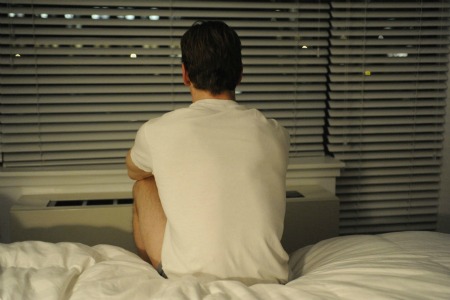
Brandon (Michael Fassbender) is a successful New York City professional with a tony midtown Manhattan address and charisma to spare. What he actually does for a profession, like almost all of his backstory, is undefined, despite quite a few scenes that take place at his office. What isn’t left to the imagination, however, is what he does with his free time. In an opening sequence that jumps around in time, we see his routine: His morning masturbation in the shower; his afternoon session in the office bathroom; after-work porn surfing; sex in the evening with either someone he’s picked up, or with a prostitute; and starting up again the next morning, getting ready for work while listening to voicemail messages from women he never has any intention of calling back.
It’s a concise and beautifully edited portrait of compulsion, conveying just what one needs to know about Brandon for the purposes of the story, and no more. This is more than just sex without love; or even sex without joy. This is an utterly pleasureless cycle; Brandon is in a boat filling with water, and each orgasm is a bucket bailed over the side, an activity that must be done to keep from sinking.
 When someone else, his sister Sissy (Carey Mulligan), hops into the boat with him, the whole ship starts going down in a hurry, with both of them in it. Sissy is as damaged as Brandon, but less adept at hiding it. There is an allusion to some horrible event in their past, but McQueen isn’t interested in the cause so much as how damage manifests itself in adults. For Brandon, it’s his sexual compulsion. For Sissy, it’s a bohemian vagabond lifestyle that has her catching odd jobs as a lounge singer and crashing wherever is handy.
She arrives in Brandon’s apartment unannounced after a messy breakup that is, again, just barely alluded to in one side of a desperate, tearful phone call on the night of her arrival. These large blanks to fill in are, just two films into his career, becoming a trademark for McQueen. His feature debut, 2008’s Hunger, similarly used suggestion far more than explanation to tell the story. A one-time video artist, he is devoted to the doctrine of showing rather than telling to a degree that may frustrate audiences at times, as his films require more intellectual interaction than most.
Shame also continues his tendency toward long, unbroken takes that refuse to allow the viewer respite from the uncomfortable realities on display. Edits are what remind us, subconsciously, that what we are seeing onscreen is manufactured. Life has no edits, so when McQueen sets up his camera to record long events in real time, there is no retreat from reality.
That technique is used most masterfully here in a deceptively simple scene of Sissy singing “New York, New York” in a downtown nightclub, as Brandon and his boss watch from a nearby table. Once she gets into the performance, McQueen puts her in close-up without movement or cutaway for much of the song. The camera is unable to take its eye off of Mulligan because her rendition is one that would bring the world to a halt. She turns the normally celebratory tune into a smoky and melancholy piece of already defeated yearning. Her eyes say that the change of scenery isn’t going to make a brand new start of anything, and that she probably can’t make it here or anywhere. When McQueen finally cuts away to Brandon, he’s crying. Is it at at his sister’s failings or his own?
Probably at both, because it becomes clear that the scars and the fates of these two is inextricably tangled. When things begin to fall apart for him, he can’t avoid dragging her down with him any more than he can save himself. At the point where he recognizes his problem, the shame sends him on a complete purge of all the implements of his addiction and an attempt to forge a real human connection with another person. The irony is that the only time he’s unable to perform is when sex has the potential to be meaningful. He’s hopelessly broken.
There are lines here, between the highly sexual and the sexually addicted, between the sexually addicted and the sexually self-destructive. Brandon begins over the former line, and McQueen takes him over the latter in another disjointed and gorgeously constructed sequence that bookends the film with the opening. The careful control of the opening is replaced with reckless disregard for safety, as McQueen shoots sex scenes with a parody of eroticism that simply highlights the sad desperation.
The sequences are tied together with a sound cue of a relentlessly ticking clock that becomes an insistent rhythmic banging in the soundtrack. Brandon’s addiction is constantly counting down to a meltdown. After it comes, Brandon’s choice, as he notices the physical scars his sister bears from past suicide attempts, which match his own self-destructive scarring, is whether to reset that clock or just toss it out entirely. McQueen, a leaves us with his future, just like his past, undefined.
—
Shame
Directed by Steve McQueen
Written by Steve McQueen and Abi Morgan
Starring Michael Fassbender and Carey Mulligan
Running time: 101 minutes
Rated NC-17 for some explicit sexual content.
Opens today at E Street Cinema.