 Photo by gerdaindc
In 134 years of Washington Post archives, the Brentwood neighborhood is mentioned in the same story as its namesake only twice.
The sole accessible mention is an advertisement for the neighborhood by the Washington Permanent Building Association that ran on July 5, 1948, which reads: “The name ‘Brentwood’ is doubtless derived from the Brent family, early residents who held a large tract of land in the northeast. Robert Brent was the first Mayor of Washington…”
The Brentwood neighborhood takes its name from the Brentwood Mansion, named after the city’s first mayor. The mansion once stood at Florida Avenue and 6th Street NE, and today Gallaudet University, a school for the deaf, encompasses part of the old estate. It is said that Brent gave the mansion (see page 620 of Washington, outside and inside for a sketch) as a wedding gift to his daughter Eleanor and her husband Joseph Pearson, a Congressman from North Carolina.
The Brent family was well-known in the District. From The Post on April 3, 1921:
The family of Robert Brent, the first mayor of Washington, was distinguished in the opening years of the nineteenth century for its service to the infant Capital of the young republic. …Robert Brent first served as justice of the peace for Washington county. He was married to the eldest daughter of Notley Young, one of the original owners of the site on which the Capital was founded and lived in Washington at his father-in-law’s residence for some time. On June 4, 1802, President Jefferson appointed him mayor of Washington. He filled that office until 1812 through various reappointments and for part of his time held the posts of paymaster general of the army and judge of the orphans court as well. During his service as mayor, Mr. Brent received no salary.
Below is the letter, dated June 3, 1802, which President Thomas Jefferson sent to Robert Brent expressing his desire to have him serve as mayor of D.C. From the Records of the Columbia Historical Society, Washington, Volumes 1-2:
Dear Sir:
The Act of Congress incorporating the city of Washington has confided to the President of the U.S. the appointment of the Mayor of the city. As the agency of that officer will be immediately requisite, I am desirous to avail the city of your services in it, if you will permit me to send you the commission. I will ask the favor of an answer to this proposition.
Will you also do me that of dining with me the day after tomorrow (Friday) at half after three? Accept my friendly and respectful salutations.
TH: Jefferson.
Robert Brent responded:
Dear Sir:
I have had the honor of receiving your favor of this date, asking my acceptance of the appointment of Mayor under the late Act of Congress for incorporating this city.
Altho I feel great diffidence in the talents I possess for executing that duty, in a manner which may afford general satisfaction, yet feeling it a duty to contribute my feeble aid for the public service, I will venture upon its duties.
Through various reappointments, Brent served as mayor until 1812, when Congress decided that the duty of electing a mayor would belong to the City Council. Brent passed away in 1819.
Family members inherited the Brent Mansion, and over the years it changed hands and suffered drifts in management. It was eventually referred to as the “old Patterson home,” since Captain Carlisle Patterson owned the property for a time. In 1889, Lt. Francis Winslow II — a Patterson descendant — began subdividing, developing and selling portions of the property. The Brentwood Mansion eventually burned down, and the land became the site of a World War I army staging camp, Camp Meigs. From The Post:
Camp Meigs. Where is Camp Meigs? Three-quarters of the people of Washington never heard of this place. Yet Camp Meigs is very much alive. It is the only cantonment of its kind in the country and the only mobilization point located in the heart of the city. On the Patterson tract, Florida avenue, near Fifth Street, adjacent to Gallaudet College, is Camp Meigs, laid out with the regulation cantonment barracks, concrete streets and housing at present 1,149 men.
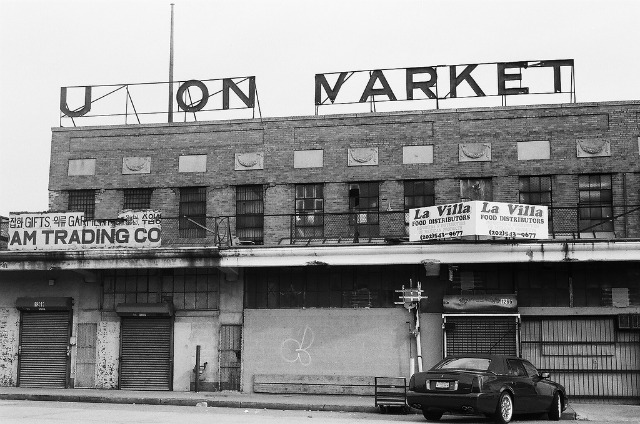
In the 1920s, Francis Winslow III took over managing the estate. He is responsible for the development of the Union Market/Florida Avenue Market and served as president of the Union Market Development Corp.
In addition to the historic market, over the years a large portion of the land was acquired by or donated to Gallaudet University. Today, a part of its campus is where the first D.C. mayor’s mansion once stood.