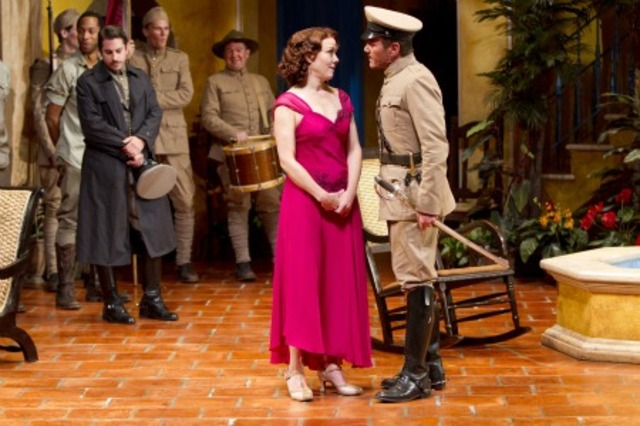
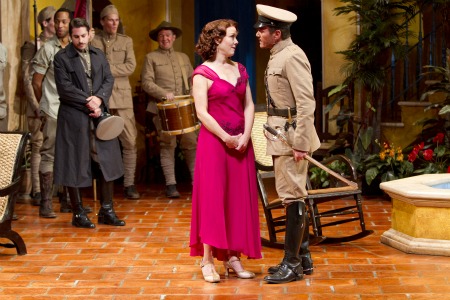
 Kathryn Meisle as Beatrice and Derek Smith as Benedick in the Shakespeare Theatre Company’s production of Much Ado About Nothing, directed by Ethan McSweeny. Photo by Scott Suchman.
Much Ado About Nothing may not be the first romantic comedy of the English language, or even of Shakespeare’s own canon, but it is an archetypal piece. Many of today’s Hollywood moguls would do well to revisit the Bard’s work, considering the standard megaplex fare that is currently being foisted onto the public. The play endures because it simply strikes the perfect balance of “rom” and “com” that eludes so many playwrights and filmmakers. The play itself also challenges those who are trying to create a new and interesting production, as getting creative is only likely to screw things up.
Fortunately for the Shakespeare Theatre Company, its current production of Much Ado sidesteps any potential landmines. Currently running on the Company’s Sidney Harman Hall Stage, Ethan McSweeny’s interpretation transposes the setting while maintaining the play’s original intention as a funny, insightful and entertaining look at the vagaries of love.
This staging of Much Ado is set in a pre-revolution era Cuban hacienda that belongs to Leonato (Adrian Sparks), an elderly gentleman whose family includes daughter Hero (Kate Hurster), his sharp-tongued niece Beatrice (Kathryn Meisle) and his brother Antonio (Bev Appleton). The play begins with the family welcoming Don Pedro, a triumphant prince returning from war, and an entourage that includes the loyal Benedick (Derek Smith), the Claudio (Ryan Garbayo) and Don John (Matthew Saldivar), who has just suffered a humiliating defeat at the hands of Don Pedro. Claudio takes an immediate liking to Hero, while the exact opposite happens between Benedick and Beatrice. He does not hold much regard for the fairer sex. She has equal disdain for those in possession of a Y chromosome. Don Pedro takes it upon himself to bring the two together, and this story runs in parallel between the budding romance of Claudio and Hero. Don John’s machinations and other misunderstandings threaten to keep the couples apart, but of course, these problems stand no chance in the face of True Love.
The success or failure on any version of Much Ado rests on the chemistry between the actors playing Benedick and Beatrice. Smith and Meisle rise to the occasion, slinging their hilariously stinging barbs with conviction. Scenes in which their mates are conniving to bring them together are the highlights of the play. In particular, Smith conducts a masterclass in physical comedy as his Benedick eavesdrops on Don Pedro & Co. as they unfurl their plot to unite him with Beatrice. Garbayo and Hurster are a handsome pair indeed, and do an effective job as the star-crossed lovers and get to exercise their acting chops when it seems like everything is falling apart. Of course, no Shakespearean comedy is complete without a clown, and Ted Van Griethuysen’s Dogberry draws laughs with each dimwitted malapropism. Verges, played by Floyd King, adds to the humor as Dogberry’s geriatric sidekick.
The decision to set the play in Cuba has little impact on the story. If anything, it gave the creative team license to incorporate the vibrancy of the island nation into the production design with Lee Savage’s beautiful set, Steven Cahill’s use of salsa music in the sound design and Clint Ramos’s colorful costumes. So in the end, the setting just gave the audience something pretty to look at and listen to, which benefits the experience and serves as a reminder that Shakespeare’s plays are living entities that should be watched on stage and not read in a library.
Much Ado About Nothing runs at the Shakespeare Theatre Company’s Harman Hall Stage through January 1, 2012. Full schedule and ticket information is available here.