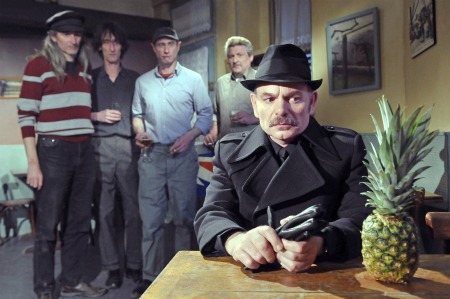
 A detective walks into a bar wearing a black suit, hat, tie, and trenchcoat, carrying nothing but a pineapple. No, that’s not the setup for a joke. Rather, that is the joke, or at least the source of laughs in once scene from Aki Kaurismäki’s Le Havre. It’s a deadpan and strange little sight-gag, and typifies the kind of offbeat humor the Finnish director is known for. Showing the absurd in a stripped-down, matter-of-fact fashion is how Kaurismäki gets his laughs, even as he tells a story with serious themes.
Le Havre is a port town in Normandy, on the north coast of France on the banks of the English Channel. As the film starts, we see two shoe-shiners, one an older gentleman, Marcel (André Wilms), the other a younger asian man, and the opening moments are nearly dialog-free, a quasi-silent film of these men attempting to ply their trade at the train station. An intense man attached to a briefcase by handcuffs comes on the scene, as well as a couple of shady-looking characters following. In the darkly comic world of Kaurismäki, his offscreen execution a few moments later is played for laughs.
 Marcel, the film’s focal point, heads all over town trying to drum up business. He even sets up shop outside a shoe store, suggesting to the owner as he gets chased off the sidewalk that they should have a symbiotic relationship. But fewer people get shoeshines anymore, and times are tough for this former writer and his anxious wife. Marcel is quickly becoming a human anachronism, a reminder of another time in a film that thrives on the temporally out of place. Kaurismäki throws in a newspaper reference to Al Qaeda just so we’ll be sure to know this is meant to be the present, but other than that there are few cues to indicate whether this is 10, 20, or 30 years ago. No one even uses mobile phones.
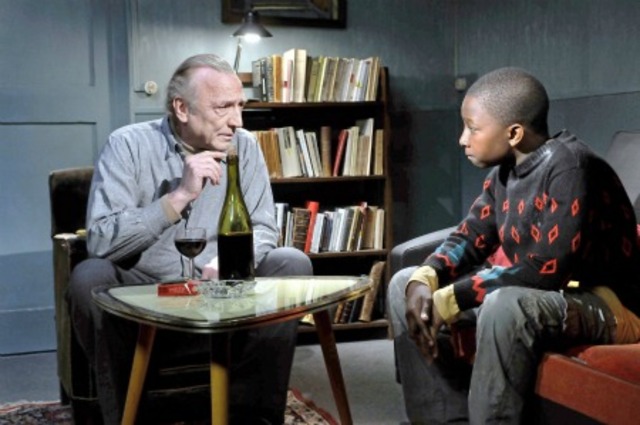
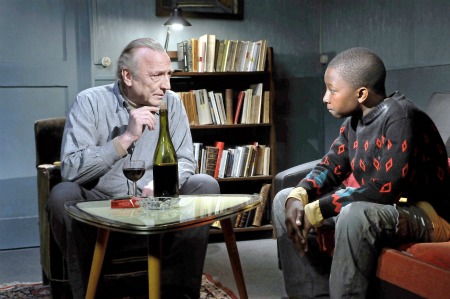
Marcel happens upon a young African boy, who has escaped from the shipping container that his family was found hiding in by Le Havre police, as it sat in the port en route to what they hoped would be their new life in London. He takes the boy in, and he and the shopkeepers of the neighborhood band together to help him out. In a way, his whole neighborhood is one of outcasts and loners, strange characters who have pointless debates in bars and don’t see much difference in life from day to day. “Miracles do happen,” someone says at one point. The deadpan reply: “Not in my neighborhood.”
Kaurismäki does put together a little miracle for the neighborhood though, without ever getting maudlin, nor ever being too overtly preachy regarding his obvious views on France’s attitudes towards its immigrant population. While the film never reaches any hugely profound revelations with its parable-styled stories of compassion and community, and occasionally feels a little slight, it’s also enormously enjoyable and gorgeous to watch. The film takes place just off-center from reality, all dressed up as the disaffected sad clown, capable of more laughs than one might think.
—
Le Havre
Written and Directed by Aki Kaurismäki
Starring André Wilms, Blondin Miguel, Kati Outinen
Running time: 93 minutes
Not rated.
Opens today at E Street.