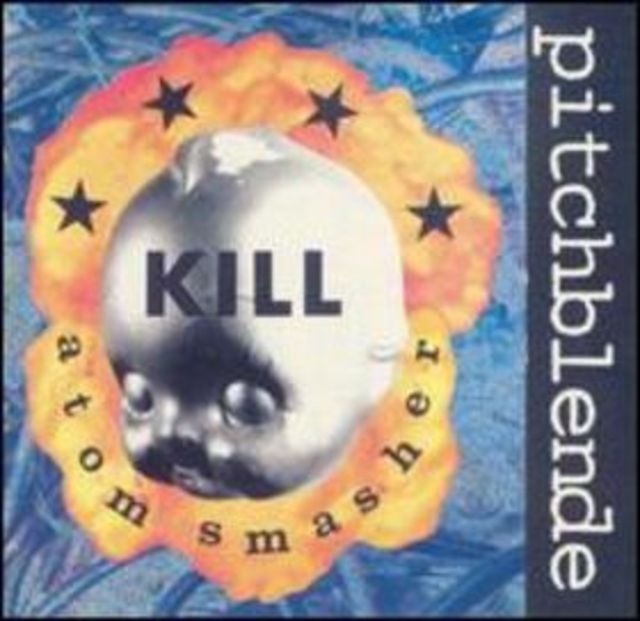
 Secret History profiles classic D.C. albums to expose the brilliance of the District’s rich indie rock past. This entry takes a swing at noise-mongering quartet Pitchblende’s knotty debut, Kill Atom Smasher (Cargo, 1993).
For fans of tangled, vitriolic, vaguely avant-garde guitar noise, the 1990s were a golden age. All across this fair nation, scruffy semi-stars, their ears tuned to the volume-tweaking frequencies of Sonic Youth and the Pixies and Mission of Burma, were dedicating themselves to six-string misconduct and overt amplifier abuse. Melodies were skewed, sonic chaos mined for pop nuggets. The approaches were sometimes oblique, but the riffs were usually acute.
Alongside out-of-town talent like Polvo and Archers of Loaf, D.C.’s own Pitchblende managed to generate some of the era’s finest post-punk disharmony, bending the rules of tonality to fit their own obscure needs. From 1991 to 1996, Justin Chearno (guitar), Treiops Treyfid (guitar), Scott DeSimon (bass), and Patrick Gough (drums) released a handful of 7-inches and three LPs, staking claim to some of the District’s more abstract indie rock territory.
“Justin and Treiops met while working at Olsson’s Books & Records in Old Town Alexandria. I met Scott at a party; he was wearing a Mission of Burma t-shirt, so I went up and talked to him about music, and we agreed to start working on something,” says Gough, explaining how the band managed to coalesce. “Justin and Treiops placed an ad in the City Paper, looking for a drummer into ‘Sonic Youth, Live Skull, and William Shatner.’ So I answered it, went over to Treiops’ house in Alexandria, heard some songs he was working on, played some drums, and told him I had a friend who could play bass. The first time the four of us got together it clicked right away. In fact, at that first practice in early 1991, we wrote ‘Pilot Light,’ which ended up on Kill Atom Smasher.”
Drawn together by a shared love of noise, the quartet immediately began to refine their style, built on feedback squall and a churning, off-kilter rhythmic attack. Compelling, without a doubt, and powerful, and more than a little catchy, but not a natural fit for the era’s hometown sounds.
“I’m sure all non-super popular bands say this, but I think we felt a bit like outsiders musically in the D.C. scene,” says DeSimon. “We weren’t pop-oriented like the Teenbeat/Simple Machines/Slumberland crowd, and we really didn’t fit into the Dischord category, either (though we would have killed to be on Dischord)…. Everyone was supportive, sure, but like I said, we felt like we really didn’t sound like a ‘D.C. band’ at all. People always seemed to think we were from New York. Also, a lot of the more ‘indie pop’ D.C. bands seemed to be looking to the music of the UK at the time, which we definitely were not.”
Says Chearno, “There were a lot of sides to the D.C. scene, and we were also into bands from New York and Chicago, and the stuff that had come out on Homestead, Touch and Go, Amphetamine Reptile, Matador, etc., so we luckily got to be in a great position to open for a lot of those bands when they came through town. Norm Veenstra, who at the time managed the 9:30 Club (and later started the band Tone), was a big supporter of ours and got us so many great shows. We really owe a lot to everyone at the old 9:30; we were so lucky to play in front of so many bands we loved and build an audience.
“It was the early ‘90s, everyone was kind of working on their own thing, and audiences were smaller in general, but people always seemed up for it. I think our reputation in D.C. was ‘the nerdy guys with all the inside jokes that play too loud.’”
“I felt a very close kinship with Polvo,” says Treyfid. “I thought we were very similar in our uniqueness and crazy song structures. I loved the way each guitar player was playing totally different riffs that sounded great together. I thought Pitchblende was alike in that respect. I was blown away the first time I saw Polvo at the 9:30 Club. I liked them personally a lot, too.”
“I always felt like Candy Machine, from Baltimore, and Polvo, from North Carolina, were the closest things musically to what we were doing at the time,” observes Gough. “My personal favorite band from that time was Jawbox. Scott lived in their house for a time, and we shared a practice space with them. But Jawbox was on a whole other level of popularity than we were, especially once they signed to a major label. But they were really terrific.”
“I had heard Minor Threat growing up in Maine, so I had some idea of the D.C. thing,” says DeSimon, “But really I was much more of a huge, HUGE Mission of Burma fan. Oh, and I loved Echo and the Bunnymen. And Bitch Magnet. And Kate Bush! Treiops was the art school guy. When I met him, he was literally making soundscapes as pieces of art and recording these cassettes of music concrete, a term I’d never heard before.”
“I had a ‘cassette culture’ label at the time and was making and listening to a lot of experimental and electronic music,” explains Treyfid.
“Brainiac, Rodan, Polvo, Unwound, Trenchmouth, Eggs, Crain, and Codeine were like extended family,” says Chearno, name-checking some of the decade’s odder and / or more abrasive acts. “We were four guys into very different bands and because of that we were generally able to mask some of the more obvious influences since we weren’t coming from the same place. Like every other band in the area, we loved Fugazi and saw them all the time, but it always felt cheap to take from their sound directly. Also, this was the heyday of Noise Rock, and while we were all wussy suburban guys, we were pretty hellbent on making as big of a dissonant racket as we could.”
Listening to Pitchblende’s 1993 debut, Kill Atom Smasher, it’s difficult to argue that they didn’t succeed. The LP is a testament to the power of odd tunings, alien time signatures, and overdriven amps, proof that in the right hands these things can be transformed into pure sonic sorcery. The frantic strumming of “Red Cap” ushers in the album in a paranoid style, kicking off 54 minutes of jarring, jangling blitzkrieg. “Flax” lurches when it doesn’t pummel, and “Discoskull” is No Wave at Studio 54, hi-hat shuffles making way for a twin-guitar disembowelment. “Reticence” manages to inject some vulnerability into the mix, its airy, soaring choruses exhilarating when pitted against the gnarled primary melodies, while “Shepherdess” is shoegaze with teeth.
“Going into the recording we were writing and playing two nights a week at this terrifying practice space in Anacostia,” remembers DeSimon. “It was an abandoned store right off the highway, and somehow we knew the caretaker of the property and talked her into letting us play there. I can’t stress how terrifying it was. Remember, this was, like, late 1992. Crack had yet to become a punch line. When people said, ‘You’re on crack,’ they usually were saying it to the guy breaking into their car and stealing their radio.
“So we would load in all our gear to the space from our cars, set up, literally barricade ourselves inside the building so no one could get in and kill us, then play at a deafening volume for three hours with one light and all the instruments plugged into one outlet. Then we’d stop. Listen to see if anyone was outside. Then we’d frantically pack everything back into our cars and drive away. Oh, and the door had a fake lock, as I remember. But we wrote some of my favorite Kill Atom Smasher songs there: ‘Flax,’ ‘Shepherdess,’ ‘Reticence.’ That all ended when we showed up one night and the door had been kicked in. We just turned around and never came back.”
After surviving the myriad hazards of early-‘90s nocturnal off-ramp Anacostia, Pitchblende moved into the relatively safer environs of Arlington’s Inner Ear studios. “Inner Ear had this deal where bands could record on the 16-track between midnight and 6 AM for $16 an hour,” says Chearno. “The engineers at the time were the guys who were just learning, and they happened to be ‘amateurs’ like Eli Janney, Geoff Turner, and Charles Bennington. We were very well rehearsed, and I think we were able to get everything down really quickly. The trend during that era was distorting and burying the vocals, and while we were pretty conservative about the instruments, we did a bunch of wacky stuff when we were tracking the vocals. I have a hilarious memory of Pat singing the vocals for ‘Visceral Plane’ into a metal mixing bowl in the hallway. We never, ever took ourselves too seriously.”
“Somehow we got hooked up with Eli Janney, who, God love him, did a fantastic job recording a band that really had zero studio experience,” raves DeSimon. “We’d roll in after work and record from, like, 8 PM to 4 AM, go home, sleep for two hours, and then go to work. It was a blast, though.”
Recalls Treyfid, “Eli Janney was fantastic. He got our sound down perfectly, somehow. It was pretty simple. The mixing was at WGNS in their leaky basement studio. Charles was in particular willing to try interesting recording tricks, such as running the snare out of the board into another actual snare that was sitting on a speaker, and then that was recorded! It sounded so cool, especially on ‘Discoskull.’”
“Eli was a monster at getting guitar sounds, especially considering the volume Treiops and I were playing,” says Chearno. “Again, we played so much that we came in and pretty much just laid down the songs live. There was a backwards feedback overdub on ‘Visceral Plane,’ but I don’t think there was much other additional stuff.”
The band also spent time at American University recording with Andrew Beaujon and Rob Christensen from Eggs. “What Andrew and Rob recorded were the little in-between snippets on the album. They were students at American University at the time, and had access to a studio where we could record for free. So we had this idea for Kill Atom Smasher that we’d have a song, and then a random, improvised track of music; then another song; and then another snippet; and so on. So we hauled all sorts of instruments into AU’s studio and Andrew and Rob indulged us in some wacky ideas.”
“I think we were still trying to figure out what we wanted to sound like,” observes DeSimon about Kill Atom Smasher-era Pitchblende. “Someone would bring in an idea in that was probably very much inspired by some band we’d played with, but by the time it got filtered through the other people, the influence was usually less recognizable…. We’d already previously recorded about six of the Kill Atom Smasher songs in Treiops’ basement for a cassette; that’s how we ended up on Cargo, they were the only people who wanted to put out our record. But there were four or so other songs on that cassette that we dropped because they sounded too much like influences we’d already left behind. My favorite was a song about a superhero mouse called ‘Infinite Mouse.’ It was kind of hilarious, but really just sounded like ‘Kennedy’ by the Wedding Present. Also, I’m fairly sure there was a song that sounded like Mudhoney, with a wah solo. But by the time we went into make the record for Cargo, we’d ditched these older songs and with a couple exceptions – ‘Sawed Off City,’ for example – it was a good encapsulation of what we were doing at that moment.
“When we sent the master of the record off to Cargo, they were kind of confused, because they thought we were just re-recording the songs on the cassette that we’d sent them. Which means they actually wanted ‘Infinite Mouse’ and a couple other songs that we’d dropped, which should have been a tip off for us on their judgment.”
After Kill Atom Smasher, Pitchblende released two more full-length albums, 1994’s Au Jus and 1996’s Gygax!. Chearno and DeSimon would play together again in Brooklyn instrumental outfit Turing Machine; Treyfid has released LPs under his own name; and Gough currently plays in D.C.’s Imperial China.
“I think it stands as a great record of the sort of ‘anything goes’ nature of early ’90’s indie rock,” says Chearno of Kill Atom Smasher, regarding the LP with the benefit of nearly two decades of hindsight. “I don’t know if we could’ve made that record if we were over 25; the spazziness, the total disregard for song structure, key or tempo now sound so free to me. But under it all there’s an almost pop music-like foundation anchoring the whole thing that I don’t think we ever captured again.”
“Looking back, it’s amazing that they were able to play off of each other at all because the four of us were basically playing as hard and loud as we could all the time,” says DeSimon. “Yet somehow they always managed to come up with these great, unexpected parts. And just when you think you knew Treiops’ playing from Justin’s and vice versa, they’d play in the other guy’s style.”
“I listened to it again a few months ago, and honestly it seemed really unfocused to me,” admits Gough. “Not to say it’s a bad record, but I think our influences are a little too much on display on Kill Atom Smasher, and our sound is all over the map. I think we found our own sound as a band and hit our stride as songwriters with the second album, Au Jus. But that’s coming from a person who was in the band – people involved in creating something tend to be their own harshest critics. But, as I said, the album has more energy and volume than the two that came after it. Put it this way: it was a solid debut effort.”
“I love Kill Atom Smasher, and think it’s the best thing we ever did,” enthuses Treyfid. “I liked ‘Flax’ a lot. ‘Sawed off City’ was great. ‘Discoskull’ kicked ass.” That said, admits the guitarist, “I’ve never heard any band do a Pitchblende cover. That really says it all on how influential we were.”
“Back then there were people who would mention bands to me they thought were doing ‘our thing’ (whatever that was), but I never heard it,” says Chearno. “To me it just sounded like we owned a bunch of the same records. I will say I still get called ‘the guy from Pitchblende’ more often than any of the other bands I was associated with, and I like that.”
Says DeSimon, “We never played overseas, where I think we would have gone over pretty well. We didn’t tour on our last record at all, essentially breaking up a few months after Gygax! came out. Our 194th and last show was on September 5, 1995, at Brownies in New York City, where both Justin and I had moved, separately. I think by that point Kill Atom Smasher had sold almost 5,000 copies of LP/CDs, which to me is astounding. It’s more than the other two records sold, for what it’s worth. All in all, I’m very proud of the record, but really it would be sad to say otherwise, right?”
“We were nowhere near the same league as Nirvana, Pavement, or Fugazi. We weren’t even as well known as Jawbox or Shudder to Think; we’d routinely play for like 15 or 20 people in Montana or Texas or whatever,” says Gough. “But then 10 years later I’d read a review of some band where the writer used Pitchblende as a reference point. A friend of mine who’s working on a PhD in music theory told me just last week that he saw a mention of Pitchblende in a journal article about noise-rock. So that’s kind of cool that we were name-dropped in an academic work.”
“Kill Atom Smasher is a lost treasure that people can find and be blown away by,” assures Treyfid. “This will happen more and more in the future as new collectors will happen upon it. I’m really happy to have been a part of bringing these people an exciting discovery. And to be a part of this hidden reality with such dear lads as were in Pitchblende makes me feel very satisfied and proud. Go, Pitchblende, go!”