Martin Austermuhle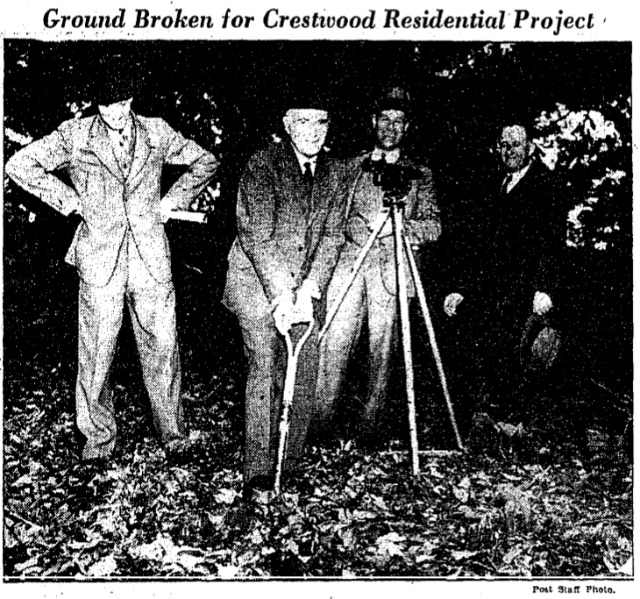
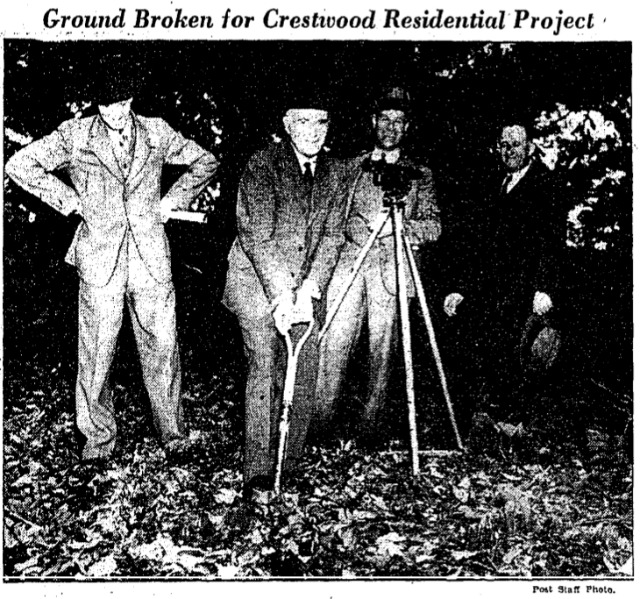 The Washington Post covered the ground-breaking of the Crestwood at Rock Creek Park development on June 5, 1938.
We often mock neighborhood names that seem to emerge from developer-hatched branding schemes more than from an organic sense of identity crafted by residents — think NoMa and Capitol Riverfront. But without such a practice, the neighborhood we now know as Crestwood may never have come to be.
In the mid-1800s, anything north of Florida Avenue — then Boundary Road — was basically the suburbs. Washingtonians looking for a quick weekend getaway needed not go much further than Mt. Pleasant Village, which while still within the District’s boundaries, was part of wooded Washington County.
But by 1895, development had started to proceed northward, and neighborhoods like Petworth, Brightwood Park and Cleveland Park were being subdivided. One area that remained stubbornly underdeveloped, though, was just north of Mt. Pleasant and east of the newly created Rock Creek Park.
There was a reason not much was happening there — a large chunk of the land that is now known as the Crestwood neighborhood was owned by one man, Thomas Blagden, who had bought the former location of the Argyle estate from Russia’s ambassador to the U.S. in 1853. Though he died in 1870 and the land was divided amongst his family, it remained a country estate. His son, though, donated 39 acres for the creation of Rock Creek, and in 1899 gave another stretch of land for the creation of Blagden Avenue, which was used to access the park.
By the turn of the century, though, parcels of land were slowly sold off at Washington continued expanding north along 16th Street. By 1905, real estate developers had started advertising plots in what was called Mt. Pleasant Heights, and in 1907 a “suburb de luxe” known as Argyle Park was advertised in local newspapers.
Blagden the son died in October 1938, only months after the area his family had called home for so long took on the name it has today — Crestwood. The neighborhood’s name wasn’t particularly organic, though — in June of that year, developers interested in the area had broken ground on a 300-home parcel called “Crestwood at Rock Creek Park.” While the neighborhood’s former names of Mt. Pleasant Heights and Argyle Park had some foundation in history, Crestwood was purely a real estate brand.
According to resident David Swerdlof, who wrote a comprehensive history on the neighborhood, Crestwood was to be something of a model suburban getaway in the District, and it developed quickly:
The site for the Crestwood development was described as “wooded country in the downtown residential district and only 10 minutes from the White House.”
Crestwood homes were marketed as Washington Post Display Homes and Evening Star “Silver Star” Homes. The first exhibit home at 4220 Argyle Terrace opened October 2, 1938 and offered such wonders as a dishwasher and air conditioning. The development helped accelerate construction in the neighborhood, with more than 130 building permits issued from 1938 to 1941.
Also in 1938, the DC government finalized the road grid for our neighborhood—creating plans for Crestwood Drive, Mathewson Drive and the loop comprised of 18th, Quincy and Argyle. The order also scrapped “Trumbull Circle,” a traffic circle to be built at the site where Argyle Terrace and Taylor Street intersected (under the former plan, Upshur Street stopped at Argyle; it was Taylor that continued west to the park boundary). The name Trumbull would later be revived as Trumbull Terrace.
The development that gave the neighborhood its name certainly doesn’t reflect what the neighborhood has become — at the time, African Americans, Jews, Syrians and Persians were forbidden from buying any of the new plots. And while it remained largely white in its first years, the number of African American residents exploded from 1950 to 1960, bringing them on par with their white neighbors.
To date, Crestwood is a leafy and quiet residential redoubt — in a 1987 Post article, it was called a “wooded oasis” — home to a cross-section of Washingtonians from former Mayor Adrian Fenty to Sen. John Rockefeller (D-WV), who lives on what was once one of the single largest estates in the District.