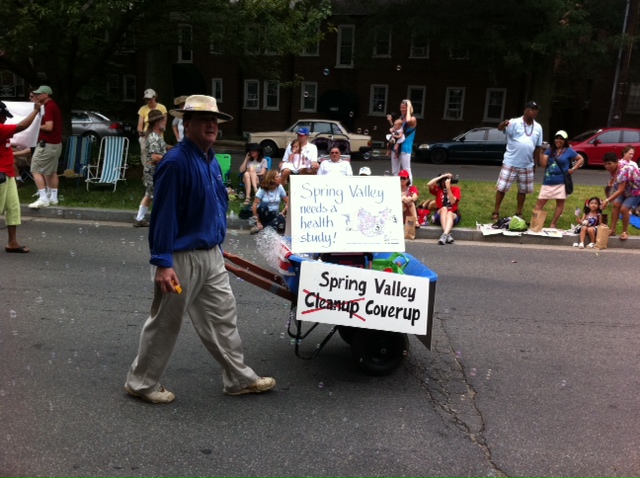
 At this year’s Palisades Day Parade, a Spring Valley resident demanded a health study.
In today’s Post, Sylvia Carignan leads off with a story on the latest study by Johns Hopkins University researchers into the long-term effects of World War I-era chemical weapons testing in the Spring Valley neighborhood and on parts of American University’s campus.
The Army Corps of Engineers has been excavating and analyzing soil samples of the upscale pocket of Northwest D.C. for the last two decades, and in 2004 deployed ferns to combat lingering traces of arsenic.
In 2007, Carignan notes, Johns Hopkins released a study that found below-average cancer rates in Spring Valley, but elevated reports of arsenic-related maladies that affect respiratory and endocrine functions. The new study will not gauge individuals’ illnesses, rather, it’ll be a “community health study,” a Hopkins researcher tells the Post.
Not every current and former Spring Valley resident Carignan spoke with is optimistic about the study, though:
Tall but fragile, Geza Teleki moves slowly around his Bethesda home, where he moved a few years ago with his wife, Heather, after raising their children in Spring Valley.
Before he retired, Teleki was a conservationist, once serving as director of national parks in Sierra Leone. He was in “excellent health,” he said, before he left Africa in the 1990s and returned to Spring Valley. Teleki then worked from his basement office as a lobbyist for the World Wildlife Fund.
Teleki, 67, said he has no idea how many pills he takes in a week. His laundry list of health issues includes hypertension, kidney failure and diabetes. He was in his early 60s when the problems unexpectedly started.
Teleki is convinced that toxins left over from the military’s use of the area caused his health issues.
Carignan also writes that Teleki is quibbling with the results of a 2003 Army Corps of Engineers assessment of his former Spring Valley residence, which found no problems.
It’s hardly the only criticism being lobbied at the corps right now. The actor and satirist Harry Shearer has spent much of the past two years touring the country with his documentary The Big Uneasy, which attempts to trace the root causes of why so much of New Orleans flooded due to Hurricane Katrina in 2005. I spoke with Shearer in March for the City Paper. In the interview, Shearer faulted the corps for operating with “bureaucratic complacency.”
From Teleki’s quotes in today’s Post story, it seems Shearer’s sentiment may reach well beyond New Orleans.