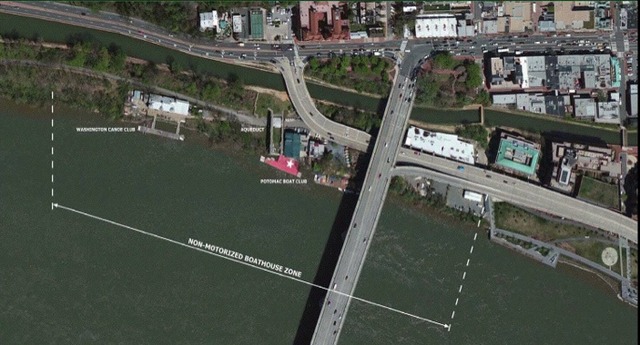
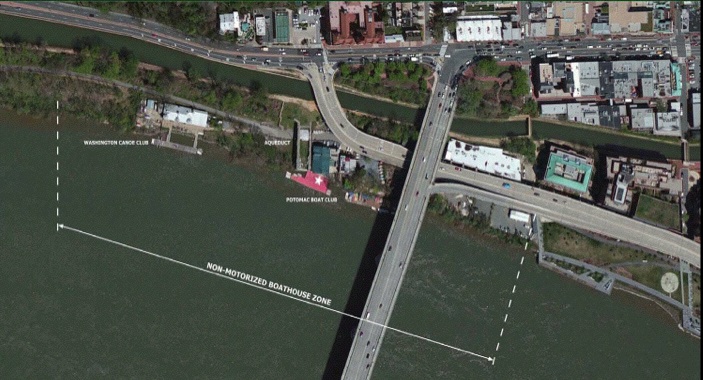
 The proposed area for boathouse development in Georgetown. (Courtesy of the National Park Service)
A crowd of boating enthusiasts gathered in an unfinished office above Washington Harbour last night to kick off a National Park Service study to determine the feasibility of designating a large segment of the Potomac riverfront in Georgetown for the development of new boathouses for non-motorized crafts.
The study is based on plans for the Georgetown Waterfront Park, which was originally devised in 1985 but was only completed in September. For the project, the Park Service is looking at a stretch of waterfront beginning at the western edge of the park at 34th Street and ending 1,200 feet upstream of the Key Bridge.
The event was the first peek at the Park Service’s vision of the Georgetown waterfront for the canoers and rowers who showed up to express their curiosity about the possibility of adding more docks and launch points to the area. Currently, the Potomac Boat Club and Washington Canoe Club are the only facilities in the designated zone that serve non-motorized vessels. (The Thompson Boat Center sits downstream from the Georgetown Waterfront Park.) But there is plenty of demand for more, people involved with the study said at the meeting.
On hand was Carolyn Mitchell, a landscape architect with the Louis Berger Group, which is consulting on the project. Mitchell detailed several physical considerations that went into drawing up what the Park Service is calling a Non-Motorized Boathouse Zone.
The Potomac riverfront in the study is far narrower than, say, the shore of the Schuylkill River in Philadelphia, a section of which accommodates Boathouse Row, a warren of 15 facilities on the water. Additionally, Georgetown lies in a flood plain, and forestation between the C&O Canal and the river would need to be considered before any new boathouses are constructed, Mitchell said.
Peter May, a Park Service administrator who oversees many of the District’s federally-controlled recreation areas, also voiced concern over the condition of the Washington Canoe Club, which was inundated in 1981 and has deteriorated further since then. The Park Service, upon seizing control of the canal area in 1971, also took possession of buildings on the site, including the Canoe Club. (Housing Complex notes the club was evicted in 2007 and that its boathouse is now padlocked.) There are also three townhouses adjacent to the Potomac Boat Club; two are used as housing by the George Washington University, the other is privately owned.
Beyond the current structures on the waterfront, Park Service officials said they will be meeting over the next several months with various stakeholders, including groups such as Friends of Georgetown Waterfront Park, the Washington Area Bicyclist Association, high school boating clubs and the rowing teams at GW and Georgetown University. The plan is to spend the first half of 2012 meeting with the public and developing the study, with the results being unveiled in late summer or early fall.
Still, it wasn’t just canoers, rowers and kayakers that had a vested interest in the Georgetown riverfront. During the question-and-answer session, Harold Seigel, a Fairfax resident, stood up and made an impassioned plea for yacht owners.
“Every time you mention non-motorized boats you’re sticking me,” he barked after listing his membership in several regional yacht clubs. “Why is this not being considered for a powerboat marina?”
Later, May said that the Park Service’s motorboat facilities were underused. Seigel disagreed, insisting the Georgetown waterfront was as much his as any other boater’s.
“The rules of navigation apply to all,” he said.
Forrest Schuster, a senior member of the Potomac Boat Club, was unmoved by this promotion of yachting. Schuster, who said his club hosted more than 100 crafts at any given time, said the Georgetown boathouses are “busting at the seams” and that in the popularity contest of river-faring vessels, non-motorized boats reigned supreme.
“If you combine all the mileage of all recreational activities, rowing is by far the greatest,” he said.