 Some biopics are destined to end up as educational supplements for teachers looking to engage students in a subject with a little more entertainment value than a lecture can provide. David Cronenberg’s A Dangerous Method at times almost seems to be playing directly to that market. This loose history of the evolution of the working relationship between two of the 20th century’s most prominent psychoanalysts—Carl Jung (Michael Fassbender) and Sigmund Freud (Viggo Mortensen)—practically follows a Psych 101 syllabus: Freud’s obsessions with both relating all psychological issues back to sex; his rigid categorizations; Jung’s uncertainty about those simplistic assessments; Jung’s fascination with parapsychological phenomenon and the resulting battle for the heart of psychology as hard science or metaphysical theorizing.
Those elements of the movie don’t feel much more engaging than a lecture though, and so writer Christopher Hampton—adapting his own play The Talking Cure, itself based on a non-fiction book by John Kerr, A Most Dangerous Method—plays up a third party: Sabina Spielrein (Keria Knightley), a medical student who comes to Jung for treatment in 1904 and winds up becoming his assistant, lover, and the first prominent female voice in the field. The film opens on her carriage ride up to the institution where Jung is practicing, literally clawing at the windows in her madness.
Jung quickly uncovers the root of her malady: The abuse she received at the hands of her father as a child, the guilt over the sexual excitement she felt when it was doled out, and the way the conflicting feelings of guilt and sexualization have found their way into her sexual compulsions as an adult. The ease of that revelation points to one of the primary problems in the film: how does one convincingly represent the results of a lengthy, time consuming process like psychoanalysis within the compressed timeline of a film? It’s a problem Cronenberg never manages to solve.
 Spielrein isn’t the only one being analyzed here. Jung brings his wife in for therapy with Spielrein assisting, Jung and Spielrein conduct large-scale psychological studies together, and meanwhile Freud (who is barely even in the movie for the first half) analyzes Jung, who analyzes his mentor right back. These latter scenes that often hinge on brief stories of dreams and quick and easy judgements of their meanings. The shorthand comes off as less Psych 101 as it does Psychoanalysis for Dummies. Meanwhile the long time span of the film, stretching from 1904 to just before World War I, means that there simply isn’t time for the depth of necessary to dig into these characters as significantly as the film wants to.
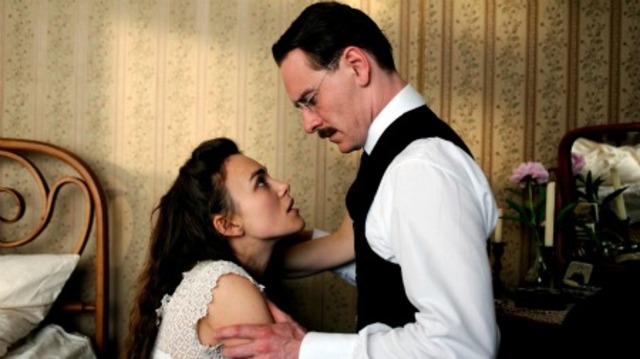
These are three actors capable of remarkable work, and while they’re fine here, the material simply doesn’t give them the space to create multi-dimensional characters. The conflicts between Freud and Jung, which were profound in reality, feel petty and half-baked. Jung’s affair with Spielrein comes across less as a natural extension of either of their characters and more as an excuse to see Fassbender and Knightley engage in some light, tastefully shot S&M.
At barely over an hour and a half, A Dangerous Method simply feels rushed and incomplete, a CliffsNotes version of events where a novel was required. As a dramatic imagining of events, the sketched characterizations mean that the conflicts between these characters have little weight. But given how simplified it makes the more fact-based historical bullet-points, it fails as an educational piece as well. Ultimately that leaves it as the classroom movie played at the end of the semester when an instructor just needs to fill some time.
—
A Dangerous Method
Directed by David Cronenberg
Written by Christopher Hampton, based on his own play, The Talking Cure, which was in turn based on the book A Most Dangerous Method by John Kerr.
Starring Michael Fassbender, Keira Knightley, Viggo Mortensen, Vincent Cassel
Running time: 99 minutes
Rated R for sexual content and brief language.
Opens today at several area theaters.