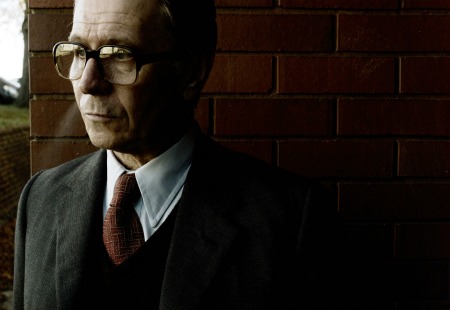
 You could spend an entire essay talking about the visual detail of Tomas Alfredson’s Tinker, Tailor, Solider, Spy. This is a film that never needs a word to express that it’s not just about the Cold War, but about cold men, cold interactions, a cold decade. There’s the grey, muted color scheme that creates an eternal autumn out of the entirety of the 70s. The pale, doughy faces of men who look as if they’ve never seen the sun, faces sitting under bad haircuts and worse combovers, sequestered in smoky, soundproof underground rooms discussing the activities of their intelligence counterparts in other countries, who are likely also overwhelmingly pale, male, and grimly disaffected. The wallpaper is textured, the filing cabinets metallic and industrial, and the secretarial pool seems designed to take leering gazes just as much as they take dictation.
Welcome to the British Secret Intelligence Service in the early 70s. As the film opens, frequent John le Carré protagonist George Smiley (Gary Oldman)—a nearly emotionless intelligence expert who is among the top brass of the SIS—has just been forced into early retirement along with his boss, “Control” (John Hurt) in the fallout of a botched operation in Hungary that results in the death of an operative. But someone else who remains in the agency has information that suggests there is a Russian mole sitting among the men who make up the SIS management, and he goes to Smiley in secret, recruiting him to ferret out the double agent.
Smiley’s focus is laserlike, and yours will need to be, too. Tinker, Tailor, Soldier, Spy was previously adapted for the BBC in 1979 (with Alec Guinness in the Smiley role), and that miniseries version ran nearly six hours. Compressed to just over two hours, Alfredson’s version is almost too dense to absorb in a single viewing. The film, like the book, employs frequent flashbacks and jumps around in time as Smiley slowly pieces together a puzzle with pieces supplied by sources of varying degrees of reliability. The amount of information to process can get dizzying.
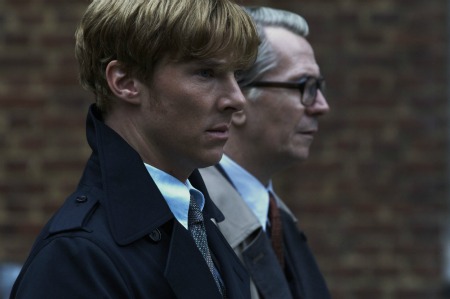 But Alfredson’s obsession with those finer details, the classy, classic visual stylization that makes it so much grim and atmospheric eye candy, points to the fact that the director is interested in more than just relating a not-so-simple mystery. What Alfredson is after is the very character of the Cold War itself. The secret at the center of the film, who the Russian mole is, exists as a symbol of the cloudy and uncertain objectives of a war with no battlefield.
This is a war fought by meetings, by phone calls, by lies, smoke, and mirrors. Its battles weren’t fought by young men taking strategic objectives with firepower, courage, and strength, but by old and middle-aged men overseeing a massive chessboard of strategic secrets, where information is the weapon of choice and guns are a last resort. Alfredson gives us a portrait of the Cold War that displays in vivid detail the emotional fatigue of a working life kept under a constant shroud.
The collapse of Smiley’s marriage, shown as a corollary to the flashbacks that also lead to the mole, is not just extra color for his character, but an illustration of the fallout of lives lived with such a sharp divide. All of these characters—and there are quite a few to keep tabs on, with an ensemble includes a fantastic collection of some of the best British actors working today, from Oldman and Hurt to Colin Firth, Toby Jones, Ciarán Hinds, Tom Hardy, and Benedict Cumberbatch—are isolated and alone, by the necessity of their job, which become their lives. “I want a family,” the relatively young operative played by Hardy says at one point, “I do not want to end up like you lot.”
If your attention does wane enough to get a little lost, it’s entirely understandable in a labyrinthine movie like this. In fact, it may be by design. Confusion and uncertainty is the frustrating daily reality for the characters, so why shouldn’t it be the same for anyone watching? More importantly, Alfredson’s meticulous attention to detail is so complete that you could turn the sound off, ignore the intricacies of the plot, and still completely understand the miserable, cold existences of the Cold War’s infantry.
—
Tinker, Tailor, Soldier, Spy
Directed by Tomas Alfredson
Written by Bridget O’Connor and Peter Straughan, based on the novel by John le Carré
Starring Gary Oldman, Mark Strong, Benedict Cumberbatch, Colin Firth, John Hurt, Tom Hardy
Running time: 127 minutes
Rated R for violence, some sexuality/nudity and language
Opens today at E Street and Bethesda Row.