Martin Austermuhle
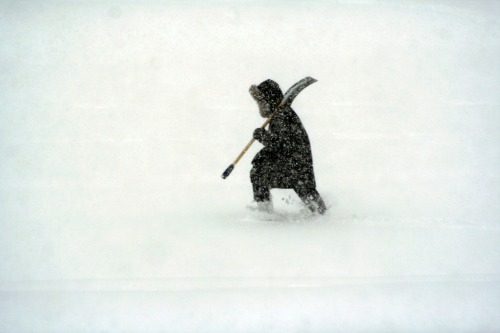 Photo by caryn74
This post has been updated.
It’s a usual winter-time complaint in the District—snow falls, residents and business-owners alike fail to properly shovel and pedestrians are left to navigate treacherous sidewalks.
But a bill making its way through the D.C. Council would finally update a ninety-year-old law and more forcefully require residents and business to shovel their walks after any significant amount of snow.
The bill, originally introduced in January by Councilmember Tommy Wells (D-Ward 6) and Councilmember Mary Cheh (D-Ward 3), would increase fines imposed against residents and businesses that don’t shovel their walks within the first eight daylight hours after a storm. More importantly, though, it would create a more efficient enforcement mechanism, allowing the city to actually collect those fines and impress upon non-shoveling scofflaws the errors of their ways.
As we learned earlier this year, the District’s existing shoveling law dates back to 1922 and imposes a $25 fine for not clearing a sidewalk when there’s snow on it. But it also sports an enforcement mechanism that isn’t terribly easy to employ—essentially, the District has to clear the snow and then sue a resident or business to get the fines. Not surprisingly, it wasn’t particularly effective.
Under the new law, a resident could see a first fine of $50 for not shoveling, with subsequent violations being met with $100 and $200 fines. For businesses, a first violation would bring a $250 ticket, and a second and third $250 and $1,000, respectively. Enforcement would be divvied up between the Department of Public Works, Department of Transportation and MPD.
The bill was not without detractors, though. A lawyer speaking on behalf of CVS argued that the proposed fines were too high for small businesses, while some residents advocated for increasing the time available for shoveling from eight to 24 hours. DPW Director Bill Howland also had concerns to share—he argued that even with a clearer mandate, DPW personnel are too busy clearing streets after snowfalls to be out ticketing homeowners and businesses.
Still, even if the law were to sail through the council, it it may not become the standing norm until late in the winter. Beyond the fact that the bill allows the city to issue warnings before the new fines take effect, it will still have to go to Congress for the usual 30-day review. At best, that means that it’ll be early March before those non-shovelers get what’s coming to them. And even then, there’s little the District can do to punish the federal government from clearing its sidewalks—and it’s one of the most consistent offenders.
UPDATE, 11:15 a.m.: It looks like those sidewalks won’t get much clearer this winter — the legislation has been put on hold.