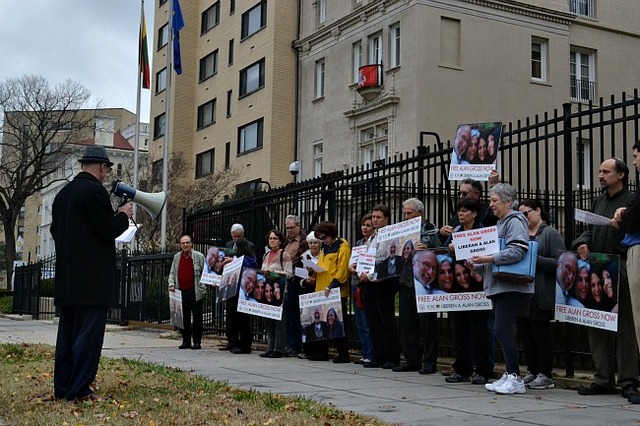
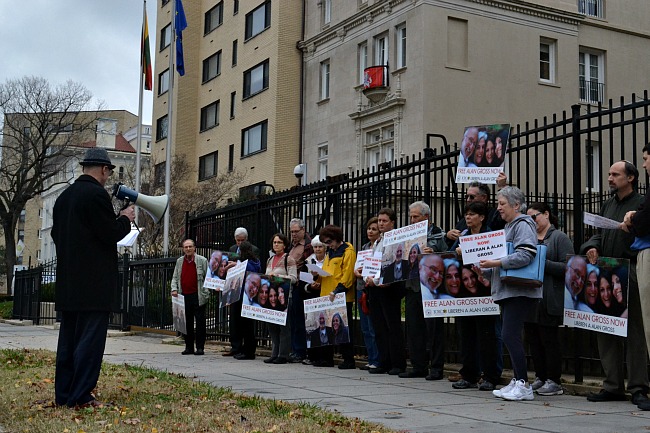
 One of the Monday vigils for Alan Gross in front of the Cuban Interests Section in Adams Morgan.
Walk up 16th Street NW on a Monday and you’re likely to hear a growing chorus around the intersection at Euclid Street, just outside the Cuban Interests Section:
“Free Alan Gross!”
The refrain is part of a weekly protest outside the imposing black gates of the diplomatic mission, where every Monday interfaith vigils call for the release of a Jewish-American government contractor from Maryland who has been sitting in a Cuban jail cell since Dec. 3, 2009.
They hold large posters showcasing a smiling family photo of Gross, his wife Judy and and their two daughters, often breaking into Jewish songs and prayers, hoping to influence President Raúl Castro’s government to release him on humanitarian grounds. Gross’ cadre of supporters includes relatives, friends, acquaintances, his fellow worshipers at the Am Kolel congregation in Montgomery County and strangers who believe in his case.
“I didn’t know him. I just know he is a U.S. citizen held in Cuba,” says John Wassel, a Hagerstown, Md. resident who works for the Jewish Federation of Greater Washington and is a regular at the vigils. “I heard of his plight, and I thought it was a legitimate cause.”
Arnold Saltzman also doesn’t know Gross, but he’s “sympathetic to a person anywhere who has been used for political reasons.”
“We believe he should be released under humanitarian grounds,” says Saltzman, a rabbi at three Maryland synagogues.
Gross’ incarceration has attracted international attention for being entangled in a long-standing feud between the United States and Cuba since Fidel Castro took over the island nation in 1959.
“Alan Gross is a victim of the bilateral issues between the U.S. and Cuba,” says Ron Halber, executive of the Jewish Community Relations Council of Greater Washington, one of the organizations pressing for Gross’ release and coordinating the vigils.
Now 62, Gross, a resident of Potomac, Md., was arrested two years ago trying to board a flight at José Martí Internationa Airport in Havana. Cuban authorities accused him of espionage for distributing telecommunications equipment and held him for several months without charge. At the time of his arrest, Gross was a small-business subcontractor for Development Alternatives Inc., an international development firm based in Bethesda that won a pro-democracy contract from the U.S. Agency for International Development to help Cuba’s small Jewish community connect to the Internet.
In March, a Cuban court sentenced him to 15 years for “subversive” activities. His appeal a few months later was rejected.
Cuba’s ongoing detention of Gross is hampering what were seen as small strides toward normalizing relations between Cuba and the United States after half a century of diplomatic antagonism. Shortly after taking office, President Obama eased travel restrictions to the island nation and allowed Cuban expats to wire money to their relatives. The White House has openly said that no further relaxation of U.S. policy toward Cuba will take place until Gross is released.
The bigger issue, however, is that USAID’s democracy program is illegal in Cuba. Experts on U.S.-Cuban relations even consider the program as a semi-covert operation aimed at overthrowing the Castro regime, and a Cuban statute known as “Law 88” explicitly prohibits U.S.-backed pro-democracy campaigns.
“It’s important to be clear that this isn’t about helping Cuban people get connected to the Internet,” says Anya Landau French, the director for the U.S.-Cuba Policy Initiative at the New America Foundation, a public-policy think tank. “[The program] was a crime in Cuba and so how are we going to get Gross out?”
Gross’ long record of humanitarian work all over the world—he’s developed mines in Pakistan and cultivated fields Azerbaijan and the West Bank—has been highlighted by those clamoring for his release. His family, friends and former coworkers insist that he had no malicious intentions when he undertook the Cuban project. They describe him as a compassionate individual who has worked for 25 years to improve the quality of people’s lives without ever arousing the ire of the local authorities.
“I know him as a solid professional and a really good guy,” says Les Ulanow, a Potomac resident who worked with Gross while they were at the Jewish Federation and now attends the vigils.
Besides the political implications, Gross’ supporters also point out his deteriorating health and his family’s well-being. He has lost 100 pounds, but his wife, Judy, has told news outlets that he gained a few back because his arthritis prevents him from moving around. Both his mother and daughter have been stricken with cancer. Without her husband helping the finances, Judy also had to sell their home in Potomac.
Like many experts in her field, French believes that the subcontractor went to Cuba without any protection from the U.S. government. Jim Boomgard, the president of Development Alternatives, told The Washington Post that Gross hadn’t been trained properly and traveled to Cuba without the correct documentation.
The situation has attracted diplomatic heavyweights such as former President Jimmy Carter and former New Mexico Gov. Bill Richardson—who has played a role in negotiating the release of Americans held by other unfriendly regimes—to visit Havana and attempt to bargain for Gross’ release.
Raúl Castro’s government has often suggested swapping the jailed American with a group of Cuban intelligence agents, called the Cuban Five, whom many in the communist regime consider to be national heroes. The agents were captured in September 1998 while spying on members of a Cuban dissident community in Miami, where they have been held ever since. (One of the five, Rene Gonzalez, was released in October and placed on probation that requires him to remain in the United States.)
The State Department maintains that Gross’ case is not comparable to that of the Cuban prisoners’ and refuses to make the exchange.
Although the religious community and the Gross family’s campaign to raise more awareness about the case have recently ignited more interest from other U.S. leaders, the Obama administration hasn’t been too vocal about the next steps.
When Gross was mentioned at a recent White House press conference, spokesman Jay Carney expressed little assurance of progress.
“Cuban authorities have failed in their effort to use Mr. Gross as a pawn for their own ends,” Carney said at the Dec. 2 briefing. “They must heed the call of Mr. Gross’ family and friends, the international community and the U.S., to immediately release Mr. Gross.”
When asked if the president will make a personal appeal, Carney said he didn’t want to “make any announcements about what he may or may not be saying or statements he might issue.”
Despite little improvement over the past year, Gross’ supporters do have hope that he will be released.
“Being here is essential,” Saltzman says of the vigils. “We’re building a step on the ladder to reach to him.”