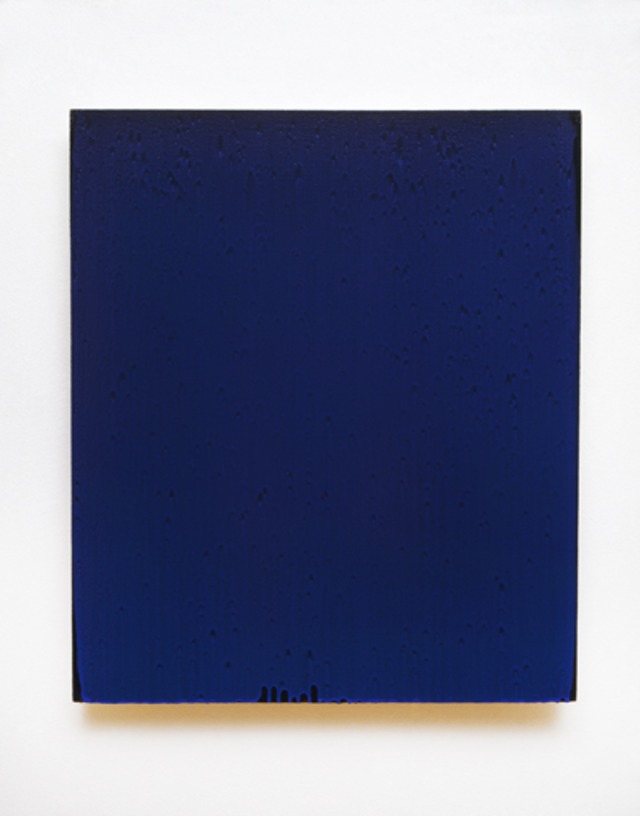
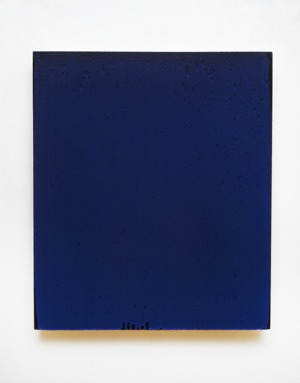
 Joseph Marioni. Blue Painting, 1995, No. 26. Acrylic and Linen on Stretcher. 28 x 24 in. Courtesy The Phillips Collection.
As 2011 winds down, you still have a chance to see successful exhibitions at the Phillips Collection that focus on two wildly different painters. One is an old master who may be more modern than you think; the other is a contemporary expert in radical painting. Yet their approaches to color and motion connect in direct and indirect ways throughout the gallery.
Eye to Eye: Joseph Marioni at the Phillips, is the first Washington exhibit of the artist’s paintings, but the “liquid light” of the artist’s bold mochromatic canvasses echoes current and previous exhibits at The Phillips, like the Rothko room and last year’s Robert Ryman show. Like Ryman, who was the subject of 2009 lecture he gave at the Phillips, Marioni treats paint as an object. But unlike Ryman, who would take a blank canvas and make art with a simple inked line drawn around the canvas’s perimeter, Marioni makes full expressive use of color. Blue Painting No. 26 gives the illusion of drips as well as real drips. These are not mere color fields but are loaded with subtle texture that suggest the motion of paint. As pure abstractions, they may not be representative in the sense of a stil llife, but the textures capture a sense of quiet motion and change despite their surface stillness.
Movement and color are seen in a very different context in Degas’ Dancers at the Barre: Point and Counterpoint, which showcases one of the artist’s most popular and well-regarded paintings with related sketches and other ballet-minded canvases. A pastel and charcoal sketch of the dancer shows a slightly wider composition and legs properly situated – probably drawn from a model. But the finished painting moves the leg to a subtly unnatural position. It’s not obvious at first but it seems a soft prelude to cubism in its suggestion of movement. Degas’ bold orange and slightly jagged anatomy sound notes of tension in a delicate figure, and perhaps convey a bit of the physical difficulty and pain behind even the most graceful art.
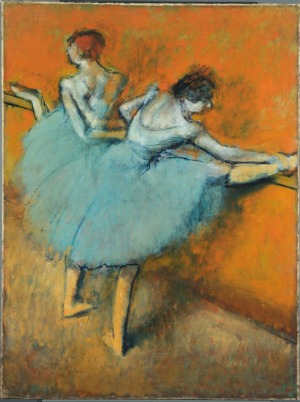 Hilaire-Germain-Edgar Degas, Dancers at the Barre, early 1880s−c. 1900. Oil on canvas, 51 1/4 x 38 1/2 in. The Phillips Collection, Washington, D.C. Acquired 1944.
I asked Vesela Sretenovic, Curator of the Marioni exhibition and Senior Curator of Modern and Contemporary Art at the Phillips, if she found any relationship between Degas and Marioni and their approach to motion and color:
“Their approaches, including techniques and thinking behind, could not have been more different. Degas uses color as a means of formal composition whereas for Marioni color is the end to itself: a means and the final result; the form and the subject matter of painting. Degas is rendering (or representing) subjects of his fascination (ballet) from life and through color, light and movement; Marioni’s paintings are non-representational, non-narrative, or in his own terms, “radical” for they are independent objects in space that use fundamental properties of the medium – color and light- as its guiding principles. As opposed to Degas, Marioni’s paintings are not about motion but stillness: a depth of color imbued with light.”
Still, Marioni’s paintings are exhibited adjacent to a companion gallery of works fom the Phillips Collection by Pierre Bonnard, Paul Cezanne, Morris Louis, and Henri Matisse, among others. Director Dorothy Kosinski notes that “The deep colors of [Marioni’s] luminous paintings” work “in conversation with works from our collection” and “reverberate through the galleries.” Kosinski may have been writing specifically about the comapnion galleries, but Marioni’s intense approach to color indeed resonates to unlikely places as in Degas’ intense orange in Dancers at the Barre. Marioni may well be an architect of monochromatic stillness, but his suggestion of motion is palpable. Time and sundry art movements separate Degas and Marioni, but the concerns of the artist – the expressiveness of color and light – resonate across the years.
Degas’s Dancers at the Barre: Point and Counterpoint is open through Jan. 8, 2012 and Eye to Eye: Joseph Marioni is on view through Jan. 29, 2012 at the Phillips Collection, 1600 21st St. NW, 10 a.m. to 5 p.m. Tuesdays through Saturdays, 10 a.m. to 8:30 p.m. Thursdays, 11 a.m. to 6 p.m. Sundays. $12.