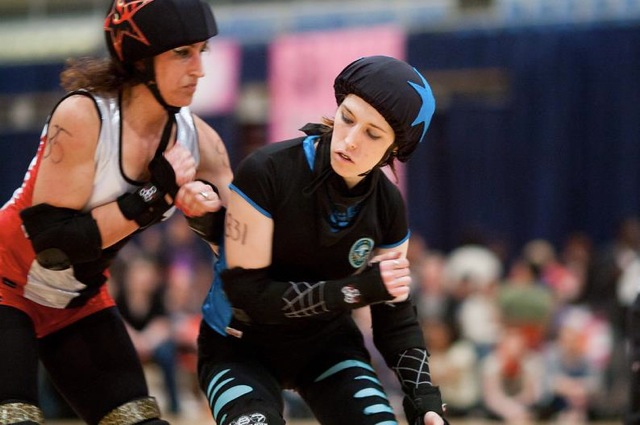
 Photographs by James Calder
When Kayley Whalen signed up for roller derby in May 2008, she lied about who she was.
“I was required to sign a code of conduct that stated, ‘transsexual women are allowed to join if it has been at least two years since surgery, per International Olympic Committee rules’,” she writes in a recent article for FiveOnFive, a roller derby magazine.
Whalen, who skates under the name Lenore Gore, was drafted onto the DC Rollergirls team Scare Force One, and in this newfound sport, she found excitement, competition and friendship. She bonded with her teammates during games, after practices and at other squad outings.
In the rink, Lenore Gore is the “jammer,” scoring points while speeding past the other team’s players while blockers with names like Dyke Diggler, Velocity Raptor and Marion Barrycuda toss opponents aside to clear the way. It’s sisterhood through bruising.
Whalen, who is 26, is lean and athletic, has shoulder-length brown hair and affects a disarmingly cheerful smile. One minute she’s on the bench, grinning in anticipation; the next she’s elbowing her way past other skaters, her smile transformed into “get-the-hell-out-of-my-way” determination.
Naturally, as members of Scare Force One drew closer together, the conversations eventually turned toward personal origins. Here, Whalen was forced to clam up. The policies used then by DC Rollergirls meant that if she came out to her teammates as transgender, she would be expelled from the league.
It almost came crashing down in that first season:
After winning a particularly vicious bout, an anonymous complaint was filed with my league’s Board of Directors demanding an investigation into my medical history to determine whether I was woman enough to skate with the league.
Fortunately for Whalen, Scare Force One’s captain was empathetic. Her team’s leader studied up on transgender issues and said there was no pressure to come out. Still, Whalen also learned during this conversation that a few rumors had been bandied about alleging her transgender status gave her an “unfair advantage.”
Not long after, Whalen was confronted at practice by another skater who didn’t quite understand; the conversation escalated until their respective captains pulled them apart. That anonymous complaint was tossed out as a privacy violation, but the message was sent: Roller derby needed to become more inclusive toward Whalen and other present and future transgender players.
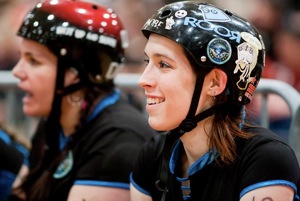 (James Calder)
Whalen’s no stranger to activism. For years, she’s been at the throat of the Michigan Womyn’s Music Festival, which is just about the biggest grassroots, feminist music and arts event in the country. But for all its progressivism, the festival has always been closed to transgender women. In 2006 and 2008, Whalen helped establish Camp Trans, an offsite protest settlement. For the past two years, she’s infiltrated the festival gates to bring Camp Trans inside the event.
“I think I know just about every transgender activist woman who identifies as queer in every major city in the U.S. and Canada,” she says in an interview.
Given her brio for making the world a fairer, more open place, it’s no surprise to learn that today Whalen spends a lot of time with Occupy D.C., or that her day job is with an outfit called the American Humanist Association.
But not all activism can be so overt. Transforming roller derby has been more procedural and more personal. And the job’s not finished yet.
Whalen came out to some of her teammates in dribs and drabs in the months after those initial conversations, but not to all of them, and definitely not to the league.
In 2009, Whalen contributed an essay for Gender Outlaws, an anthology of personal stories from transgender writers making their way in what is hopefully a more accepting century. But given what would happen if DC Rollergirls realized she was transgender, Whalen submitted her essay under a pen name—the derby-appropriate Uzi Sioux. That she didn’t want to upset those who had helped make D.C. Rollergirls a more accepting organization also contributed to her anonymity.
In October 2010, a few months after Gender Outlaws was published, Bluestockings, a feminist bookstore in New York, held a release party. Of the book’s many contributors, Whalen was one of a handful invited to read a passage. No more anonymity.
“At that point I was out to a lot of members of my team, but not the whole league,” she says. Promoting the book in public “was a pretty simple decision because I love fighting for transgender inclusion and rights. And it wasn’t my city.”
Even though she was away from home, this would blow her cover. Bluestockings was packed with bodies. “I was like, ‘I don’t give a fuck. Here’s my real name,’ ” she says.
By then, and in the ensuing months, it had become an open secret that leagues sanctioned by the Women’s Flat Track Derby Association (WFTDA), the sport’s governing body, were home to transgender players. The surgery-based policy needed changing.
If roller derby’s transgender movement had its Yalta Conference, the East Coast Derby Extravaganza in Philadelphia this past June was it. In March, WFTDA announced a new policy defining “female” as having a “medically acceptable” level of hormones according to a player’s physician.
It’s far from perfect, Whalen says, but it’s a big step forward. Not all at the Philadelphia derby confab agreed. The Philly Rollergirls came out against the new policy as still too restrictive, saying it would lead to witch-hunts. Among her hometown squad, Whalen’s support for the new policy put her in an awkward position.
“A bunch who knew I was trans said, ‘We don’t like the policy, I’m voting against it,’ “ she says. “Ironically what happened was I sided with the girls who had called me out years before and had bullied me.”
 (James Calder)
In promoting WFTDA’s revised policy, Whalen found herself coming out to more people—teammates, even—than before. But telling her story was no longer the burden it had been just three years prior.
“I talked to so many people about the policy,” she says. “Dozens, hundreds—it was so easy.”
After the conversations about the new rules, which take effect in January, Whalen asked FiveOnFive, the derby magazine, if she could write about the conversations she had to make her sport more open toward transgender players. And she wrote this one under her own name.
Not that things are entirely settled. The Philly Rollergirls are still against the revised transgender policy, and Whalen writes in her article that she hopes their protests will lead to further, “more inclusive” changes such as written guarantees against the use of hormone testing.
But Whalen’s article isn’t just about a new policy; it’s how she came to be accepted within roller derby and how it’s a bit less scary today for an eager transgender skater to jump into that anarchic rink. Today, Lenore Gore plays “derby mom” to two newer members of DC Rollergirls, one of whom is transgender herself. Riled up Girl Scouts approach her in admiration after matches. She’s even compelled a few seasoned veterans to come out.
After Whalen’s article was published online, a former member of Chicago’s Windy City Rollers—“one of the best leagues in the world,” Whalen says—came out in one of the comments. The skater, who goes by the name Meg Guyver, wrote:
I’m a transgender skater as well, but I actually completely approve of the policy that is about to be implemented. One thing I’m sure nearly everyone can agree on is how wonderful it is that we’ve progressed to a point when everyone can openly and honestly discuss this issue as adults.
“I never knew she was trans,” Whalen says.
Correction: Due to a reporting error, this article originally stated the rule barring transexual women within two years of surgery was implemented by WFTDA. It was issued by DC Rollergirls.