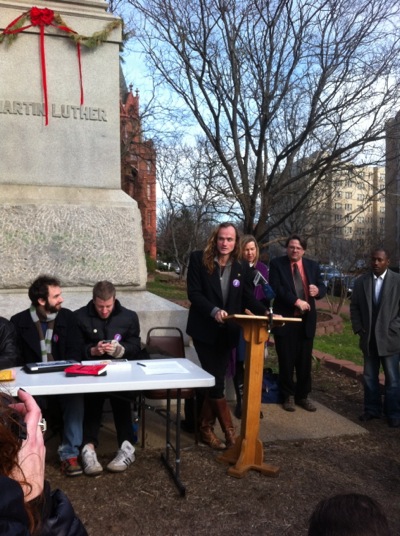
 Photograph by Benjamin R. Freed
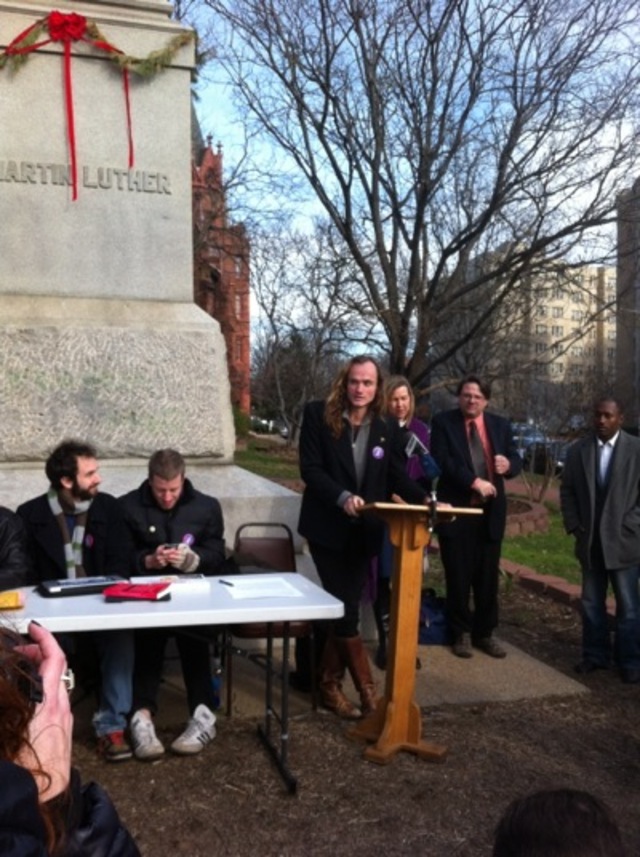
The group of activists on an extended hunger strike—really, just two are currently fasting—held a press conference earlier today outside the Luther Place Memorial Church on Vermont Avenue NW to announce three initiatives they hope will result in full Congressional representation for the District.
Now residing at the church’s 28-bed hostel, the hunger strikers have come up with some new methods to achieve statehood, or at least some legislative and budgetary autonomy.
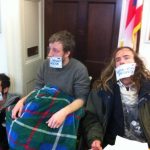
Adrian Parsons, the hunger strike’s ringleader and the lone holdout of the original group of fasters, appeared as gaunt as ever in announcing the new tactics. Now on his 23rd day without food, Parsons looked far older than his 29 years, speaking slowly while standing at a podium. (Since the beginning of his protest on December 8, he has been seen most often either sitting in a wheelchair or laying in a bed.)
The group has a new online petition demanding D.C. voting rights that they hope will gather nearly 618,000 signatures—one for every District resident—from across the country and be delivered to members of Congress.
Second is a “51-day solidarity strike,” in which the hunger strikers are asking their backers to fast for a day and then “pass on” the self-imposed deprivation to another supporter of Occupy the Vote D.C. Call it “starve it forward” for lack of a better phrase.
But the hunger strikers’ third item is somewhat of a head scratcher. Calling it “taxation for representation,” they are proposing a one-cent tax on bottled water to create a new position in the District government that would be responsible for analyzing federal legislation that affects the District and lobbying members of Congress against backing measures like those that target the District’s policies toward abortion or gun ownership.
Yet it wasn’t exactly clear how this envisioned city-paid ombudsman—who would be appointed by the D.C. Council—would be able to have a bigger impact on Capitol Hill than Del. Eleanor Holmes Norton or even the District’s three-person shadow delegation. The hunger strikers said they’ve discussed the proposal briefly with Councilmember Tommy Wells (D-Ward 6), but there’s no clear timetable for offering legislation on creating a “rider-finder,” as Parsons called it, joking that the term sounded like something Texas Gov. Rick Perry would say in his foundering presidential campaign.
Still, Parsons said that his voting-rights hunger strike was a step beyond its origins of Occupy D.C. by finally having some clear-cut demands instead of the demand-free nature of the encampment at McPherson Square.
“You have to move to a point where you have some asks,” Parsons said.
But many of the asks directed toward Parsons had more to do with his visibly declining appearance than with this new legislative initiative. Three weeks of self-induced starvation has left Parsons with deep creases in his face, a frail voice and shaky posture. He said he started the hunger strike weighing about 150 pounds and is now down to 123. The lack of nutrition has taken a toll on his kidneys, too.
How much longer will Parsons continue this fast? He shown any sign of quitting yet, and despite the sympathy strike from Rep. Keith Ellison (D-MN) and Norton’s reading of the hunger strikers’ mission statement into the Congressional Record, the District isn’t really any closer to achieving full voting rights than it was before Occupy the Vote D.C. popped up.
The group did advertise today’s event with the expected attendance of Mayor Vince Gray, though it was not on his public schedule. When Gray did not appear, Parsons issued an admonishment: “Let it be noted, we are disappointed he is not at the podium.”
Still, as TBD’s Jenny Rogers noted, we can’t stop watching the performance artist.
“If you have D.C. statehood tomorrow a lot of things will change,” Parsons said. “But that won’t happen tomorrow.”
So we’ll keep watching Parsons, I suppose.