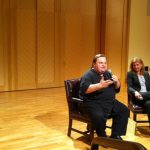
 Please keep your criticism to 140-character increments. (Photo by Danilo Lewis)
For a few of its earnest online fans, Woolly Mammoth Theatre Company will be testing out “tweet seats” for its upcoming production of Civilization (all you can eat).
Well, in moderation, at first.
The edgy theater announced today a contest to be part of a “tweet up” about Civilization, a new play by Jason Grote billed as “a vaudevillian romp of corruption, consumption, and enterprise at the dawn of the Obama age.” Woolly Mammoth’s artistic director Howard Shalwitz, who is not a Twitter user, is directing the show.
Woolly Mammoth spokeswoman Brooke Miller said the idea came from artistic development director Miriam Weisfeld after hearing about one of NASA’s “tweet ups”, events at which followers of an organization, company or past-time deign to meet each other in the real world, and live-tweet the whole experience.
Miller said Woolly Mammoth will pick three of its Twitter followers (it has about 3,100) who enter the contest using the hashtag “#WoollyCIV.” The winners will then be invited to attend Civilization‘s first rehearsal, a technical rehearsal and final dress rehearsal. It is at that final run-through that they’ll be permitted to tweet their way through the show.
Twitter can sometimes be a sticky topic among members of the theater community. On one hand, it’s allowed artists, critics and theatergoers to engage each other like never before. On the other hand, it’s the Internet, and people can be jerks. That was sort of the gist of a event last November at Arena Stage, during which Washington Post theater critic Peter Marks and former American Theatre Wing director Howard Sherman talked about Twitter, among other changing aspects of the theatergoing experience.
Marks, a fairly prolific Twitter user himself, was curious why Woolly Mammoth was keeping this promotion to just three winners.
“It’s an experiment,” Miller said in an interview. “If it does work, we may possibly do more.”
But the idea of tweeting during a live stage performance gives some people pause. The Cincinnati Symphony Orchestra and Palm Beach (Fla.) Opera have been experimenting with them, and last month the Public Theater in New York started selling tickets to thumb-typers. Though tweet seats allow a few audience members to provide a running commentary, the idea hardly sits well with all. In an op-ed in Sunday’s New York Times, the writer Peter Funt dismissed the concept outright:
So what’s the deal with tweeting and texting in theaters? Are promoters so desperate to attract younger audiences that they’re willing to risk disrupting the experience for the majority of paying theatergoers? The answer, in five characters, is “u bet.” Here’s a suggestion for the Palm Beach Opera: Since you already have super titles to provide the English translation, why not also display messages from the tweet seats? They could scroll along during the show, the way CNN and Fox News Channel have been running distracting viewer tweets across the bottom of the TV screen during presidential debates.
…
Several players have been discovered tweeting during games, among them Chad Ochocinco, who was once fined $25,000 by the N.F.L. for sending messages during a Cincinnati Bengals game. What’s next? Plácido Domingo tweeting from backstage at The Met that the conductor failed to keep up with him during “The Enchanted Island”?
“I think the opinions on the issue are divided,” Miller said. “We’re willing to take risks. We’ve sort of been playing with the ideas of creating ‘Twitter ambassadors.'”
Of course, for Woolly Mammoth, the obvious risk is the chance someone will hate on the show as it happens.
“It’s always a risk that you take,” Miller said. “You hope they’ll either give constructive criticism or not completely trash it.”
But if it’s a successful experiment, she said, Woolly Mammoth audiences may one day include tweet seats during the regular schedule.
“Obviously you want keep them in the back row,” she said.