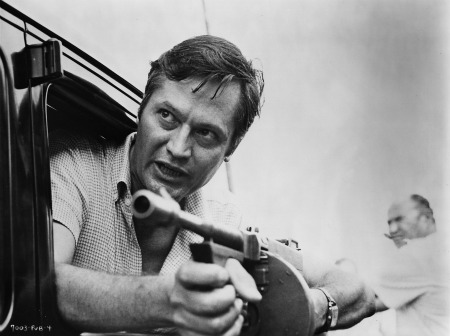
 If you head over to the IMDb, look up Roger Corman, and start scrolling through his filmography, make sure your scrolling finger is limbered up. The list of producing credits alone stretches, as of this writing, to 398. And Corman, well into his 80s now, is still consistently averaging two to three movies a year. Many of those aren’t just putting-up-the-money executive producer credits, either. Corman, as Alex Stapleton’s documentary Corman’s World demonstrates in its opening minutes, is a hands-on producer, offering directorial input onset (keep scrolling down the page and you’ll find over 50 directorial credits from 1955-1990), and sitting with the editor and guiding the cutting process.
If you look more closely at the titles in those credits, it becomes clear what the focus of Corman’s career has been: Attack of the Giant Leeches; Naked Vengeance; Night of the Blood Beast; Sharktopus. Corman is called the King of the B’s for a reason, but as an interview clip from the Tom Snyder show that Stapleton highlights during her film shows, he’s not that comfortable with the label.
Stapleton dedicates much of her film to showing just why such a limiting nickname isn’t entirely fair. After all, without Corman, luminaries like Jack Nicholson, Martin Scorsese, Jonathan Demme, Robert DeNiro (just to name a very few) might never have gotten the breaks needed to become the giants they are now, nor might European masters like Fellini and Bergman ever become quite as familiar to American audiences during the 70s.
Stapleton interviews many of these artists and more, and the portrait that emerges isn’t one of a money-hungry, cigar-chomping, two-bit Hollywood schlock-meister grinding out film after film just to turn a profit. Corman is a thoughtful and genteel figure, who recognizes the need in our movie diets for high art, low trash, and everything in between. Even more than that, he’s a man who understood exactly what was going on with changing movie tastes from the 50s onward, giving young moviegoers the kinds of films they wanted before Hollywood had even realized they wanted them. What Corman understood intuitively about youth culture in the 50s and 60s would take a studio millions of dollars and endless experts and focus groups to figure out today.
 That’s not to say Corman wasn’t obsessed with the bottom line. Nearly every interviewee comes around to the subject of money, and how tight Corman was with it. He reused sets from film to film, constricted shooting schedules for entire feature films down to a mind-blowing two days, eliminated jobs by doing many things himself, and often alienated some of his most talented protégés by refusing to pay them more than the bare minimum required by union scale.
Ron Howard, whose first feature was for Corman (and turned into one of the producer’s most successful films, 1977’s Grand Theft Auto), tells some hilarious stories of his discussions with Corman over cash. Jack Nicholson, too, tells of arguments over his pay as a writer, and then of how Corman missed out on one of the biggest cash cows of the New Hollywood era when he let Easy Rider slip through his fingers due to his own stinginess.
Stapleton’s structure is fairly by-the-numbers, but with a subject as fascinating (and archival clips as entertaining) as this, the quality is onscreen as soon as you turn on the camera. It’s a loving portrait, and one could possibly complain it’s a little too worshipful of its subject. But Corman is a lovable subject, and there’s probably no other figure of 20th century cinema who has been quite as undervalued in relation to the magnitude of his contributions as Corman. Which is to say, he’s deserving of a little worship.
Corman taught us it’s no crime to let ourselves be cheaply entertained at the movies; Corman’s World offers plenty of entertainment, and, if there’s any justice, will cause every person who watches to seek out some of the fast, cheap, and out of this world fun amusements that Corman devoted his life to creating.
—
Corman’s World: Exploits of a Hollywood Rebel
Directed by Alex Stapleton
Written by Alex Stapleton and Gregory Locklear
Running time: 95minutes
Rated R for some violent images, nudity and language.
Opens today at West End Cinema.