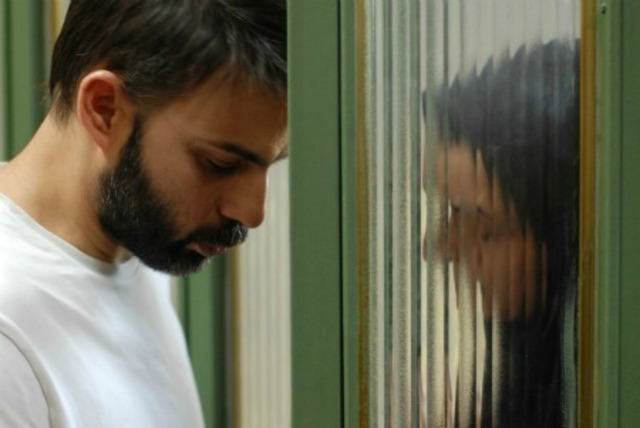
 Iranian writer/director Asghar Farhadi’s latest starts with a long, unmoving shot of a couple sitting before a judge. On one side is Simin (Leila Hatami), a wife who is asking for a divorce from her husband. He’s not a bad man, she insists, he just refuses to leave Iran, and she believes the opportunities for her and their daughter Termeh (Sarina Farhadi) will be better if they leave the country. Her husband Nader (Peyman Moadi) explains that he simply can’t leave: his father suffers from Alzheimer’s and he must remain to care for him. Both argue their cases passionately, but the judge is unmoved: This is Iran, and Nader hasn’t wronged Simin in any way, so he refuses to grant Simin the divorce.
It’s a simple, unflashy opening to a movie that is similarly straightforward and doesn’t try to show off. Farhadi realizes that the complex realities of human emotions and experience are more than sufficient to carry a film, and doesn’t let fussy direction or attempts to be overly clever get in the way of letting this brilliant, quietly insightful story unfold.
Once Simin fails to get the divorce, a domino effect of events is set off. She moves in with her parents, but can’t legally take Termeh with her. Nader, now a working single father with a pre-adolescent daughter and ailing father, must hire a housekeeper, Razieh (Sareh Bayat) to watch over things during the day. But Razieh has problems of her own: she and her short-tempered husband Hodjat (Shahab Hosseini) are deeply in debt, and she’s pregnant. She’s traveling over two hours just to get to this job, and must keep it a secret from her husband to boot; they’re deeply religious (in contrast to the secularity of Simin and Nader) and he wouldn’t approve of her working in the house of a single man.
 The dominos really begin to fall when Razieh, who has already accidentally let Nader’s father wander out of the apartment once, decides to tie him to the bed while she goes out to run an errand. Nader returns home to find his father collapsed on the floor and tied to the bed, and, unsurprisingly, blows up at Razieh, pushing her out the door as he fires her. From here, things become muddy in the way that they do when things start to go horribly wrong for people and they’re forced to make choices between the truth and their own ruination.
Iranian filmmakers must dance a real tightrope in their filmmaking. Not only must the government approve of their work and not object to anything subversive, but if they do object, they face not just censure, but prison time. (Jafar Panahi’s excellent documentary, This is Not a Film details his own house arrest following just such a charge.) It’s hard to watch A Separation without thinking that Farhadi got away with something here, because the film serves as an incisive look at class and religious divisions in his country that one could easily imagine a government objecting to on the grounds that it is bound to start discussions they’d rather not go on.
Farhadi beautifully camouflages that commentary within a film that, while a family drama, has the contours of a thriller. There’s a mystery at work here, because Farhadi keeps himself at enough of a distance that for much of the film, we’re never sure exactly who has wronged who; accusations are thrown around, criminal charges are filed, demands for blood money are made.
But always, at the center of A Separation, are the characters, who have a fullness and a richness that that drives the plot, rather than the plot carrying them along. Everyone here has nearly everything to lose. The choices they made are less choices than they are instinctual moves toward self-preservation, which makes every one of them sympathetic, even when we know they’re doing the wrong thing. Movies generally have heros and villains much more clearly delineated than life; Farhadi does more than blur those lines, he erases them completely.
—
A Separation
Written and Directed by Asghar Farhadi
Starring Peyman Moadi, Leila Hatami, Sareh Bayat
Running time: 123 minutes
Rated PG-13 for mature thematic material.
Opens today at Bethesda Row and Shirlington.