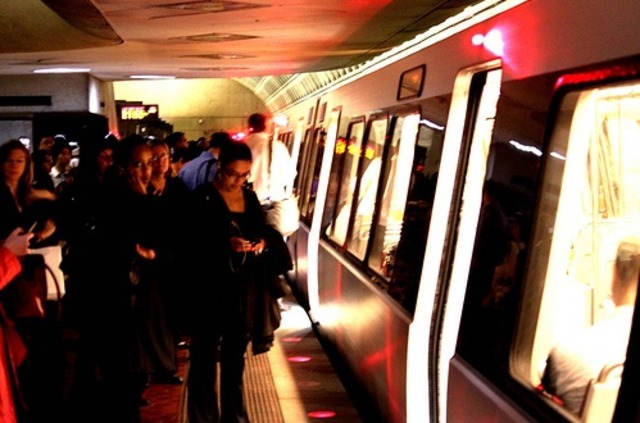
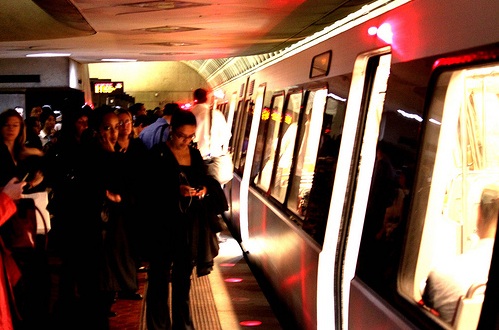
 This scene, from 2010, was repeated en masse last night. (Photo by brianmka)
Maybe it was just unfortunate coincidence, or perhaps the Washington Metropolitan Area Transportation Authority was just observing the yarhzeit of a particularly troubled evening for commuting, but something went terribly wrong with Metro’s computer systems last night, crippling train service about midnight and leaving late-night riders struggling to get home. (It was the second mishap for the transit agency yesterday.)
The notice on Metro’s website says a power outage knocked out computer and radio systems at its bus and rail control centers at 11:59 p.m. At the time, portions of the Red, Orange and Blue lines were already in single-track mode because of scheduled track work. The outage knocking out its communications systems started when a device known as an uninterrupted power supply, which is designed to maintain operations when transferring between main power and backup generators, failed, said Metro spokesman Dan Stessel.
“That was the failure point, it appears,” he said. “It wasn’t a total power failure at the control center, but it knocked out the computer systems.”
The outage knocked out Metro’s website, ability to send out alerts and public-announcement systems at Metrorail stations, leaving customers stranded in train cars or on platforms with no information fromt the transit service. Additionally, it affected Metro’s desktop radio consoles, which are effectively computers themselves, Stessel said. Metro employees switched to handheld radios thereafter, he added.
At the time, trains on the Red, Blue and Orange lines were already traveling with delays of over half an hour due to track work along various segments: on the Red Line between Friendship Heights and Dupont Circle and between Takoma Park and Forest Glen; on the Blue Line between Arlington Cemetery and Foggy Bottom-GWU and between Eastern Market and Stadium-Armory; and on the Orange Line between Ballston-MU and Foggy Bottom-GWU and between Eastern Market and Stadium-Armory.
When the power supply unit blew out, trains along those routes were held in place for about 15 minutes. On Twitter, however, riders reported waiting nearly an hour in some places:
Was just stuck on Metro between Capitol South and Eastern Market for an hour. Fun times.
— David Garber (@GarberDC) January 27, 2012
I want to go home redline!!Communication outage has left us standing here for an hour @unsuckdcmetro #WMATA
— Jennie Conroy (@DrJLCPhD) January 27, 2012
“The combination [of track work and the power failure] is what caused those hourlong waits,” Stessel said. “Without the ability to communicate where trains are to customers it gets folks thinking people nothing is moving.”
But Metro’s own Twitter account was running silent last night, something of an oddity for the 140-character friendly agency. Stessel does not “want to throw anyone under the bus,” but acknowledged that someone could have been manning the @wmata account from a cellphone.
“I was unaware we were not communicating with customers,” he said. “That should have happened. I’m not going to pass blame.”
Stessel said the cause of the interruption of the supposedly uninterrupted power supply is still under investigation.
As for keeping stranded customers aware of goings-on aboard trains and buses, thereby minimizing social-media freakouts (see TBD’s collection of frenzied tweets from irate passengers), Stessel said there may be some changes coming to the way his department handles emergencies.
“Obviously this is a situation that will be reviewed,” he said. “We’ll make changes to protocols not only resolving the issue with power but that we continue to have the ability to communicate with customers. A new alert system for buses, set to be deployed later this winter, will be powered independently of the system at control center, Stessel said.
For now, though, we’ll remember January 26, 2011, as the night the buses went down in a snowstorm, and January 26, 2012, as the evening Metrorail’s communications system went dark.