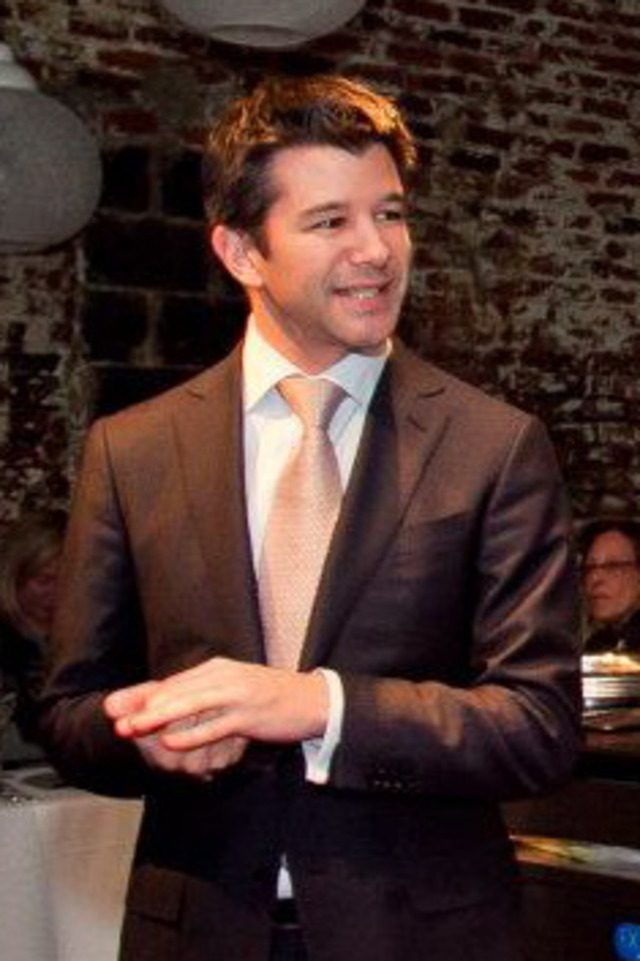
 Kalanick, at Rogue 24 in December 2011 (Via Facebook)
Uber, the upscale app-based livery service, has had a tumultuous go of it since launching in Washington late last year. Though it launched with a flurry of social-network engagement and media curiosity, it promptly ran afoul of D.C. Taxicab Commission Chairman Ron Linton.
Within a month of its debut here, Linton was openly calling the company, which pulls in off-duty sedan drivers to give a lift to customers who’d rather not take a cab, illegal for using a pricing model that calculates for both distance and time without using a District-sanctioned meter. A week later, Linton conducted a “sting” on the company, ticketing a limo driver and impounding the driver’s Lincoln Towncar on the eve of a three-day weekend.
(Disclosure: During its launch here, Uber offered people a credit to try its services. I accepted, and have used it once.)
Uber’s founder and CEO, Travis Kalanick, has said repeatedly that his company is following the District’s taxi and limousine regulations to the letter. That might not fit with reality though, as the company does have a history of irking local regulators. When it launched in 2010 in its home city of San Francisco, it quickly found itself at the business end of a cease-and-desist letter for being in violation of local taxicab regulations. Uber figured out a way to stay open there, perhaps it might find a solution here. Still, its relationship with the DCTC is thin at best; the agency has said it had only one perfunctory meeting with Uber’s representatives before the car service launched here.
Still, the company has its loyalists. Besides its ongoing Twitter and Tumblr pushes, Uber’s gotten some love from Councilmember Mary Cheh (D-Ward 3), who chairs the D.C. Council committee that oversees the taxi commission. Kalanick, who dropped in from San Francisco last week to throw Uber loyalists a swanky party, is returning again later this month to finally have a face-to-face with Linton, though he’s also lawyered up ahead of the meeting.
Kalanick’s got an interesting professional history, though, as evidenced by an article today on Fortune’s website. In it, he comes off as something of a Silicon Valley rabble-rouser—not exactly as troublesome as, say, Napster-visionary-turned-Facebook-hype-machine Sean Parker (though Kalanick, too, got his start in file-sharing), maybe closer to the risky entrepreneurialism of Tesla Motors CEO Elon Musk. “I like shaking things up in an old industry and making something new and different,” Kalanick tells Fortune.
To wit, read how Kalanick got his start in tech country:
D.C. may have picked a fight with the wrong entrepreneur, though. In one sense, Uber is the result of 14 years worth of entrepreneurial misadventures on Kalanick’s part. In 1998, he dropped out of UCLA to work on a peer-to-peer file-sharing program similar to Napster dubbed Scour. With funding from Ron Burkle and Michael Ovitz’s CKE Associates, Scour seemed headed for prime time. It wouldn’t end well. Scour got into a scrape with Ovitz over their term sheet, which eventually lead to a settlement Kalanick still bristles over. (“That matter was amicably resolved years ago,” says James Ellis, Ovitz’s attorney and former Scour board member.) Then, in the summer of 2000, Hollywood served Scour with a lawsuit claiming a whopping $250 billion in copyright damages. Though the suit would be settled for $1 million out of court, the company went bankrupt. Kalanick was scarred. He couldn’t watch a movie in the theater for months; the sight of a studio logo set his blood boiling.
Still smarting, Kalanick tried again. In 2001, he co-founded Red Swoosh with partner Michael Todd. Officially billed as a file-sharing system for corporate clients, Kalanick says he intended Red Swoosh as a “revenge business.” He wanted the Hollywood litigants who sued Scour into nonexistence to pay for a similar technology. But like Scour, Red Swoosh ran into problems. Without his knowledge, Kalanick says his co-founder sought to abandon Scour and take the engineering team to Sony (SNE). (Todd disputes this claim.) Worse, the company ran out of money in the fall of 2001. Kalanick spent those years not paying himself, desperate to keep the business afloat. That meant living with his mother again in Northridge, a suburb outside Los Angeles. At one Consumer Electronics Show, he slept in a rented Toyota (TM) Sienna, giving himself hobo baths in the restrooms of nearby casinos. “There weren’t a lot of ladies during that time period,” he jokes.
It’s also not a surprise to read Kalanick’s final quote in the piece: “I like pissing people off.”
It only took him a few weeks to accomplish that in D.C.