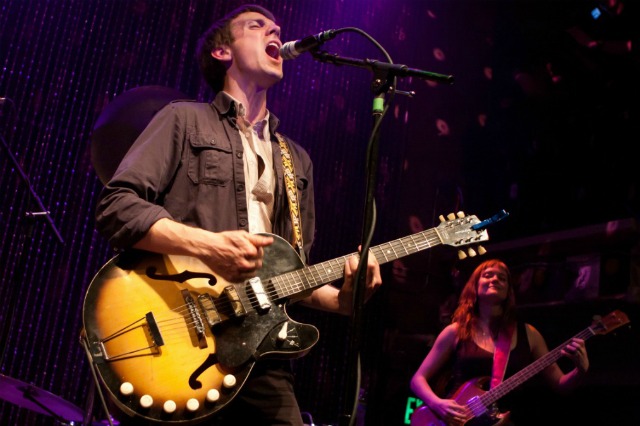
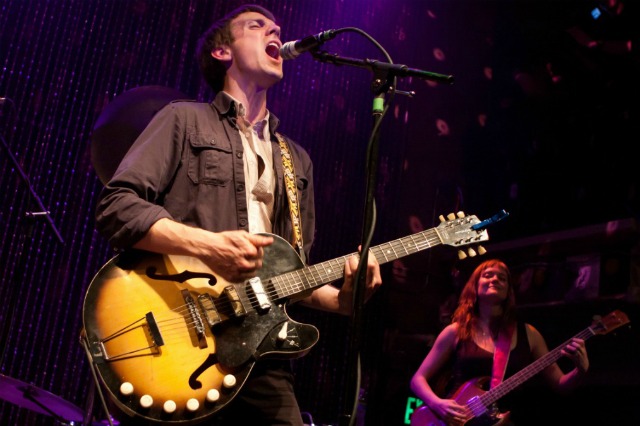
Austin-based alt-rock band Shearwater started 12 years ago as a side project of Jonathan Meiburg and fellow Okkervil River member Will Sheff. After wrapping up a conceptual album trilogy with 2010’s Golden Archipelago, Shearwater is touring in support of their first album on Sub Pop, Animal Joy. Opening for their friend and former tour manager, Sharon Van Etten, the band has hit the road with a new lineup, and Meiburg at the helm. Recruiting Wye Oak’s Andy Stack and a crew of collaborators, Animal Joy takes the band in a traditional rock direction from their signature sweeping orchestral sound. Meiburg spoke with DCist from Austin just head of their current tour.
Golden Archipelago was the final third of a trilogy that included (2008’s) Rook and (2006’s) Palo Santo. How did you transition from that body of work to the new album?
We played a show in January, in Austin last year, the last time we performed live, actually, and we performed all three albums as one complete piece. It was great fun, and a little more ambitious than I thought it would be. I realized the week of the show that the set would be twice as long as any show we’d ever played. It was really a great time, a full crowd, and it was great to sort of reenter the world of these records as one complete whole. But after we had finished with it, I felt like we’d come to the end of something. I wanted to make a break with that approach, and try something with this new record.
How does the new album diverge from what you were aiming for with the last three albums?
Well, there were some aesthetic choices we made right off the bat. I wanted the rhythm session on this record to sound very different. Instead of sounding far away, I wanted it to be right up close, near you. I didn’t want to have any strings. I didn’t want to have that sort of epic, cinematic feel we had on the last couple of albums. I wanted it to sound more like a rock band playing. And I wanted it to be more personal and human with the songs. I looked back at the last couple of records, and I felt that there was something more distant about them, more removed. Which I don’t really mind, but I wanted it to have a little more flesh and blood.
Andy Stack of Baltimore’s Wye Oak is on the new record. When you brought Wye Oak on tour two years ago, did you think future collaborations would come out of that?
Anytime you tour with another band for a long period of time, you get to know a band pretty well. I took to Andy immediately, both as a musician and a human being. He came out here for a week while we were working on the record, and played all kinds of things on the record. Not drums though! Guitar, strangely manipulated keyboard, saxaphone. Andy’s one of those strangely talented musicians who can play just about anything you put in front of him.
You have a master’s in geography and ornithology, correct?
I studied bio-geography, and what I studied specifically was the distribution of a bird that lives in far southern South America.
What was the bird?
It’s called the striated caracara. It lives around penguin and albatross colonies in the Falklands and off of Tierra del Fuego.
Well, that background is often credited as the influence behind the band’s name. Has that scientific background had an influence on your songwriting, musically, mathematically?
No. Probably not. I think that the same spirit of curiousity and fun that informs the best academic work is also present in the best music, and the thrill you get out of working on a research project in the field that’s going really well and the thrill of doing a performance at the level you like it to be, or getting a recorded song just right, is very similar. I don’t know about mathematically.
Ultimately, music is just a funny way of dividing up time. People think of science as sort of a dry pursuit, but it’s really not. It relies a lot on intuition, and being able to see sort of gestalt, whole picture, for brief moments of time, so you know what questions to ask. Music is the same. You have to have an overarching sense of what you’re trying to achieve and what emotional affect you’re going for while you’re making all these smaller decisions.
The band started as a one-off project. Twelve years on, where do you see your focus in the next few years?
I’m amazed that I’m still doing this, and that I’m as dedicated as I am. Have you ever heard the joke about the level of involvement with a plate of ham and eggs, with a chicken and a pig? The chicken feels involved, but the pig is committed. Eventually, you stop feeling like the chicken and start feeling like the pig. I feel pretty well committed at this point; it’s all I do in my life right now. I am going back down to the Falklands for a month later this year to work on a research project. But that’s going to be the minority of my time, mostly it’s going to be riding around in a van.
I was thrilled making this record, so I don’t feel like im about to hang it up anytime soon. Making this record was a breath of fresh air, I feel like I could keep going for a long time. But ask me again after 150 shows.
I’ll ask you again right before you escape to the Falklands.
Touring is like being trapped on an island in a lot of ways. You see the same five people over and over again. Clubs don’t vary much; it’s kind of like Groundhog Day.
I haven’t performed live since last January, and I really miss it a lot. I’m really excited to get out there and be playing this new stuff.
How do you perceive the mid-Atlantic music scene of DC and Baltimore in contrast with Austin’s?
My sense is that Austin is such an easy place to be a musician in a lot of ways. It’s very relaxed and informal. It’s easy to find a place to rehearse, or play. I feel like the bands I know from DC and Baltimore really have to suffer. They have to work a lot harder to find a place to practice, cheap rent. You have to work a lot harder than you do here.
On the other hand, it’s hard to achieve escape velocity from Austin. A lot of bands here rarely leave town, but a lot of bands where you are manage to slingshot themselves up the East Coast. And Texas is just so far from everywhere else. It’s easier to get to where the people are from where you are, which I think can make you feel more connected, if not the entire United States.
Shearwater opens for Sharon Van Etten tomorrow night at Black Cat’s mainstage. It is sold out.